
If you are looking up Hwadam Forest (화담숲, sometimes written Hwadamsup or Hwadam Botanic Garden), you have probably already found the photos: a wooded valley an hour from Seoul, wooden boardwalks threaded through sixteen themed gardens, and a monorail that climbs the hillside. This guide is about how the place actually works on the day. It runs on 100% advance reservation, the monorail is sold separately and sells out in a specific order, and there is a shuttle bus almost no visitor knows they are entitled to. We went on Saturday 24 October 2026, the first weekend of the autumn season, with a toddler and a stroller, and it rained on us. This guide covers reservations, getting there, the lift versus the shuttle, where to eat, the monorail, and what the foliage actually looked like.
A quick word on Gonjiam and where this is
Hwadam Forest sits in Gwangju city, Gyeonggi Province, about 50km southeast of Seoul. Not Gwangju the big city in the southwest: this is a different, much smaller Gwangju, and confusing the two is a classic mistake. It is next door to Konjiam Resort, a ski resort in winter, which is why your navigation app will often route you via the resort name. If you want to turn this into an overnight, you can check Konjiam Resort rates on Agoda (affiliate link).

It opened in 2013, is run as a non-profit by the LG Evergreen Foundation, and holds around 4,000 plant species across 16 themed gardens. That non-profit status is why admission is so low for the scale of the place.
You cannot just turn up: the reservation system
This is the single thing that catches foreign visitors out. Hwadam Forest is 100% advance reservation. There is no walk-up ticket window in the normal sense. You book a dated, timed entry slot online, and in autumn the good slots go within minutes of release.
Good news for visitors from abroad: there is a proper English route, and it does not need a Korean phone number. The Booking button on Hwadam’s English site sends you to NOL World, the English arm of the ticket platform it sells through, which lists Hwadamsup admission in English and currently features it on its own home page. You need a free account, but sign-up is by email, verified with a code, or through Google, LINE or Apple. No Korean number, no guest checkout.
Two mechanics either way. There is no paper ticket: the entry QR is issued digitally and that is what gets scanned at the gate. And a screenshot of the QR is rejected, which is how the forest blocks resold tickets, so do not buy one secondhand.
Admission for spring, summer and autumn, as posted by the forest:
Adult (19 to 64): 11,000 won
Senior (65+) and teen: 9,000 won
Child (24 months to elementary): 7,000 won
Under 24 months: free
The monorail is a separate ticket and is not included. In winter the pricing flips and the monorail is bundled in, but for autumn you are buying two things.
Opening hours change with the season. Right now (2 to 15 November) it is 08:00 to 17:00, last entry 16:00, open every day. Earlier in autumn it ran 08:00 to 18:00 with last entry at 17:00, and outside peak season the forest is closed on Mondays. The Monday closure is the detail most English-language listings omit. Check it before you build a day around it.
If the only slots left are early, or you want the forest before the coach parties arrive, the obvious move is to sleep next door. We have stayed at the resort on the same hillside and written it up separately: Konjiam Resort review.
Getting there, and the car park problem
By public transport the official route is the Gyeonggang Line to Gonjiam Station, then either a taxi or Gwangju local bus no. 9, which takes about 30 minutes from the station. From Seoul you can also take a red express bus to Gonjiam Terminal and change there: 1113-1 from Gangbyeon Station (about 1 hour 30), 500-1 from Jamsil (about 1 hour 30), 500-2 from Gangbyeon (about 1 hour 40).
You may see blog posts promising a free direct shuttle from Gonjiam Station for ticket holders. The forest’s own directions page does not mention one, so do not plan around it.
If you do not have a car, there is a third option we did not use: a small-group day tour from Seoul that pairs Hwadam Forest with Ludensia and picks you up in the city. It runs about US$92 per person, far more than the gate ticket plus a train and a bus. You are paying for the transport and the timing, not the forest, so it only makes sense if you want the whole day handled. See the tour on Klook (affiliate link: we earn a commission if you book, at no extra cost to you).
We drove, and the driving has its own catch. On a peak-season Saturday the queue starts well before the gate, and the car parks nearest the entrance fill first. We ended up in the multi-story parking tower down at the bottom, which is where most people end up once the day gets going.

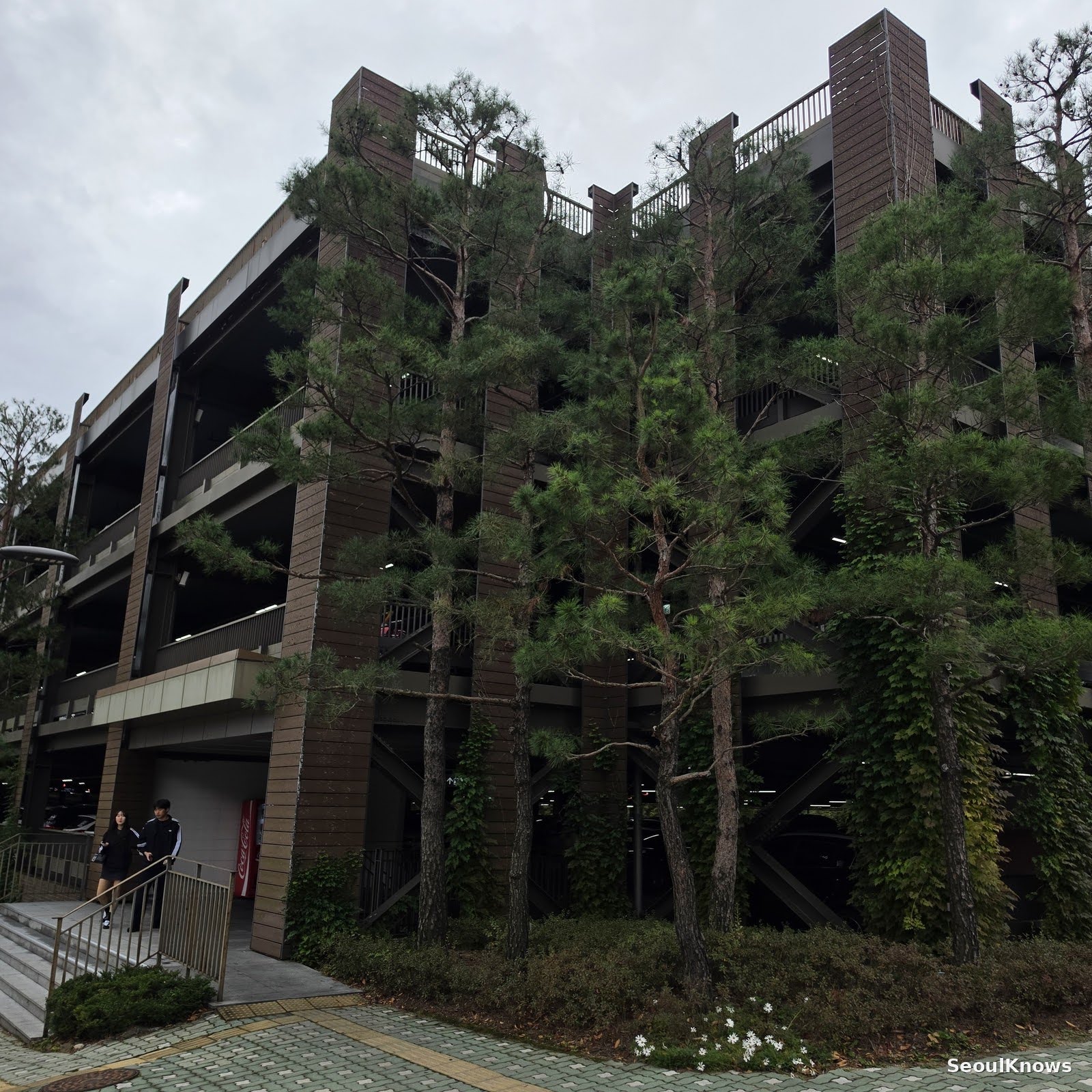
From that lower car park it is 800m and about 15 minutes on foot, uphill, to the forest entrance. That number is posted on a sign at the bottom, and it is the number to plan around, because your entry slot is timed. Arriving at the car park at your slot time means you are already late.
Honest Seoul tips, once a week. Get the newsletter →
The lift, the shuttle bus, and which one you are allowed to use
There are two ways to skip that 800m climb, and which one applies to you is decided by whether you are pushing something with wheels.
There is a free lift up the slope, which is what most visitors use. And there is a free shuttle bus. They are not alternatives you choose between. The sign at the shuttle stop is explicit, in Korean and English:
“The shuttle bus is operated for guests with strollers and wheelchairs only. All other guests, please use the lift.” and “For safety reasons, strollers and wheelchairs are not permitted on the lift.”
So if you have a stroller or a wheelchair you take the bus, and you are not allowed on the lift. Everyone else takes the lift. The shuttle’s posted operating details:
Hours: 09:00 to 16:40
Frequency: every 30 minutes
Lunch break: no service 12:00 to 13:00
Weekdays: no service at all

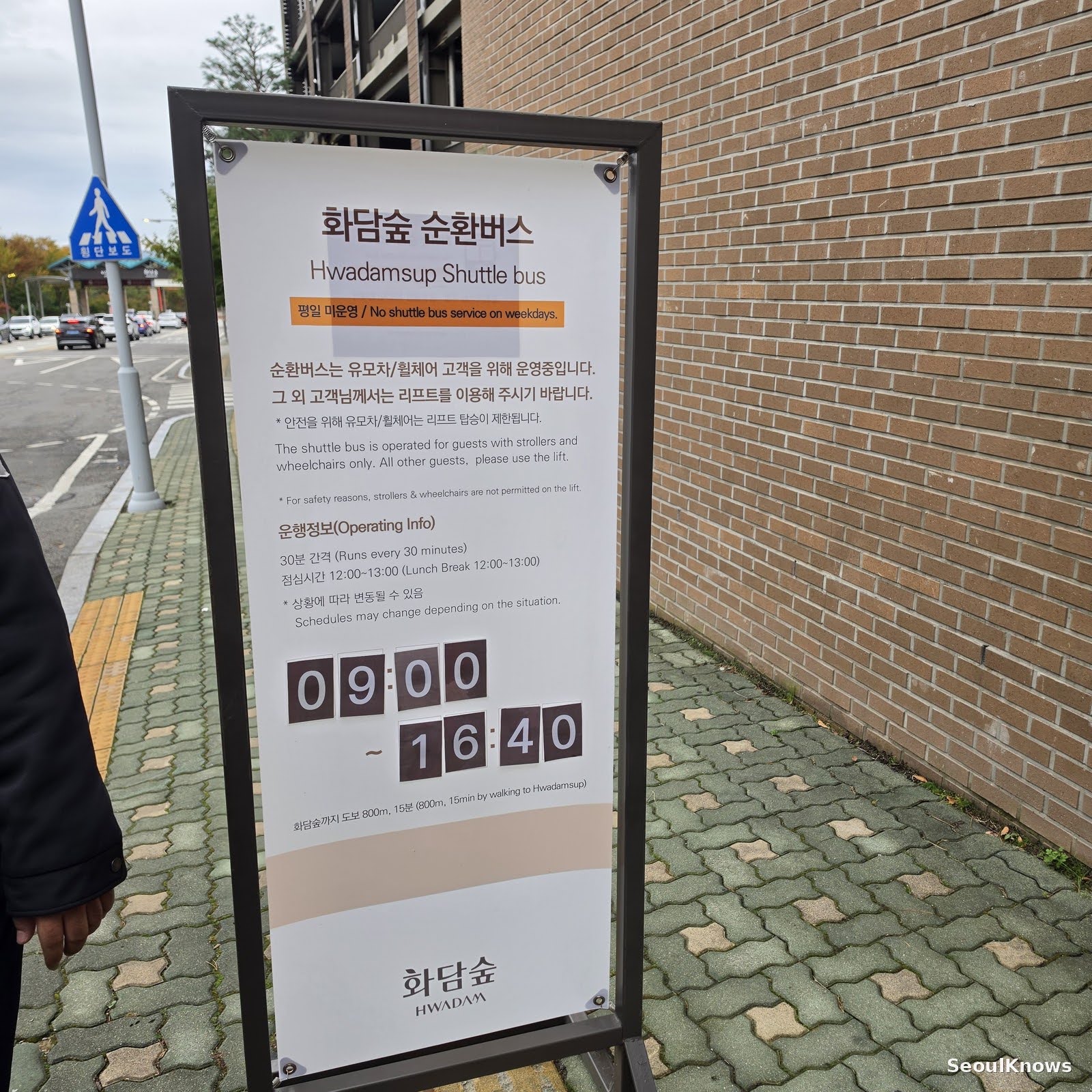
That last line matters. The shuttle does not run on weekdays. If you are visiting midweek with a stroller, you are walking the 800m, because the lift will not take you either. We went on a Saturday, so the bus was running, and a folded stroller goes in the bay near the door.

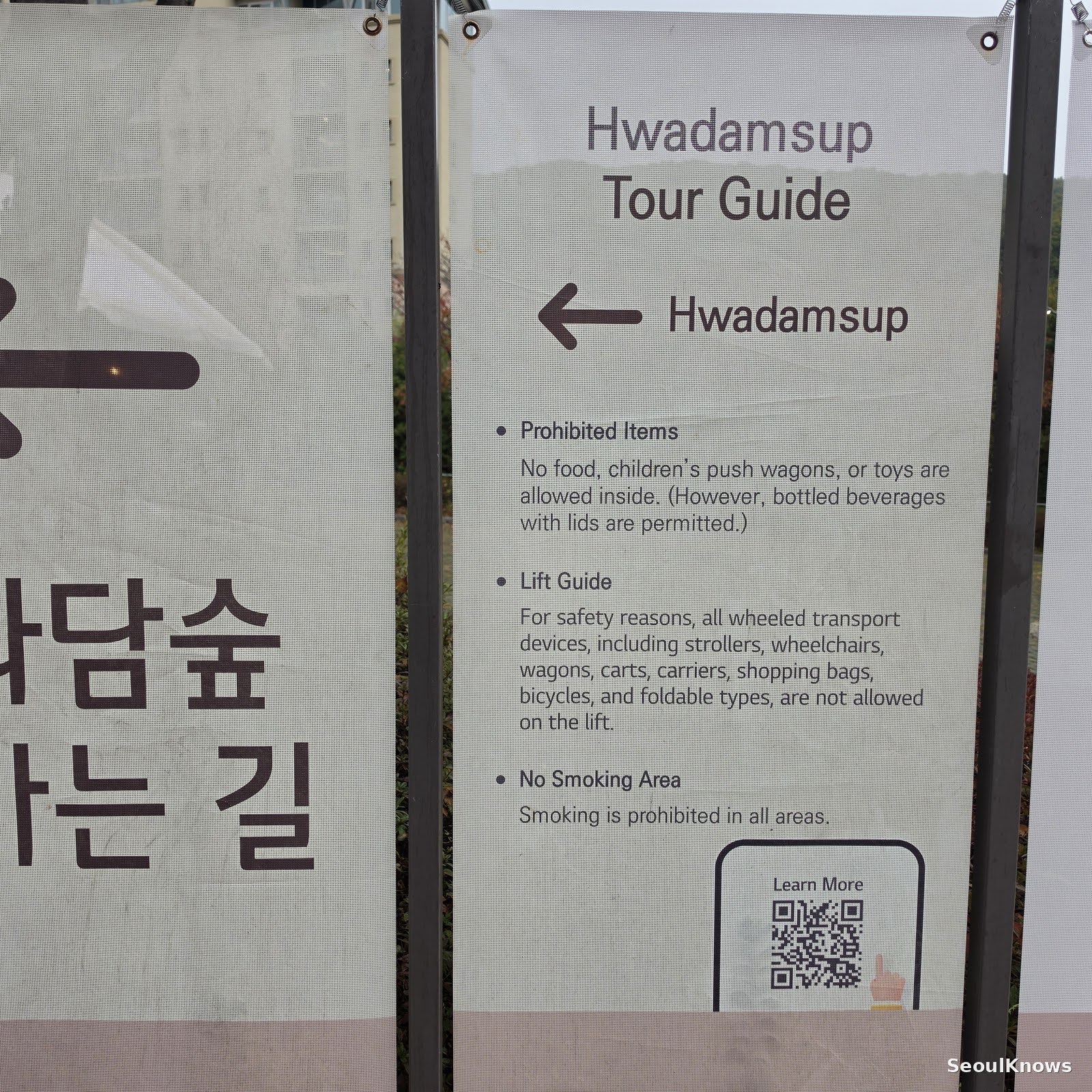
A second rule worth knowing before you pack: the forest’s own English sign lists prohibited items as “no food, children’s push wagons, or toys”, with bottled drinks with lids permitted. Wagons are banned, strollers are not. Korean families use pull-along wagons constantly at parks, so this one catches people at the gate. A stroller is fine inside, and we pushed one around the whole loop.

Eat before you go up, and grab a table first
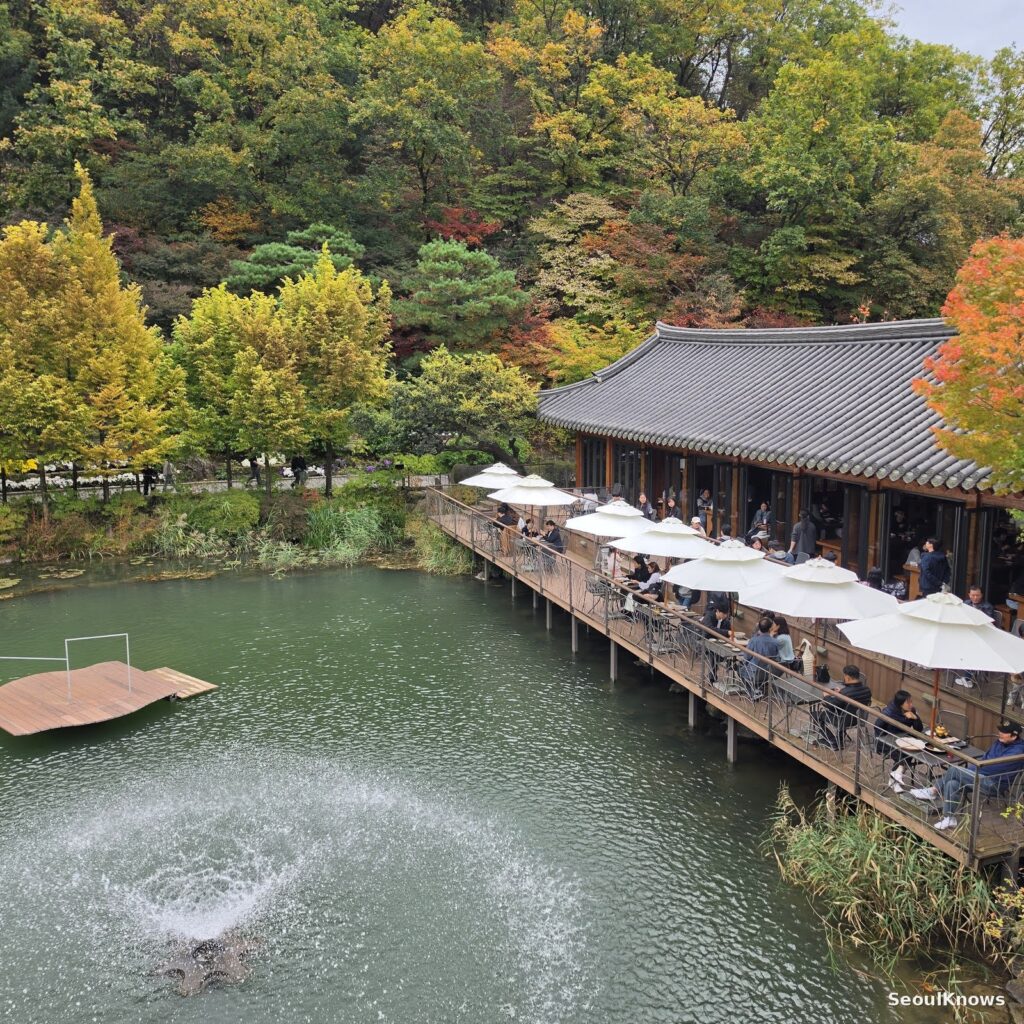
Just inside the main entrance, to the right, there is a pond with a fountain and a long wooden terrace built out over the water, with a traditional tiled-roof building behind it. This is the Hidden Tavern (the on-site Korean signage reads 번지없는 주막), and it was the best part of our day.


The signature dish is seafood pajeon, a large savory spring onion and seafood pancake, at 25,000 won. It arrives on a wicker tray with scissors to cut it, and the traditional pairing is makgeolli, cloudy unfiltered rice wine, served in a brass kettle and poured into bowls. We had that, plus kimchi fishcake udon and chungmu gimbap for the group.
Prices as posted in October 2026:
Seafood pajeon 25,000 | Byeongcheon sundae 18,000 | Tofu kimchi 18,000 | Busan fishcake 7,000
Kimchi fishcake udon 12,000 | Chungmu gimbap 13,000 | Kids’ tteokgalbi set 12,000
Makgeolli from 8,500, non-alcoholic pine nut makgeolli 6,000, premium Haechang 29,000
Sweet rice punch 7,000 | Bottled water 1,500
Opening hours are 10:30 to 18:00, last order 17:30.


The practical warning: there are not enough tables. By late morning on a season weekend the terrace is full, and people stand around holding trays waiting for someone to leave. Send one person to claim a table the moment you see a free one, then order. Doing it the other way round does not work.

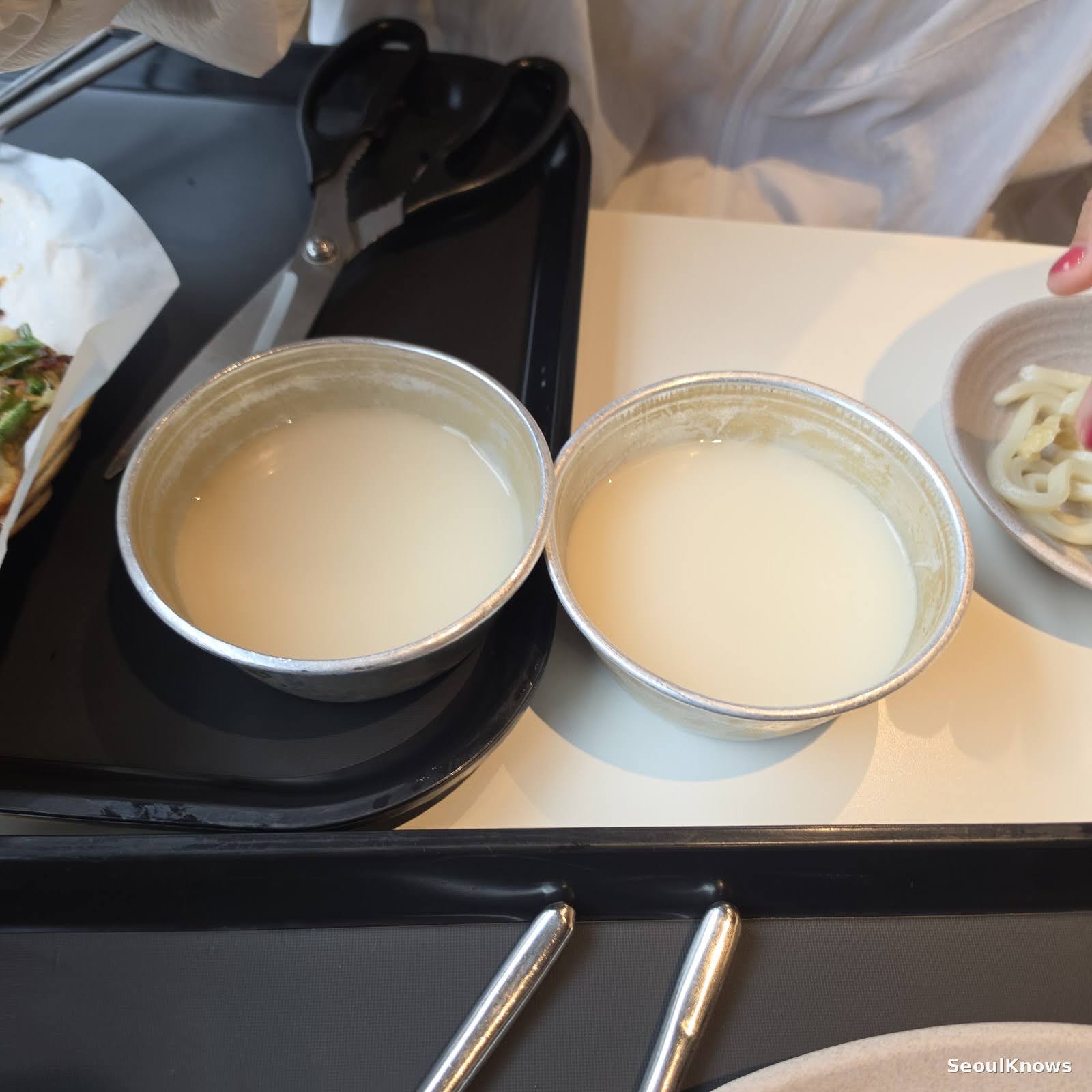
Two things make this worth building into your plan rather than treating it as a snack stop. First, the view: you are eating over a pond with a fountain, with the wooded hillside rising behind it, and it is genuinely one of the nicer places to eat outdoors near Seoul. Second, no outside food is allowed inside the forest, so this is a real meal or nothing.

The monorail: what sells out, and what you can still get
The monorail is a 1,213m loop with three platforms, and the full circuit takes about 20 minutes. Platform 1 is at the bottom near the entrance, platform 2 is partway up at the Moss Garden, platform 3 is at the top by the Bonsai Garden.
Here is what we found on the day. We could not book the monorail in advance, so we tried on site, and the leg we wanted, platform 1 to platform 2, was sold out. That is the uphill leg, the one that saves you the climb, and it is the first thing to go.

That is not the end of it, though, and this is the useful part. There are kiosks at platforms 2 and 3 selling whatever is left from those points. So you can walk up, and then ride from the top. We walked up to platform 2 and bought there.
The kiosk at platform 2 offers exactly two options, with the walking equivalent printed next to each:
Platform 2 to 3 (324m): 5 minutes riding, versus about 30 minutes and 1.4km walking. Adult 5,000, child 4,000
Platform 2 to 1 (813m): 15 minutes riding, versus about 80 minutes and 3.4km walking. Adult 7,000, child 6,000

We bought 2 to 3 at 13:29 for a 13:43 departure, two adults and one child, 14,000 won total. So the gap between buying and boarding was fourteen minutes. Then it started raining, so we bought a second ticket and rode 3 back down to 1 as well.


Rules printed on the ticket and the kiosk, all of which bite:
Be at the platform 10 minutes before departure. Miss your slot and there is no exchange and no refund.
No getting off mid-route and re-boarding on the same ticket. That is why we had to buy a second one.
A monorail ticket does not include forest admission.
Seats are for elderly, pregnant and child passengers. Everyone else stands.
Strollers must be folded.
Canceled for weather or inspection means a full refund.
Is it worth it? For the view from the upper section, yes. The track runs out along the hillside above the valley and the autumn color up there was considerably further along than at the bottom. With a small child it was also the only part of the day he talked about afterwards.


Walking it instead
If the monorail is sold out entirely, you have not wasted your trip. The forest is built as a walking route: wide wooden boardwalks for most of the climb, handrails, benches, clear signage. The forest states outright that the whole circuit is gentle enough to do with a stroller or wheelchair without riding anything.
There is also a stamp tour for people who walk it. Collect every stamp along the route, without using the monorail, and you can claim a souvenir at the ticket office on the way out.
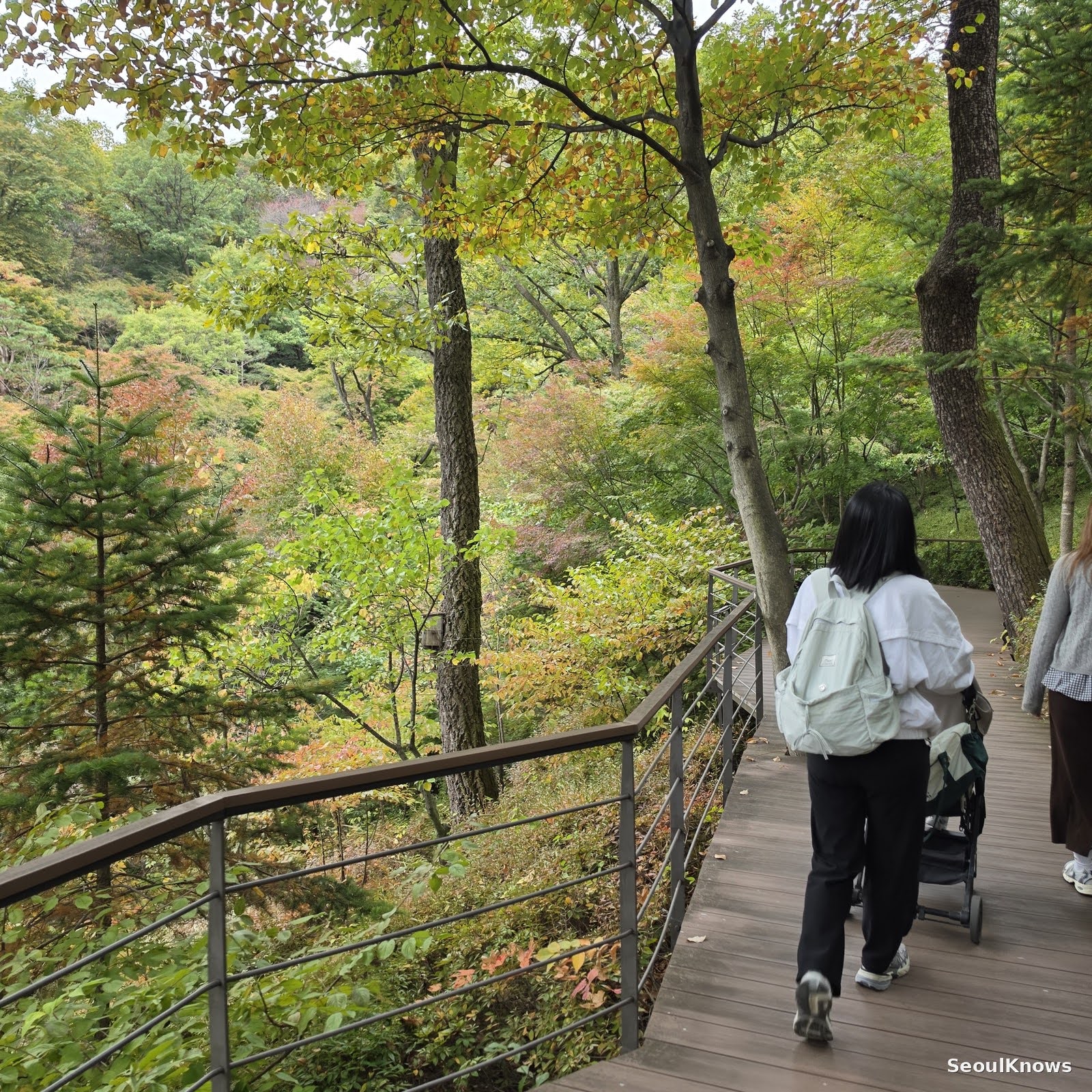

The gardens worth slowing down for: the birch forest, a dense stand of white trunks that looks completely unlike anywhere else in the park; the moss garden; the rock and water garden with a waterfall; and a long bank of purple asters that was still flowering in late October. There is a working water wheel, an insect ecology hall and a freshwater fish hall with large tanks, both free with admission and both very effective with children on a cold day.


The one photo spot everyone queues for is a heart-shaped arch on a footbridge over the valley. It is unashamedly a photo op and it works.


What the foliage actually looked like on 24 October
Honestly: not peak, and we were early. The 2026 autumn season opened on 23 October and we went on the 24th, the first Saturday, and most of the valley was still green.
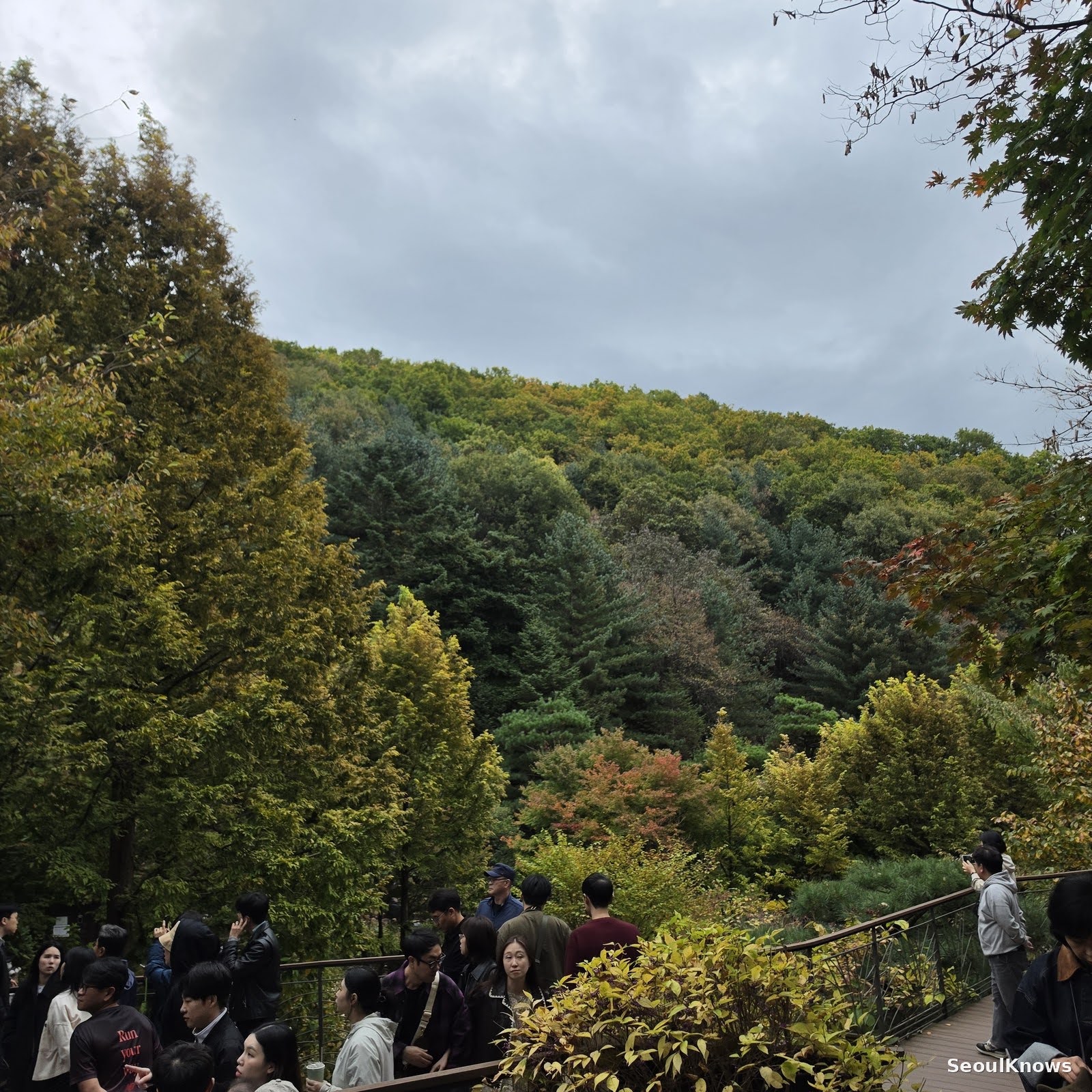
But there is a pattern worth knowing, because it changes where you spend your time. The top turns before the bottom. Around the entrance, the pond and the tavern terrace, it was overwhelmingly green with a few red maples standing out. From the monorail, higher up the hillside, the balance flipped: oranges and reds across whole slopes. If you are visiting early in the season, get height.


The second place color concentrates is the rock and water garden near the waterfall, where the maples had turned properly.

The forest posts framed photographs of the site at peak near the paths, which is either useful calibration or mildly cruel depending on your timing. Based on what we saw, early to mid November looked like the better bet, but foliage timing moves with temperature every year and nobody can promise a date.

One more ticket you may not have seen
There is a second venue on the site, Hwadamchae, an exhibition building near the entrance with a media hall and galleries. It is a separate ticket, takes about 30 minutes, and leftover same-day stock is sold from the kiosk at the ticket office. We skipped it and spent the time eating instead, but if you booked an early slot and have a gap, it is there.


It rained, and that is not the disaster it sounds
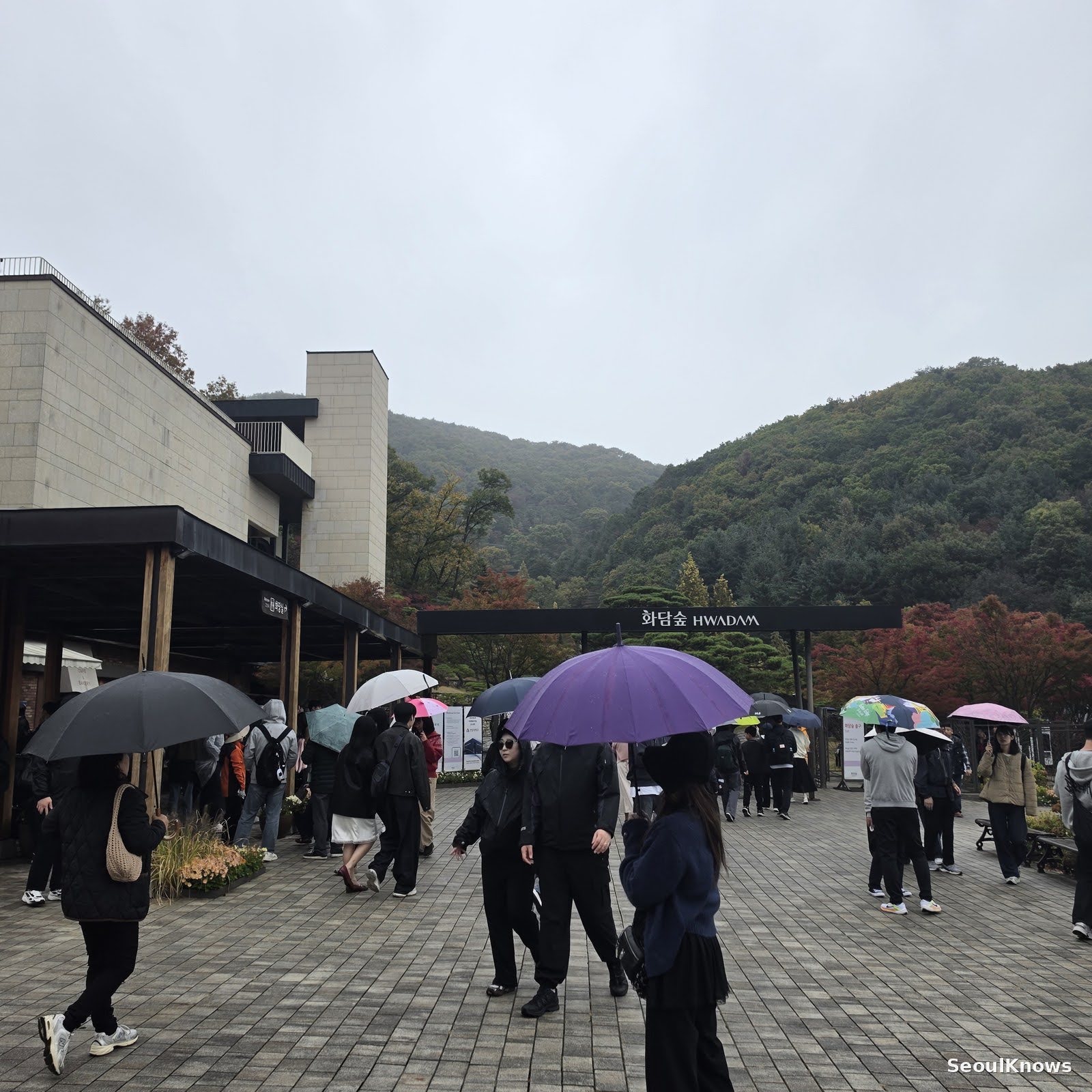
Rain arrived in the early afternoon and the forest emptied out. The boardwalks get slippery and the upper paths are exposed, so bring a jacket rather than an umbrella if you are pushing a stroller.
It is not a day-ruiner. Wet maples photograph better than dry ones, the crowds thin, and mist fills the valley. Our best shots are all from after it started.

Quick facts
Where: 278-1 Docheokwit-ro, Docheok-myeon, Gwangju-si, Gyeonggi-do. Phone 031-8026-6666
Hours: 08:00 to 17:00, last entry 16:00, open daily (2–15 November 2026). Outside peak season: closed Mondays
Booking: 100% advance reservation, online only
Admission: adult 11,000 / senior and teen 9,000 / child 7,000 / under 24 months free
Monorail: separate ticket. One sector 5,000 adult, 4,000 child. Two sectors 7,000 adult, 6,000 child
From the lower car park: 800m, about 15 minutes uphill on foot
Shuttle bus: strollers and wheelchairs only, weekends only, 09:00 to 16:40, every 30 min, no service 12:00 to 13:00
Lift: free, but no strollers, wheelchairs or wheeled items
Lockers: 1,000 won, left of the ticket office
Not allowed: outside food, push wagons, toys. Sealed bottled drinks are fine
Frequently asked questions
Can I buy a ticket at the gate?
Plan on no. Hwadam Forest runs on timed advance reservations and autumn weekends sell out. Any on-site sales are leftover stock only.
Is Hwadam Forest open on Mondays?
During the autumn peak season, yes — it runs every day, Mondays included. Outside peak season it closes on Mondays. Last entry is always an hour before closing: 16:00 on the current 08:00–17:00 schedule.
Can I book from outside Korea, without a Korean phone number?
Yes. Hwadam’s English site links through to NOL World, which sells admission in English and signs you up with an email address rather than a phone number. It was listing dates well into November for the 2026 season. We could not confirm that the monorail can be added in that English flow, so assume you may be buying that at a platform kiosk on the day.
How long should I allow?
We spent three hours twenty minutes including a long lunch and two monorail rides, and did not see everything. Half a day is the right unit.
When is peak foliage?
It moves every year with the weather. The 2026 season ran from late October, and on 24 October the lower half was still green. Early to mid November is usually the safer bet.
The bottom line
Hwadam Forest earns its reputation, but it rewards planning in a way that most day trips out of Seoul do not. Book the moment slots open, pick a weekend if you are bringing a stroller, arrive at the car park a clear half hour before your entry time, claim a table at the tavern before you order, and if the monorail is sold out walk up and buy at the top. Go in the last week of October and you will see a green valley with red edges, which is lovely but is not the photograph that brought you there. Go two weeks later and it is a different place.
Written by WY, a Seoul-based local sharing honest, first-hand guides to Korea. Every guide here is a place I’ve actually been to, written from my own visit, my own photos. More about me →