

Child fingerprint pre-registration in Korea (지문 등 사전등록) is a free police program that stores your child’s fingerprints, photo and your contact details in advance, so that if your child ever gets separated from you, the officer who finds them can identify the child and reach you in minutes instead of hours. The part that matters most for expat parents is that foreign residents can register too: the Korean National Police Agency’s own civil-affairs guidance lists the documents a foreign family brings instead of a Korean ID. I took my young son to Seoul Suseo Police Station in Gangnam to do it in person, and this guide covers what the program actually is, who qualifies, which documents a foreign parent needs, what the registration form asks (translated field by field), how the fingerprint scan went, and how the app compares with walking in.
What fingerprint pre-registration actually is
The program’s official name is 지문 등 사전등록제, literally “advance registration of fingerprints and other information.” It is run by the Korean National Police Agency under Article 7-2 of the Act on the Protection and Support of Missing Children (실종아동등의 보호 및 지원에 관한 법률). The idea is simple. A lost child who is too young, too scared or too non-verbal to say a parent’s phone number can be identified from a fingerprint or a face photo against the police database, and the registered guardian gets a call.
Three groups are eligible: children under 18, people with intellectual, autistic or psychiatric disabilities (any age), and people with dementia (any age). For a child, the record is deleted automatically when they turn 18, and a guardian can ask for it to be deleted at any time. The law also makes it a crime to use the data for anything other than finding a missing person, with a penalty of up to two years in prison or a 20 million won fine, so this is not a general-purpose biometric database.
It is not a tracker, a bracelet or a chip, and it does nothing on its own if your child wanders off. It shortens the step after your child is found: the moment an officer needs to work out whose child this is.
Can foreign residents register their children?
Yes. This is the part I could not find anywhere in English before I went, so here is the source. The police civil-affairs portal (경찰민원24) has an official service page for “Missing Person Prevention Pre-registration” (실종예방 사전등록 신청). Under required documents it states that for foreign families, the parent’s Alien Registration Card and the child’s Alien Registration Card are submitted in place of the Korean guardian ID. In other words, the program assumes you and your child are registered residents with ARCs. The same page lists the fee as none and the processing time as immediate.
Two practical implications follow. First, short-term tourists are not the audience: a child on a 90-day visa-free entry normally has no ARC, and the registration form itself has a field for a resident registration number. Second, if you are a long-term resident whose child was born here or came on a dependent visa, you are exactly who the foreign-family line was written for, and there is no separate “foreigner” process. You walk up to the same counter as everyone else.
I will add one honest caveat. The official guidance tells you what to bring, but it does not say how fluent in English the counter staff will be. At Suseo the signage was Korean only. The form is Korean only. If your Korean is limited, bring a Korean-speaking friend, or at least have this guide open on your phone so you can point at the translated field names below.
What you need to bring
The official list from the police civil-affairs page is short. You bring something that proves the family relationship (a family relation certificate, a resident registration copy, or a national health insurance card), the guardian’s ID, and a photo of the child, which the station can take for you if you do not have one. If the child is being registered for fingerprints, the child must come in person, because the prints are taken on a scanner at the counter. For a person with a disability or dementia, bring proof of that status as well.
For a foreign family, the ID line becomes the parent’s ARC and the child’s ARC. There is a gap in the guidance that you should know about. A Korean parent proves the family relationship with a family relation certificate (가족관계증명서), which is issued only to Korean nationals; foreign residents do not have one. The police page says what replaces the guardian ID for a foreign family, but it does not say what replaces the relationship proof. The two ARCs may be accepted as enough, since the page lists both, but that is not stated. To be safe, bring your child’s birth certificate from your home country (with a Korean or English translation if you have one), and if you want certainty before you go, call the police civil-affairs line at 182 or your district station. The form has a box where the officer notes that the resident registration record was checked electronically, which is what the “administrative information sharing consent” at the bottom of the form is for. If you do not consent to that electronic lookup, the form says you must submit the underlying documents yourself.
Honest Seoul tips, once a week. Get the newsletter →
Where you can register
According to the police guidance, applications are accepted at police stations, at local police substations (지구대 and 파출소, the small neighborhood posts you see on main streets), and, for dementia registrations, at public health center dementia care centers. Processing is done at police stations and substations. You can also register through the 안전Dream (Safe Dream) website at safe182.go.kr and through the 안전Dream mobile app. The police civil-affairs hotline is 182.
The app matters for foreign parents for one specific reason. The App Store listing for 안전Dream, published by the Korean National Police Agency, lists its supported languages as Korean and English. I registered in person, so I cannot tell you how complete the English interface is or how the identity verification behaves on a phone contract in a foreigner’s name, and I will not guess. But if you want to try the app route first, the English option exists on paper.
I chose a police station rather than a substation because I wanted the fingerprint scanner for certain, and I chose Suseo because it is my district station. Any station should work the same way.
Seoul Suseo Police Station: location and getting there
Seoul Suseo Police Station (서울수서경찰서) is at 617 Gaepo-ro, Gangnam-gu, Seoul (postal code 06336), in the Gaepo-dong area in the south of Gangnam. The main building is a five-story gray block with the station name in Korean and English on the facade and a police emblem over the entrance. The civil-affairs office is signposted from the street as 민원실, with arrows at the gate and a “main building, civil-affairs office entrance” sign over the doors.


A note on parking, because it caught me out. When we arrived on a Monday afternoon, the yellow sign at the vehicle barrier read 만차, “lot full,” with a line underneath asking visitors to use the Daecheong Station public parking lot instead. If you are driving, plan on that public lot or on street parking nearby rather than the station’s own small lot, which is mostly taken by police vehicles. If you are coming by subway, Daecheong Station on Line 3 is the stop the police themselves point you to.

Inside: finding the right counter
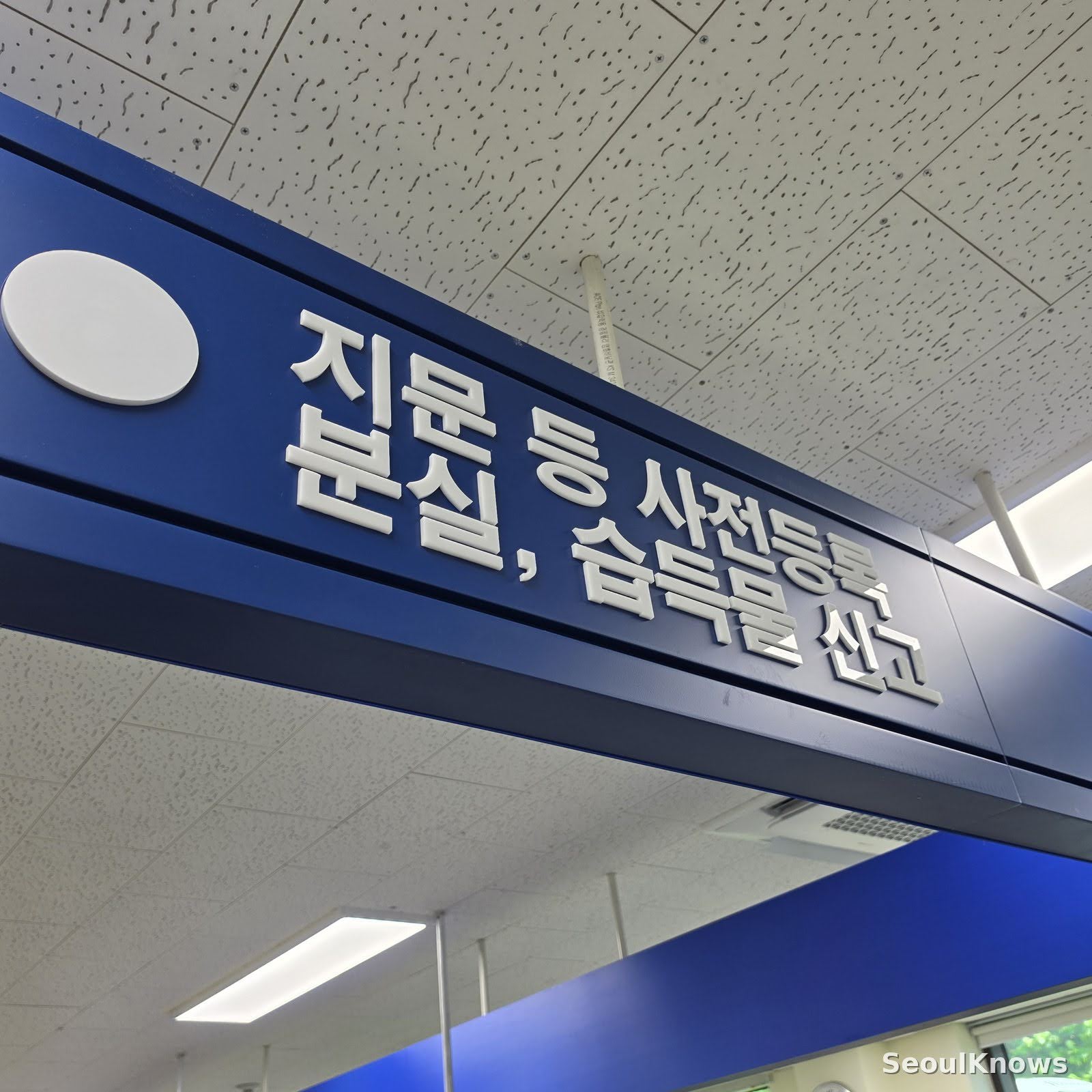
The civil-affairs office is on the ground floor behind the glass doors marked 민원실. The counter you want has a dark blue sign above it that reads 지문 등 사전등록 / 분실, 습득물 신고, which is “fingerprint pre-registration / lost and found reporting.” It shares a window with lost property, so if you see people handing in wallets, you are in the right place.
Just inside the lobby there is a floor directory for the whole compound. Two lines on it are useful for a parent. The annex building (별관) lists a 민원실 and a 수유실, a nursing room, on its second floor, so if you need to feed or change a baby before the scan there is a dedicated room on site. The main building’s second floor lists the 실종수사팀, the missing-persons investigation team, which is the unit that would actually use this record if it ever came to that.

The registration form, translated field by field
The form is a single A4 sheet titled 아동등 사전등록신청서, “Application for Pre-registration of Children and Others,” and it is Form No. 1 under the Rules on the Discovery of Missing Children and Genetic Testing, revised 31 January 2024. The header already prints the processing time as 즉시, immediate. Here is what each block asks, in order, so you can fill it in without a translator.

Applicant (신청인). Your name, resident registration number (for a foreign resident, this is where your ARC number goes), address, phone number, and your relationship to the child. The tick boxes are parent, child, spouse, relative, sibling, cohabitant, and facility.
Basic information on the person being registered (기본 정보). The child’s name and registration number, then a category tick box: child under 18, person with intellectual, autistic or psychiatric disability (any age), or dementia patient (any age). Then sex and address.
Physical characteristics (신체 특징). This is the longest block and it is what an officer would read out over a radio. Height in centimeters and weight in kilograms. Build, with options for heavy, sturdy, average, small, or unusual. Face shape: triangular, inverted triangle, oval, square, round, or slim. Hair color: black, white, gray, brown, or dyed. Scars, with a location grid (head, face, arm, hand, back, torso, buttocks, leg, foot) and a line for the shape. Moles or tattoos, with the same location grid. Medical history, with tick boxes for brain, heart, liver, internal or surgical conditions. A free line for any other distinguishing feature.
Other information (그 밖의 정보). Whether the person has gone missing or run away before, with boxes for never, once, twice, or three or more times, and a line for places they usually go.
Declaration and consent. A sentence stating that you apply under Article 7-2(1) of the Act and Article 3(2) of the Rules, addressed to the Commissioner General of the National Police Agency, with a date and your signature or seal. Below that, a box noting which documents the officer will check electronically (the resident registration record, and a disability certificate where relevant), the words 수수료 없음, “no fee,” and the administrative information sharing consent, which you sign separately.
Every field on that sheet is a sentence you would otherwise have to produce from memory while panicking. That is the real argument for doing this on a calm weekday rather than hoping you never need it.
The fingerprint scan
The scanner is a small black box with a glass window that glows red, about the size of a computer mouse, sitting on the counter. One finger at a time goes onto the glass, held steady by a parent’s hand. My son treated it as a stamp game. The whole thing was over before he thought to object, and the photos on my phone from the station span nine minutes from the gate to walking out.

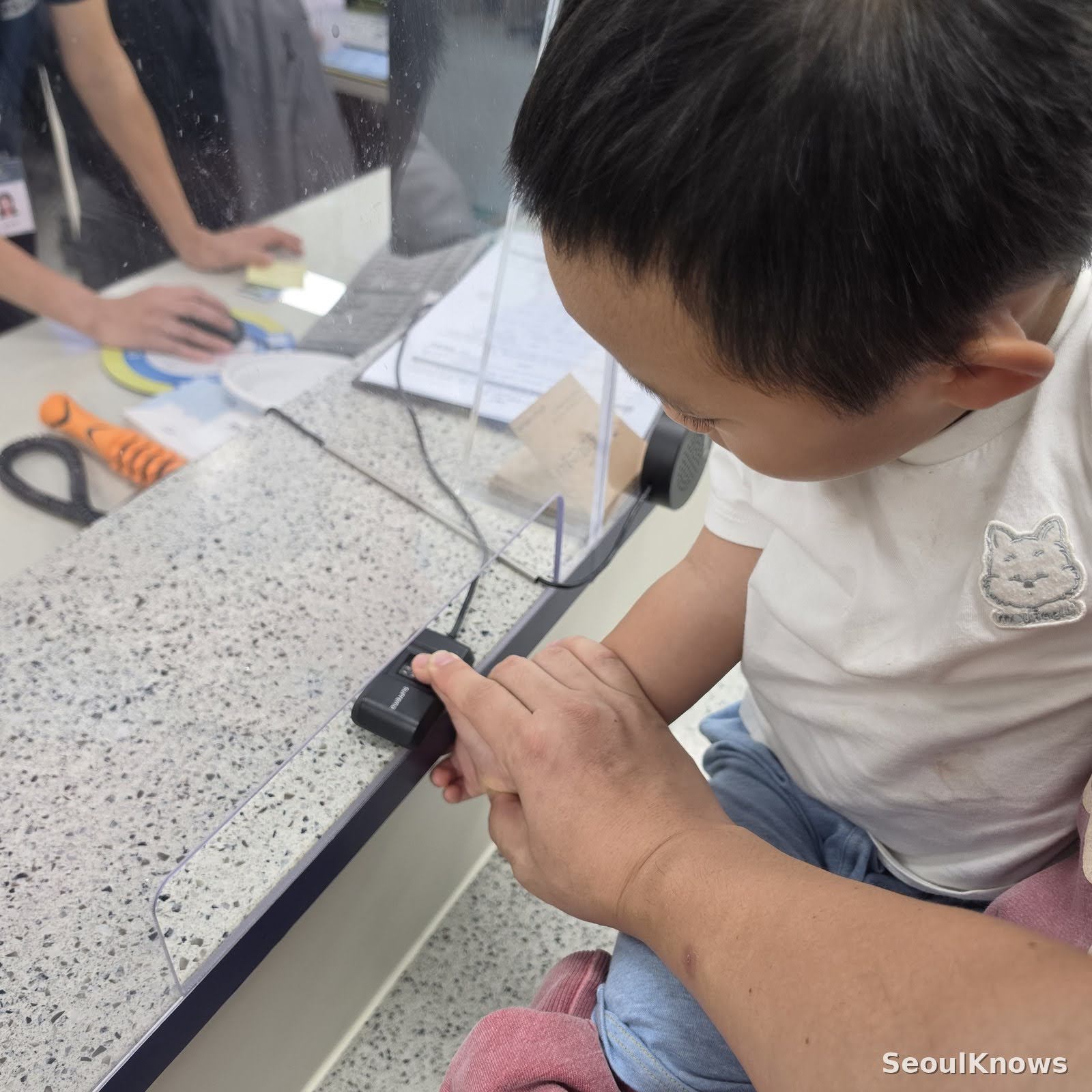
Two things made it easy. The counter at Suseo is low enough that I could sit him on the ledge and keep an arm around him the whole time. And the scanner sits right on the counter in front of the child, so there is no reaching through a window.
App or in person: which should a foreign parent choose?
The police promote the 안전Dream app heavily, and for a Korean family with a Korean phone contract it is clearly the path of least resistance: you upload a photo, type the details, and you are done without leaving the sofa. The app listing says it supports English. What the app cannot do is take a fingerprint, which is the thing the program is named after.
My suggestion for a foreign parent is this. If you want the fingerprint on file, go in person, and go to a police station rather than a substation so you are sure the scanner is there. If you just want the photo and contact details on file quickly, try the app first and treat an in-person visit as a top-up later.
One more reason to go in person: the application is processed in front of you, so you leave knowing it is on file. I am a Korean parent and did not test the foreign-family document route myself; what I can confirm is that the counter, the form and the scanner are exactly what the official guidance describes, and that guidance explicitly covers ARC holders.

What happens to the data afterwards
Under the enforcement decree, a child’s record is destroyed when the child reaches 18. A guardian can request deletion earlier and the police must comply without delay. Misusing the data for anything other than a missing-person search is a criminal offense under Article 7-4 of the Act. The registration also generates a pre-registration certificate (사전신고증) that the guardian can receive; ask for it at the counter if it is not offered.
The law does not spell out a renewal schedule and I did not ask about one, so I will not invent one. A changed phone number is the detail most likely to make the record useless, so that is the one to keep current.
Quick facts
- Program: 지문 등 사전등록제 (fingerprint and other information pre-registration), Korean National Police Agency, under Article 7-2 of the Act on the Protection and Support of Missing Children.
- Eligible: children under 18; people with intellectual, autistic or psychiatric disabilities; people with dementia.
- Foreign residents: yes. Parent’s ARC and child’s ARC in place of Korean ID, per the police civil-affairs guidance. Relationship proof for foreigners is not specified; bring the child’s birth certificate and confirm on 182 if unsure.
- Fee: none. Processing: immediate.
- Documents: proof of family relationship (family relation certificate, resident registration copy, or health insurance card), guardian ID, child’s photo (station can take one). Child must attend for fingerprints.
- Where: any police station or local substation (지구대, 파출소); dementia registrations also at public health center dementia care centers; online at safe182.go.kr; 안전Dream app (listed as Korean and English). Hotline 182.
- Seoul Suseo Police Station: 617 Gaepo-ro, Gangnam-gu, Seoul 06336. Nearest subway per the station’s own parking sign: Daecheong Station, Line 3. Station lot was full on my visit; use the Daecheong Station public lot.
- Data: deleted at 18 or on guardian request; misuse is a crime.
Frequently asked questions
Can a foreigner register a child for fingerprint pre-registration in Korea?
Yes, if you are a registered resident. The police civil-affairs guidance says a foreign family submits the parent’s Alien Registration Card and the child’s Alien Registration Card instead of a Korean guardian ID. The guidance does not say what replaces the Korean family relation certificate, which foreigners cannot obtain, so bring your child’s birth certificate as well and call 182 if you want to confirm first. Everything else, including the fee (none) and the counter, is the same as for a Korean family.
Does my child need to be there?
For fingerprints, yes. The prints are taken on a scanner at the counter. If you only want to register a photo and contact details, the app or website does not require the child to be present.
Is the 안전Dream app available in English?
The App Store listing from the Korean National Police Agency lists Korean and English as supported languages. I registered in person and did not test the English interface, so check the current app version yourself.
How long does it take?
The form prints the processing time as “immediate.” My own photos from Suseo span nine minutes from the gate to leaving the building on a Monday afternoon. Your wait will depend on the station and the time of day.
Can I do this at a small neighborhood police post?
The official guidance lists 지구대 and 파출소 as places that accept and process applications. I used a full police station to be sure the fingerprint scanner was available, and I would suggest the same if the fingerprint is the point.
What happens to the fingerprint data?
It is held in the police pre-registration system for finding missing persons only, deleted when the child turns 18 or earlier on the guardian’s request, and misuse is a criminal offense under the Act.
Bottom line
If you live in Korea with a child who cannot yet recite your phone number, this is a ten-minute errand that costs nothing and could matter enormously once. The official documents confirm that foreign residents with ARCs are covered, the form is manageable with the translation above, and the whole visit took under ten minutes. Pick a calm weekday afternoon, bring both ARCs, your child’s birth certificate if you have it, and a snack, and go.
More family guides: see our Seoul With Kids hub, every place we have taken our own child, on one page.
Written by WY, a Seoul-based local sharing honest, first-hand guides to Korea. Every guide here is a place I’ve actually been to, written from my own visit, my own photos. More about me →