
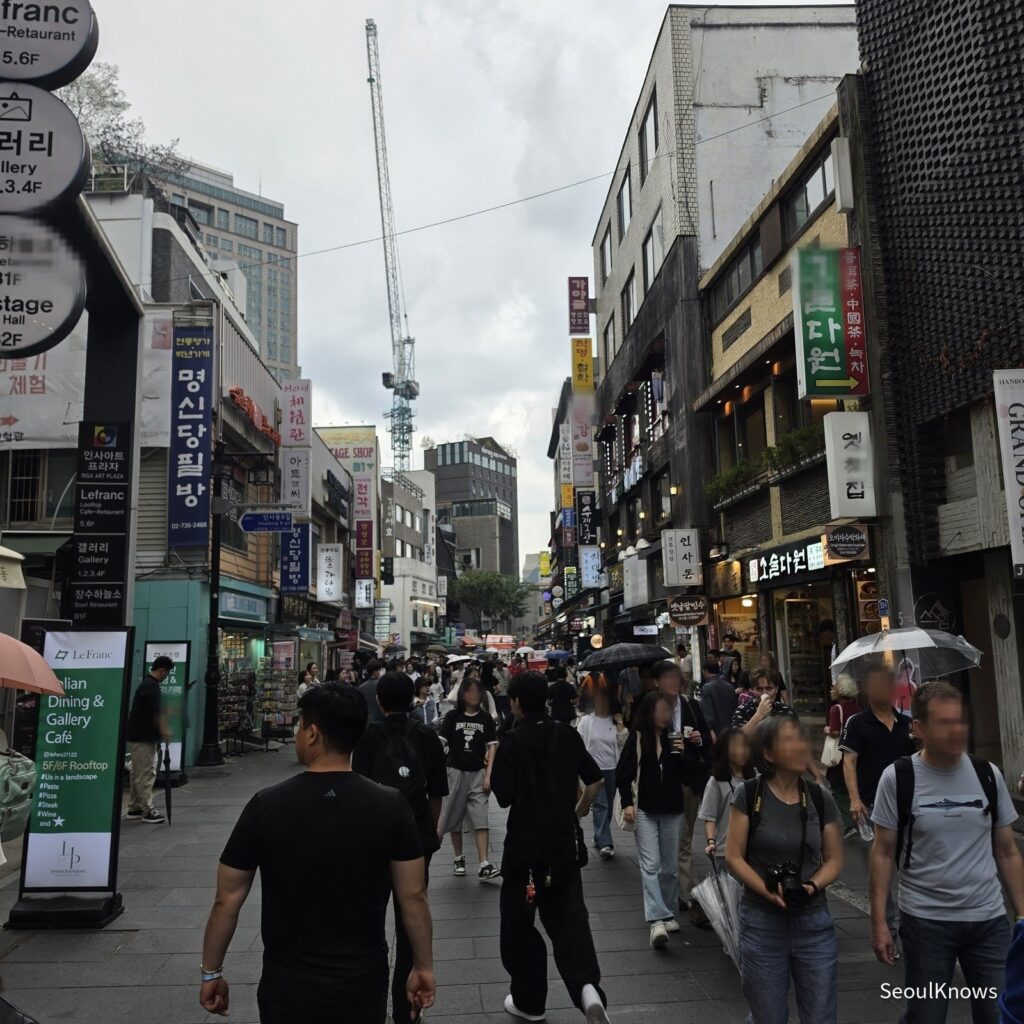
Every first-time Seoul itinerary has Insadong on it, and every second Reddit thread says to skip it. Both are half right. It is a 700 metre street of souvenir shops with a few very good things buried in it, and the trick is knowing which blocks to slow down on and which to walk through.
We went on a grey Friday in late September with my nephews, eight and ten, who were up from Daegu for the holiday. It was Chuseok day, which turned out to matter. We had spent the late morning in Ikseon-dong next door, where the boys wandered the hanok alleys and had caricatures drawn, and then walked across. That is the way I would tell anyone to do it: the two neighbourhoods are five minutes apart and they make one half day.
Here is what the street actually is in 2026, how to walk it, what things cost, and the honest answer to the question everyone asks.
A quick word on Insadong and where it sits
Insadong is one street, Insadong-gil, and the alleys off it. It runs about 700 metres from Anguk Station at the north end to Tapgol Park and Jongno 3-ga at the south. It was the antiques and calligraphy quarter for most of the twentieth century, which is why the brush shops and galleries are still here, and it became the tourist street in the 1990s, which is why everything else is.
What makes it useful for a visitor is the map, not the shops. Ikseon-dong’s hanok cafes are across the road to the east. Bukchon is up the hill to the north. Jogyesa temple is ten minutes west. Gyeongbokgung is one subway stop. You can see all of them in a day on foot, and Insadong is the corridor between them.
Is Insadong too touristy? Yes, and go anyway
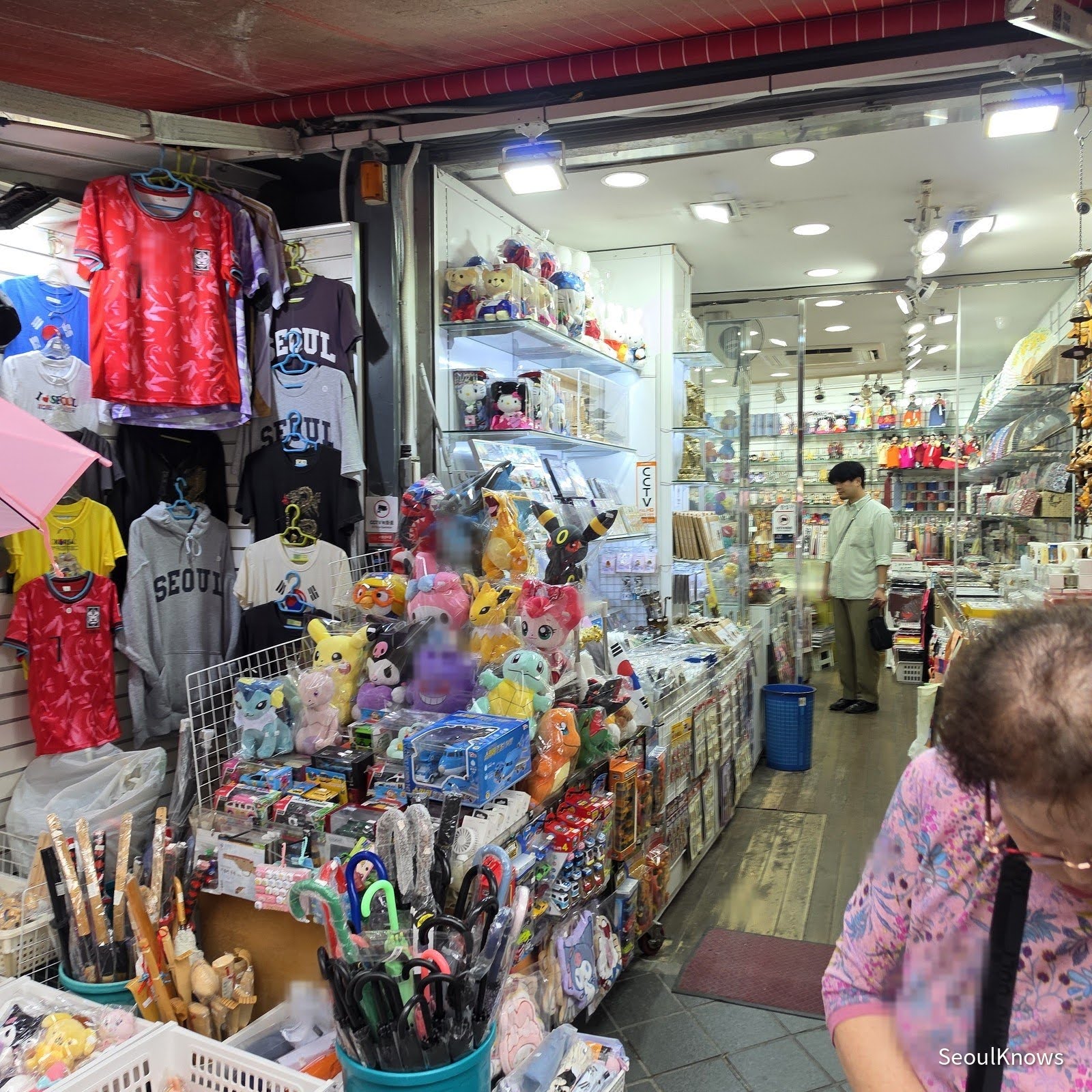
I will not pretend otherwise. The main street at lunchtime was shoulder to shoulder, holiday or not, and the shops at the south end are a caricature studio, a preserved-flower gift shop, and a stall selling “SEOUL” T-shirts next to umbrellas and plastic toys. The boys had already been drawn once that morning in Ikseon-dong, so the studio did not tempt them twice. One tea house has its menu board printed in four languages. That tells you who it is for.

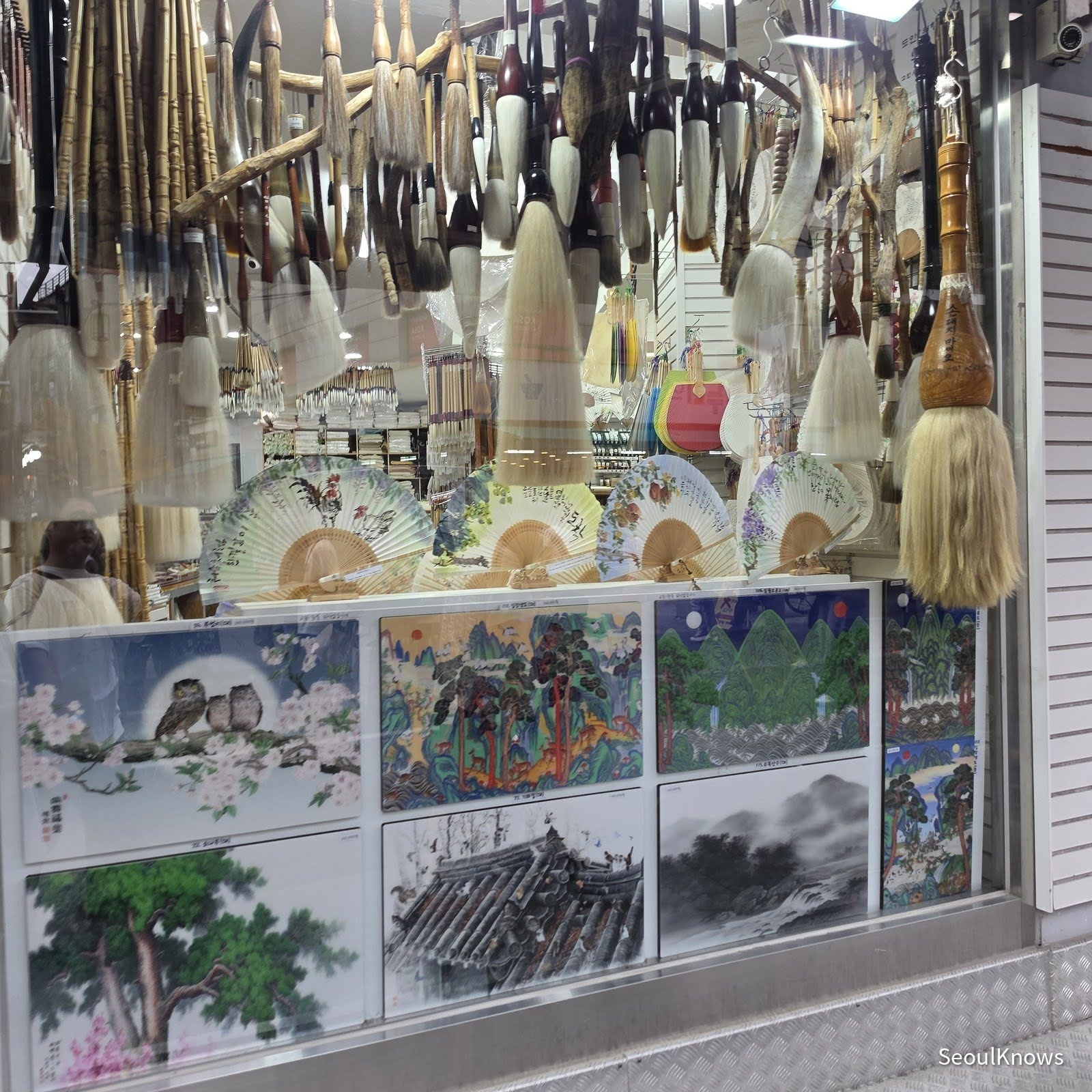
And yet. Two doors down from the T-shirts is a shop window hung floor to ceiling with calligraphy brushes, fans and folk paintings, the kind of place that has been here since before the tourists and will be here after. The side alleys still have galleries that cost nothing to walk into. The tea houses, four-language menus or not, serve things you will not find in a Starbucks: jujube tea, black herbal ssanghwa tea, pumpkin sikhye, red bean porridge.
So the answer is: yes it is touristy, it takes 90 minutes, and it is still the easiest place in Seoul to buy a real brush, drink a real jujube tea and see a gallery, all within one flat, car-free walk. Go with that expectation and it delivers.
How we walked it: south to north from Ikseon-dong
Most guides start you at Anguk Station and walk south. We did the opposite because we were coming from Ikseon-dong, and I think it is the better direction: the south end is the busiest and most generic, so you get it over with, and the street gets better as you go.
From Jongno 3-ga Station take Exit 5 and you are at the bottom of the street in two minutes. From Ikseon-dong it is a five minute walk west across Donhwamun-ro.


The first 200 metres are the souvenir stretch. Walk it, do not stop. Around the middle the brush shops, galleries and tea houses start, and the dragon beard candy stall is here too. Ssamziegil, the spiral craft mall, is two thirds of the way up on the right. The last stretch toward Anguk is quieter and greener, and it drops you at the subway and at the foot of Bukchon.
Budget 60 minutes for the walk with stops, 90 if you sit down for tea, half a day if you add Ikseon-dong before or Bukchon after.
Honest Seoul tips, once a week. Get the newsletter →
Ssamziegil: the building everyone photographs
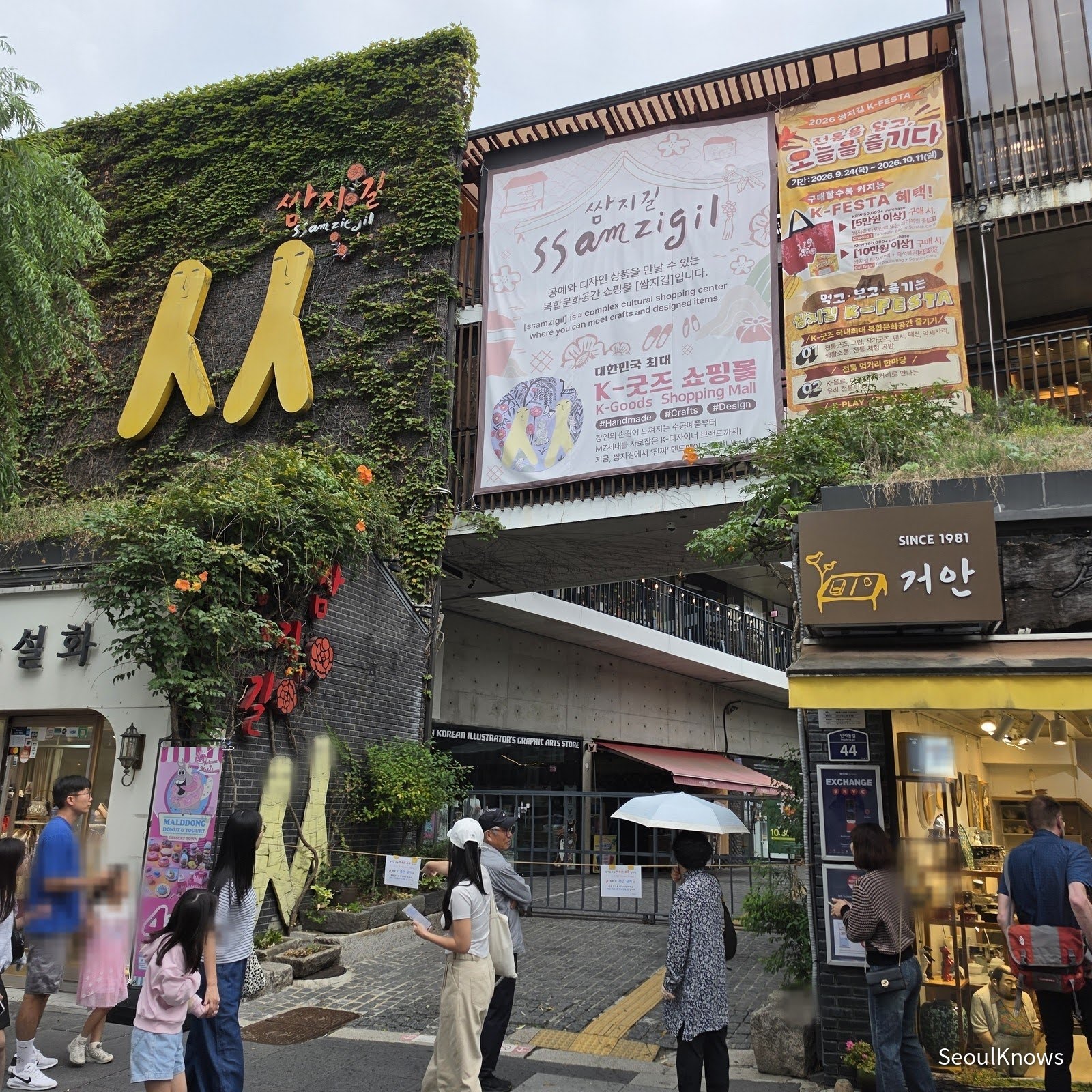
Ssamziegil (44 Insadong-gil, 10:30 to 20:30 daily) is a four storey building wrapped around a courtyard, with a ramp that spirals up past about seventy small craft shops to a rooftop. It opened in 2004 and it is still the single most recognisable thing on the street: the big yellow letters on the ivy wall are where everyone stops for a photo, us included.

Inside is handmade jewellery, ceramics, leather, the fish-shaped talismans you will see hanging in half of Seoul’s cafes, a music box shop, and the famous poop-shaped bread, ttongppang, at 1,500 won on the ground floor. There are usually a couple of hands-on workshops running in the courtyard, which is the part that works best with children.
We did not get in. It was Chuseok day and the shutters were down, which none of the English listings that say “open year-round” had warned me about. The boys were not thrilled. So the description above is what it is, not what we did, and the lesson is worth more than the building: on the days of Seollal and Chuseok a lot of Insadong closes, Ssamziegil included, even though the street itself is as busy as any weekend. Check the holiday calendar before you plan a day around it.
The verdict from people who did get in matches most reviews: a good twenty minute stop if you are already on the street, not a destination in itself. The shops are small and a lot of them sell similar things. The ramp and the rooftop are the point.
The tea houses, and what is on the menu
This is the one thing in Insadong you cannot easily do elsewhere in central Seoul, and it is what saved the afternoon after the Ssamziegil shutters. The tea houses are mostly up a flight of stairs or down an alley, floor seating in some, and the menus are built around teas most visitors have never had. We climbed the stairs to a second-floor place and had red bean shaved ice with the boys. It was good, the room was calm after the street, and there are a lot of places like it along here.


The board outside, in Korean, English, Japanese and Chinese, gives you the standard list: jujube tea (daechu-cha, sweet and thick), ssanghwa-cha (a dark herbal tea with pine nuts floating on top, the one Koreans drink when they feel a cold coming), omija five-flavour tea served cold, pumpkin sikhye, cinnamon tea, plum tea, and the two things to order if you are hungry: sweet red bean porridge (danpat-juk) and red bean shaved ice (patbingsu). Expect 7,000 to 10,000 won a cup at the well-known places.
If you want names beyond ours: Shin Old Tea House (신옛찻집, 47-8 Insadong-gil) is the one visitors come back to for the floor seating and the garden feel, and Dawon, in the courtyard of the Kyung-in Museum of Fine Art, is the one for an outdoor table under a tree. We did not sit in either this time, so take those as a shortlist rather than a review.
Street food: dragon beard candy and the rest
Dragon beard candy (kkultarae) is the one street food that is specific to Insadong, and the shop to look for is Insadong Kkultarae at 38 Insadong-gil, with the TV screenshots above the counter. Two men in white pull a lump of honey and maltose into thousands of threads, counting out loud as they fold, 32, 64, 128, and wrap the threads around a nut filling. The performance is the point and there is usually a small crowd watching, which is how you find it. We watched and did not buy, so this is observation, not a tasting.
A box runs about 8,000 to 9,000 won and comes in peanut, almond, injeolmi, green tea and chocolate. It is mild rather than sweet, it does not travel well in heat, and the box suggests freezing it for twenty minutes so the threads go crisp, which people who have tried it say is the better way to eat it.

Beyond that: ttongppang at Ssamziegil (1,500 won), hotteok from the carts toward the Tapgol Park end (1,500 to 2,000 won), and in winter roasted sweet potatoes and chestnuts. None of it is a meal. For lunch, go back across to Ikseon-dong or down into the alleys behind the street, where the old Jongno restaurants are.
What is worth buying here
Insadong is where you buy the thing that is hard to find at the airport. In rough order of how often visitors are glad they did:
A calligraphy brush from one of the old supply shops, which will also sell you ink and paper.
A name seal (dojang) carved while you wait, with your name in Korean or Chinese characters. Prices vary a lot with the stone, so ask before they start.
Hanji, Korean mulberry paper, as sheets, notebooks or lampshades. Light, flat, packable.
A folding fan with a painted scene.
Tea in a tin, from the tea shops rather than the souvenir stalls.
Yanggaeng, the red bean jelly, from the old sweet shop with the queue, if you are taking food home.
Buddhist items, a small Buddha figure, prayer beads or a temple pendant, from the shops around Jogyesa at the west end rather than the street stalls.
What to skip: anything with “SEOUL” printed on it, which is cheaper and identical in Myeongdong, and “antiques” from the street stalls, which are not.
Insadong or Bukchon or Ikseon-dong?
This is the most common question in every forum, and the answer is that they are not alternatives. They are three neighbourhoods within a fifteen minute walk of each other that do different things.
Bukchon is for the hanok rooftops and the photo, and it is a residential area, so go before nine in the morning and keep your voice down.
Ikseon-dong is for the hanok cafes and dinner, and the queues at the famous ones run over an hour at weekends, so go at opening or after five.
Insadong is for the brush shop, the tea house, the gallery and the one souvenir, and it works at any hour because it is built for crowds.
Our order, Ikseon-dong late morning then Insadong after lunch, worked. Bukchon first thing, then down through Insadong, then Ikseon-dong for an early dinner, is the full version.
With children
It is flat, car-free for most of the day and short, which already puts it ahead of a palace for a child who has had enough of palaces. With an eight and a ten year old, the things that landed were the dragon beard candy performance, the shop windows (brushes the size of a broom), and sitting down for shaved ice. Ssamziegil would have been the highlight and was shut. Caricatures were the hit of the morning, but that was in Ikseon-dong, and there is a studio here too if you skipped it there.
If you need an indoor hour, the Alive Museum (trick-art photos, basement of the Daeil Building at 12 Insadong-gil) and Museum Kimchikan (Tuesday to Sunday 10:00 to 18:00, 5,000 won) are both on the street. We did not go in on this visit.
Getting there, the car-free hours, and what is next door
Subway: Anguk Station (Line 3) Exit 6 for the north end, one minute. Jongno 3-ga (Lines 1, 3, 5) Exit 5 for the south end and for Ikseon-dong.
Car-free street: Insadong-gil is closed to cars daily from 10:00 to 22:00 according to the city, the full length at weekends and a shorter central section on weekdays. English guides still quote an older weekend-only rule. Either way, it is a pedestrian street when you are likely to be there.
Shop hours: roughly 10:00 to 20:00. Galleries close earlier, tea houses later. Seollal and Chuseok days: many shops and Ssamziegil close, whatever the listings say.
Within ten minutes on foot: Jogyesa, the head temple of Korean Buddhism, free and worth twenty minutes; Tapgol Park at the south end, with a Joseon pagoda in a glass case; Unhyeongung, a small free palace by Anguk Exit 4; and Anyoung Insadong (49 Insadong-gil, 10:00 to 22:00), the new mall across from Ssamziegil with a Line Friends shop on the ground floor and a vinyl listening cafe, Music Complex Seoul, on the fifth.

Frequently asked questions
How long do I need in Insadong?
An hour to walk it with stops, ninety minutes with a sit-down tea. Half a day if you add Ikseon-dong or Bukchon, which you should.
What is the best time to go?
Weekday mornings are quietest. Weekend afternoons are the busiest and also when the street performers and extra stalls are out, so it depends what you want. We went at lunchtime on a Friday and it was full but moving.
Can I pay by card?
Shops and tea houses, yes. Street stalls and some of the small craft counters prefer cash, so carry a little.
Is there tax refund shopping?
Ssamziegil is a registered tax refund shop. Individual small shops mostly are not. Myeongdong is the place for that, and how the refund works is its own guide.
Can I rent hanbok in Insadong?
You can, but the rental shops and the photo backdrops are at Gyeongbokgung and Bukchon. Rent there and walk down.
Is Insadong open on Korean holidays?
The street is, and it is packed. Individual shops are a lottery, and Ssamziegil was shut when we went on Chuseok day. Seollal and Chuseok are the two to watch; the days either side are usually fine.
How far is Insadong from Gyeongbokgung and Myeongdong?
Gyeongbokgung is one stop on Line 3 or a fifteen minute walk from the Anguk end. Myeongdong is two stops on Line 4 from Jongno 3-ga, or twenty five minutes on foot through Jongno. Bukchon is ten minutes uphill from Anguk.
Is Insadong a good place to stay?
For a first trip it is a quiet, central base with three subway lines within a few minutes and the palaces on foot, and it is calmer at night than Myeongdong. The trade-off is fewer late restaurants on the street itself; you walk to Ikseon-dong or Jongno for dinner.
Is Ssamziegil worth it?
As a twenty minute stop on the way past, yes. As the reason to come, no. And check it is open before you promise it to a child.
Where do I eat lunch?
Not on the main street. Ikseon-dong across the road, or the alleys behind Insadong-gil toward Jongno, where the older restaurants are.
The bottom line
Insadong is a tourist street with a real street underneath it. Give it ninety minutes, walk it from the Jongno end, skip the first two blocks, buy the one thing you cannot get at the airport, and sit down for a jujube tea or a shaved ice. Then go next door to Ikseon-dong, or up the hill to Bukchon, which is where the afternoon actually is. If this is your first trip, the First Time in Seoul guide puts all of this on one map.
Written by WY, a Seoul-based local sharing honest, first-hand guides to Korea. Every guide here is a place I have actually been to: written from my own visit, my own photos. More about me →