
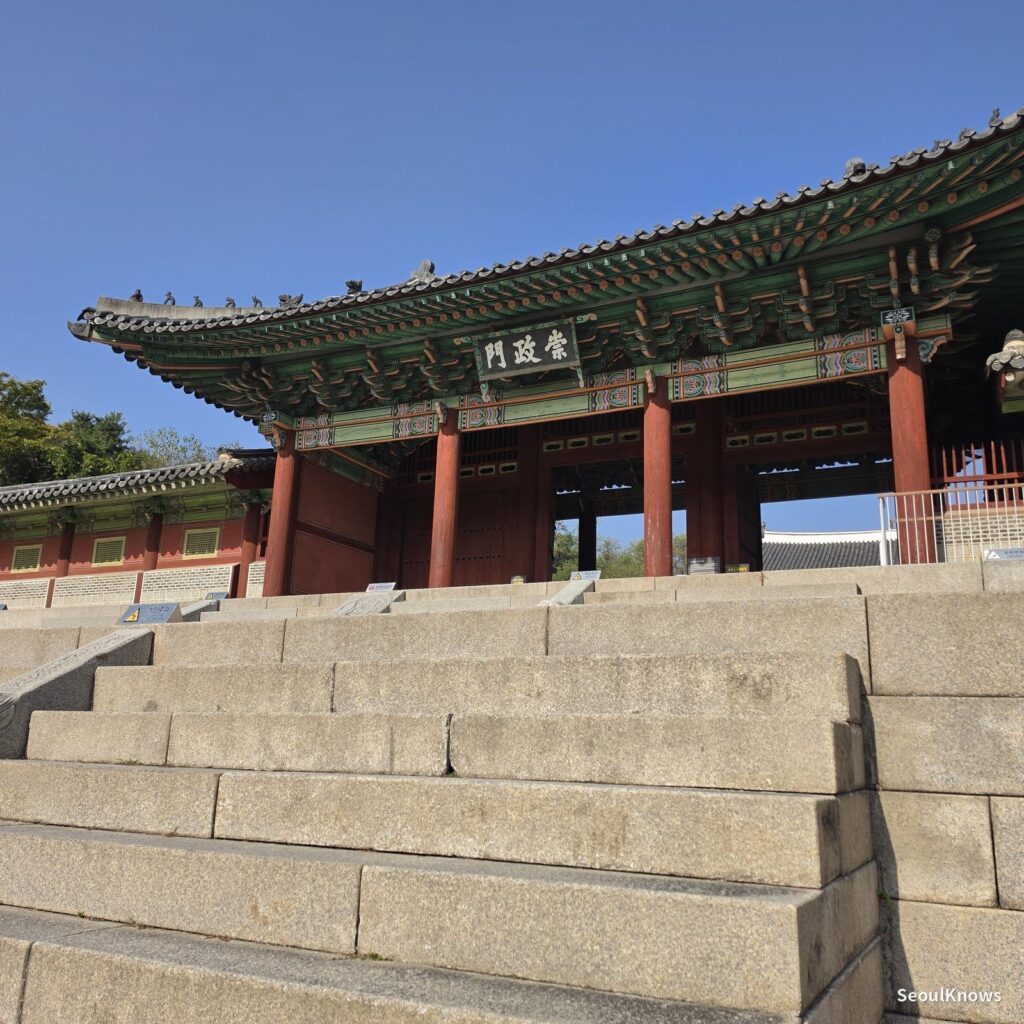
If you are working out which of Seoul’s five royal palaces to visit, most guides will tell you to skip Gyeonghuigung Palace. It is small, most of it is a reconstruction, and there is no guard-changing ceremony.
I went on a Tuesday morning in November, and I think that advice is slightly off. Not because Gyeonghuigung is secretly impressive, but because it is free, almost empty on a weekday, and has a wall of glass towers standing right behind the roofline. Standing in the main courtyard felt a bit like being in Central Park.
This guide covers what Gyeonghuigung is, how to get there, what you will and won’t see, the free guided tour almost nobody mentions, the two free sites next door, and honest answers to what people ask before going.

A quick word on the Gwanghwamun–Seodaemun area
Gyeonghuigung sits on Saemunan-ro in Jongno District, at the western edge of Seoul’s palace quarter. Gwanghwamun Square and Gyeongbokgung are about fifteen minutes’ walk east, Deoksugung fifteen minutes south.
Which means you are never making a special trip here. You are already in the area, and Gyeonghuigung is what you add on.
What is Gyeonghuigung Palace?
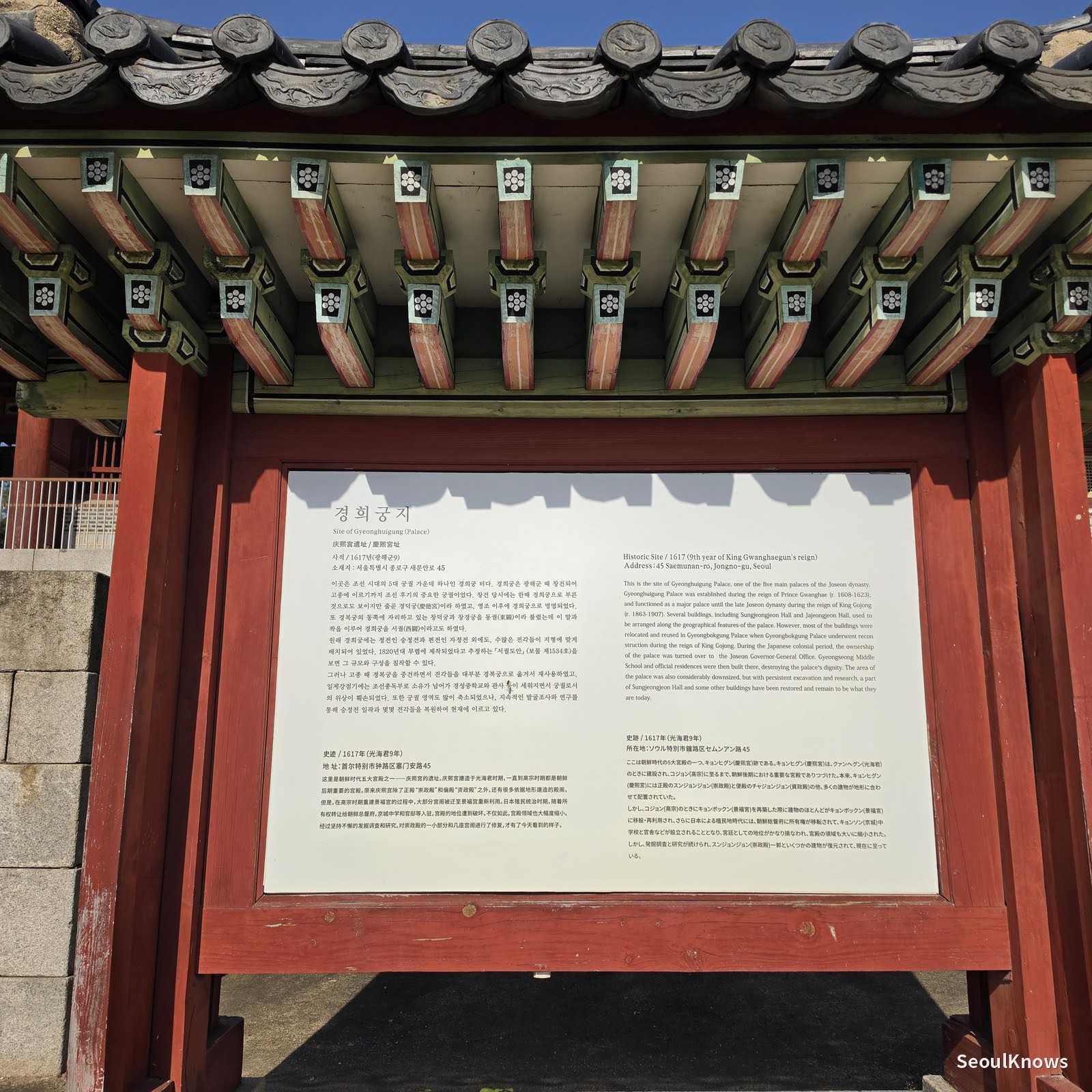
Gyeonghuigung is one of the Five Grand Palaces of the Joseon Dynasty. Construction began in 1617 under King Gwanghaegun and finished around 1623. For its first 140 years it was called Gyeongdeokgung; King Yeongjo renamed it in 1760 because the old name was too close to his father’s posthumous title.
Standing west of Gyeongbokgung, it was known as Seogwol, the West Palace, against Changdeokgung and Changgyeonggung in the east. Kings lived and governed here, and King Jeongjo was crowned at Gyeonghuigung in 1776.
Then it came apart. In the 1860s, when Gojong’s court rebuilt Gyeongbokgung, much of Gyeonghuigung was dismantled and the materials carted off. Under Japanese rule the remaining grounds were cleared for a school. The on-site information board puts numbers on it: the palace once covered about 230,000㎡, and the restored grounds are 101,174㎡, under half of what stood here.

Location & how to get there
Address: 45 Saemunan-ro, Jongno-gu, Seoul
- Seodaemun Station (Line 5), Exit 4: about 10 minutes on foot. Easiest approach.
- Gwanghwamun Station (Line 5), Exit 7: about 15 minutes west.
- Gyeongbokgung Station (Line 3), Exit 7: about 15 minutes, if you are coming straight from Gyeongbokgung.
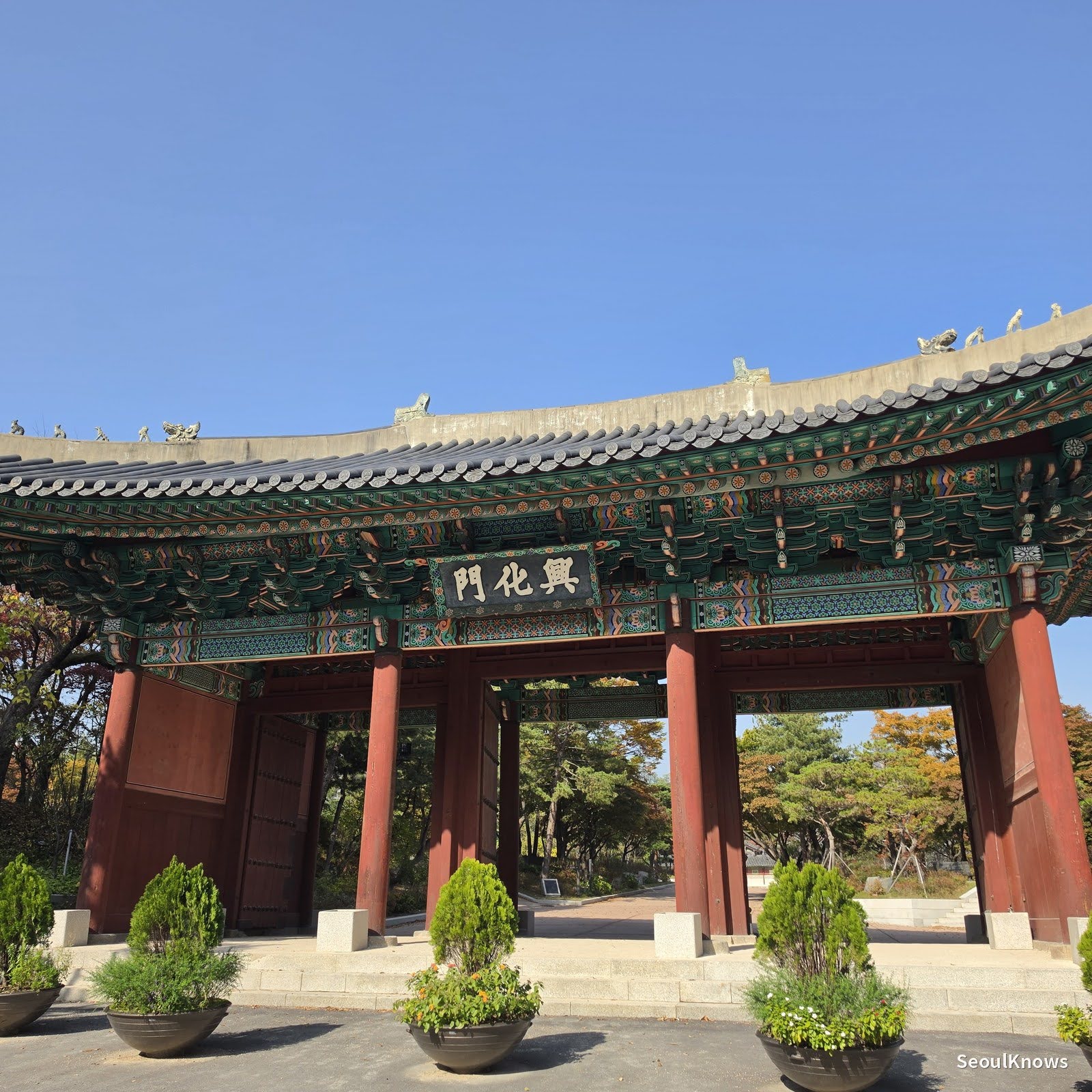
You enter through Heunghwamun, beside the Seoul Museum of History. Driving, the museum car park is the practical option: roughly 1,000 won for the first hour, about 400 won per five minutes after. Buses cannot enter without clearing it with staff first, which matters if you are on a tour.
It’s free, and that changes who shows up
Gyeonghuigung is the only one of the five palaces with no admission fee. There is no ticket booth, and the combined palace pass is irrelevant here because it covers the four that charge.
That has a side effect worth knowing. At the other palaces, wearing hanbok gets you in free, which is why those courtyards are full of rented hanbok and why the photo queue at the main hall runs twenty deep. Here the perk is meaningless, so the hanbok crowd doesn’t come. If you have rented hanbok elsewhere and want unhurried photos, this is the palace where you can take your time.
There is no rental shop on site. Rent near Gyeongbokgung or Bukchon and walk over.
Honest Seoul tips, once a week. Get the newsletter →
There is a free guided tour, and it isn’t where you’d look
English guides to Gyeonghuigung almost all state there are no tours. There is one, posted on a board inside the gate. It is free, meets in front of Sungjeongmun, and runs about 40 minutes:
- Friday: 2:00pm, 3:00pm
- Saturday: 1:00pm, 2:00pm, 3:00pm
- Sunday: every half hour from 1:00pm to 3:00pm
The timetable is posted in Korean and English, and it is run by volunteer heritage guide groups (한국의재발견, +82 2-723-4206, on Fridays; 궁궐길라잡이, +82 2-735-5733, at weekends). Whether an English-language commentary is available on a given day is worth a phone call first, but the tour itself exists.
What you’ll actually see
Heunghwamun, the main gate, was moved off-site during the colonial period and later returned, so it is not standing quite where it originally stood.
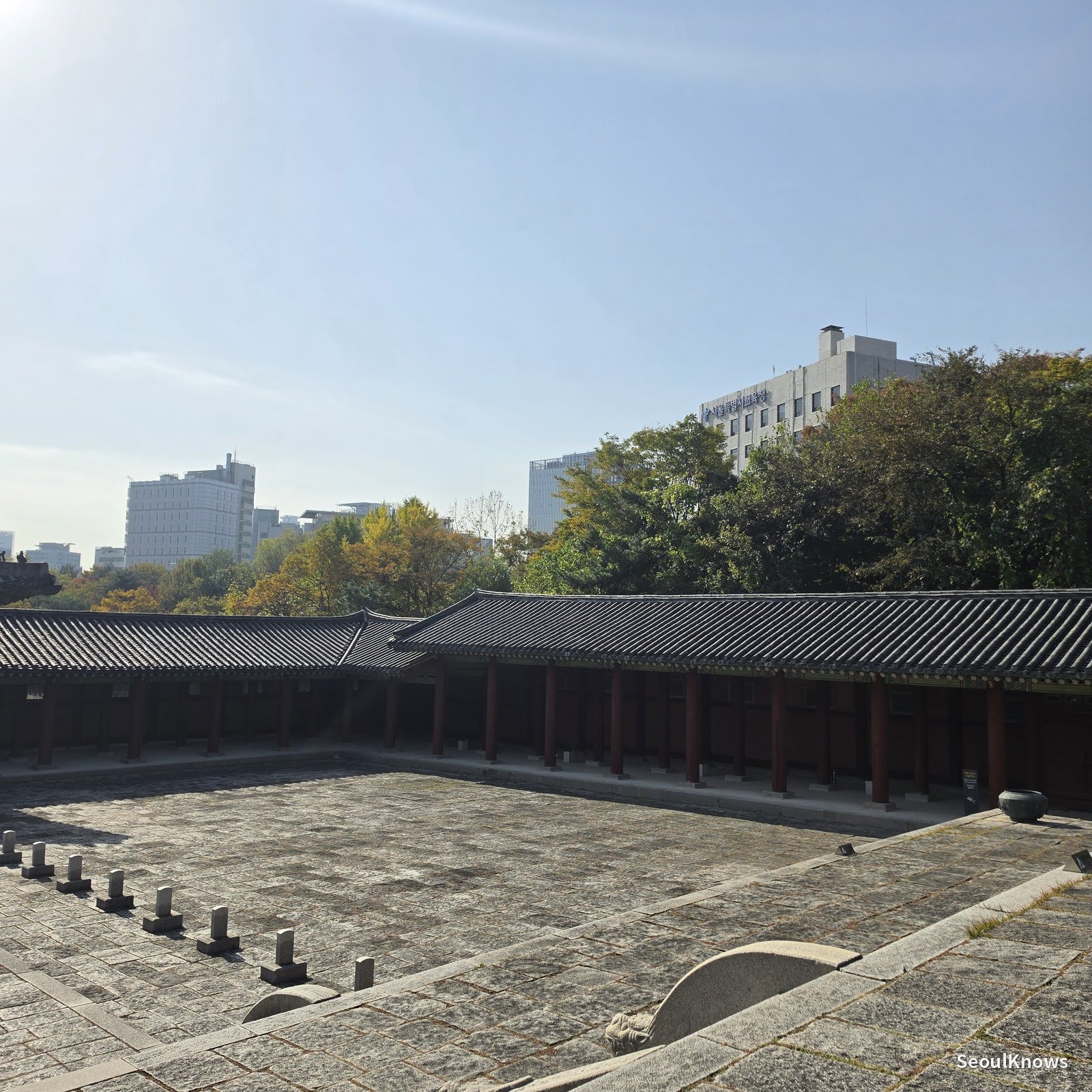
Sungjeongjeon is the throne hall and the reason to come. You climb a broad stone stair to Sungjeongmun, and the courtyard opens up with the pumgyeseok, the ranked stone markers where officials stood by seniority, running down the middle. The hall was rebuilt in 1994. The original Sungjeongjeon still exists: it was moved out in 1926 and now stands on the Dongguk University campus as Jeonggakwon.
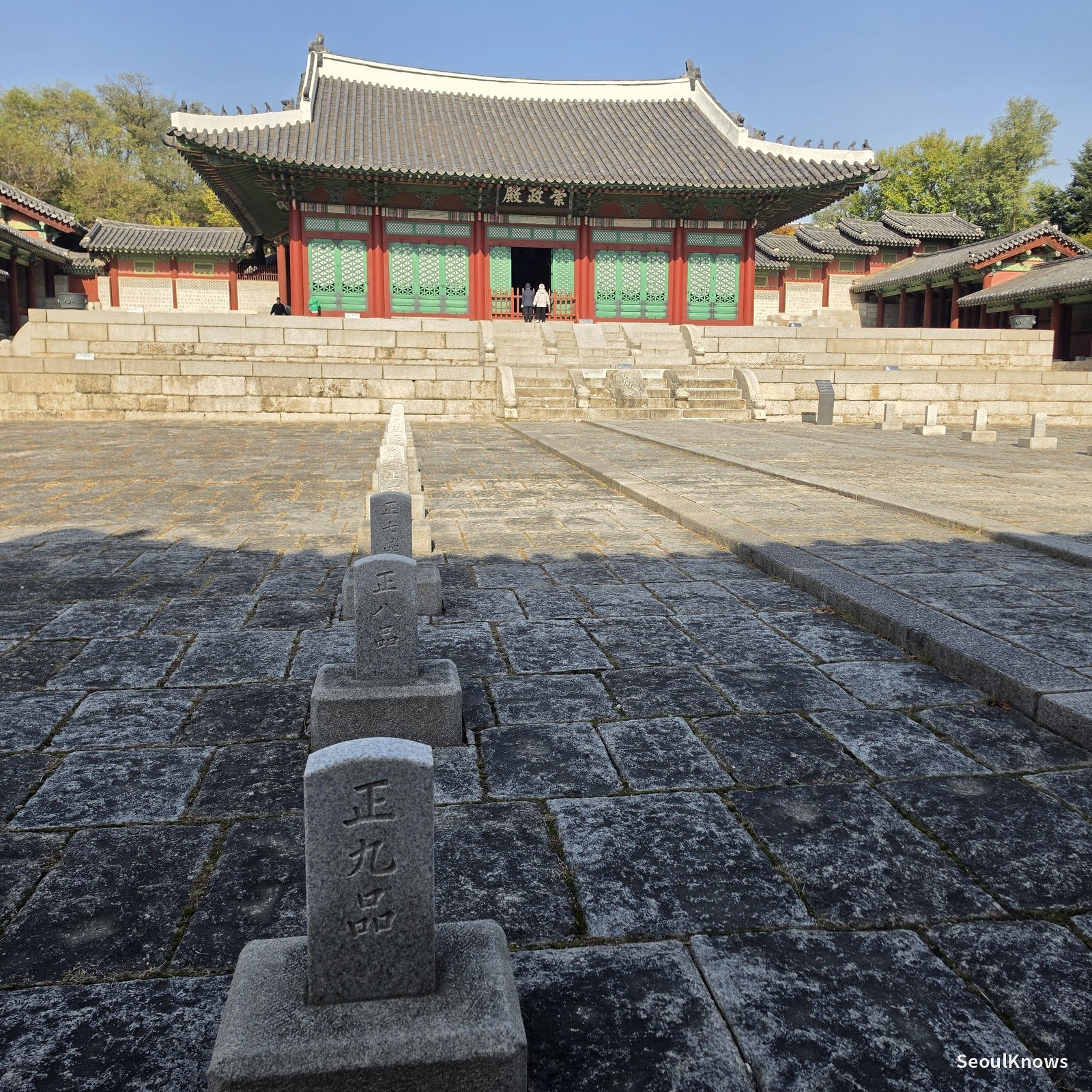
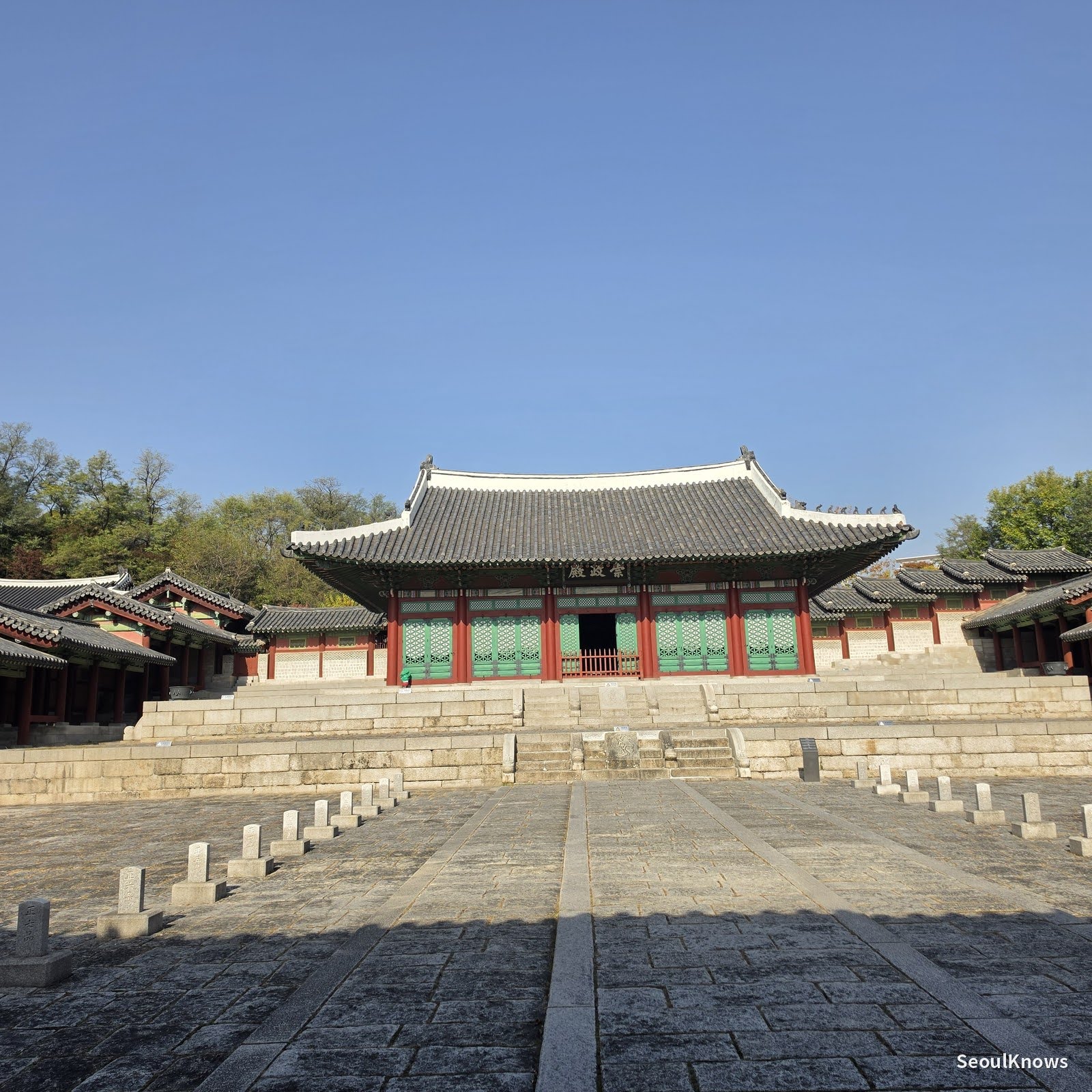
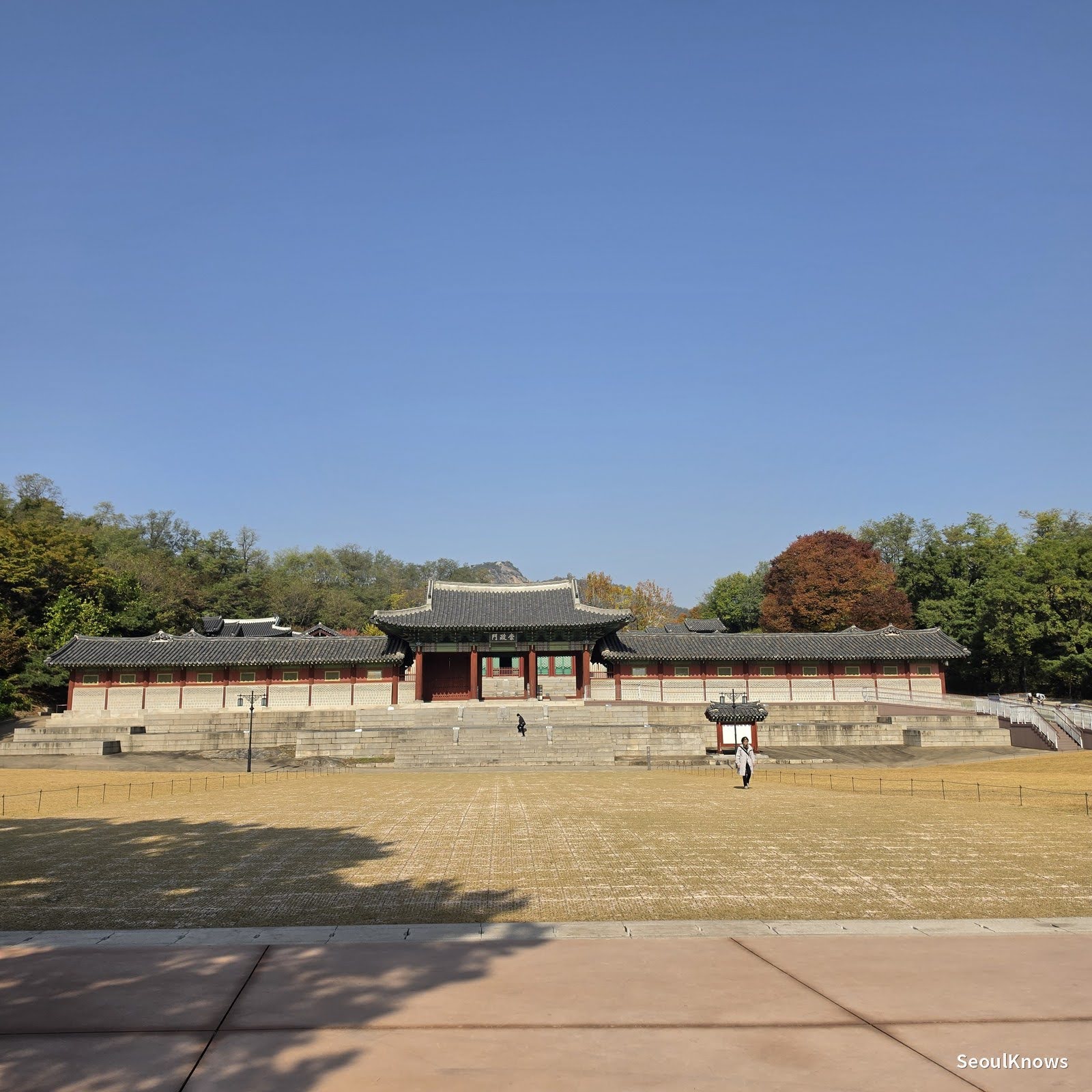
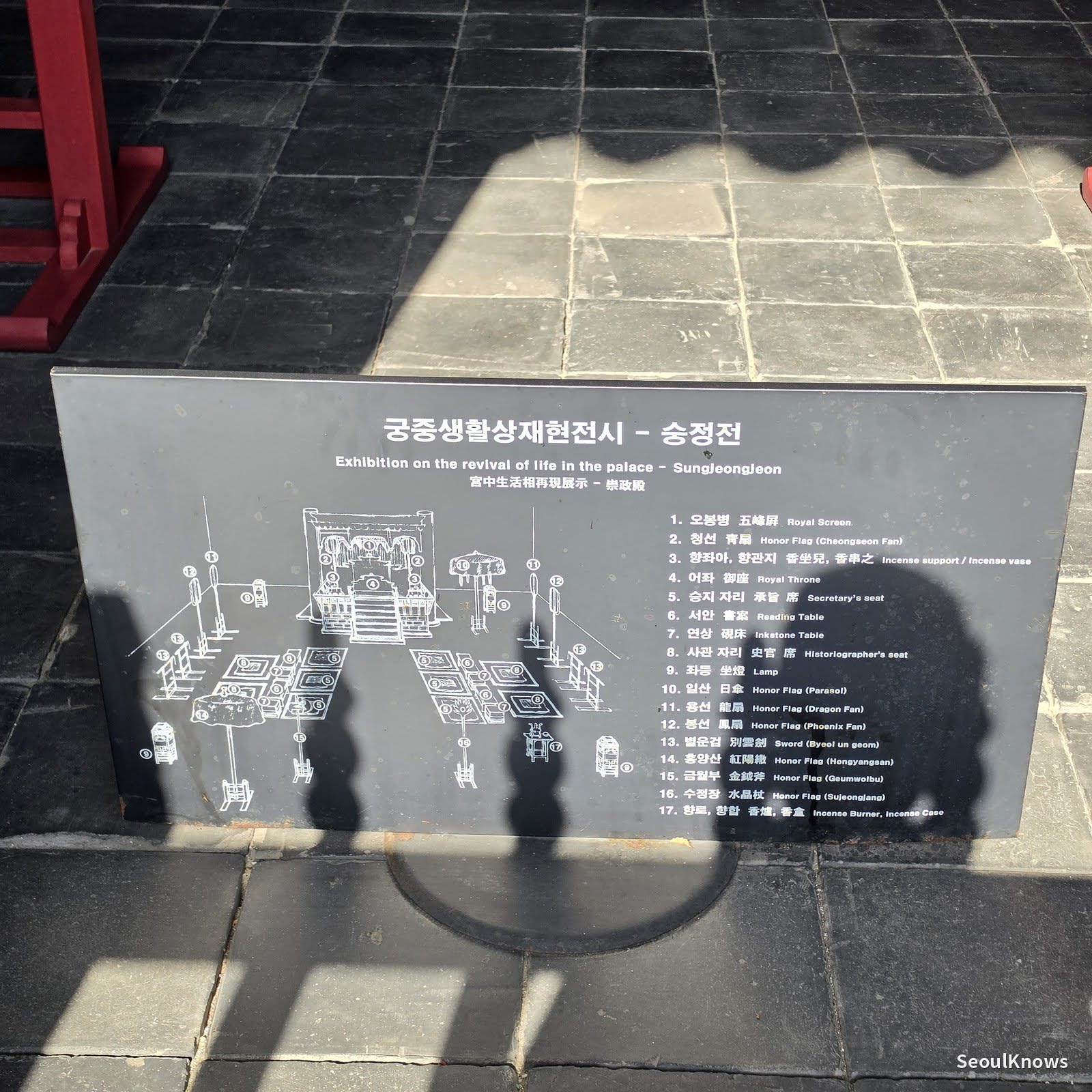
You can step up to the throne hall and look inside. The interior is set up as an exhibition on court life, with the eojwa throne and the Irwolobongdo five-peaks screen behind it, the same royal motif you see on the Korean 10,000-won note.


Behind it, Jajeongjeon was the working office where the king met ministers, and Taeryeongjeon held King Yeongjo’s portrait. Behind that sits Seoam, a large rock with a spring associated with it, one of the few things here that was never moved or rebuilt.

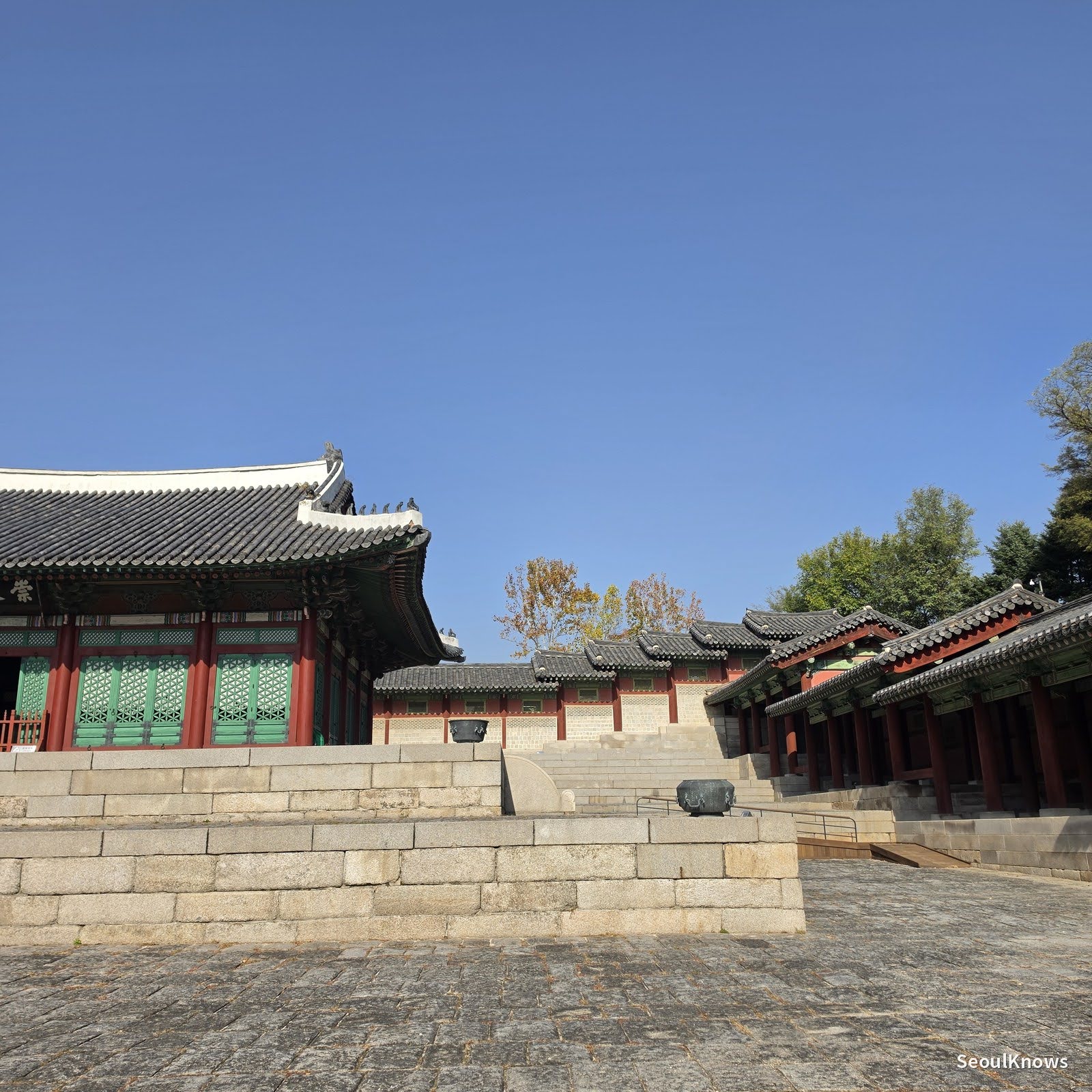
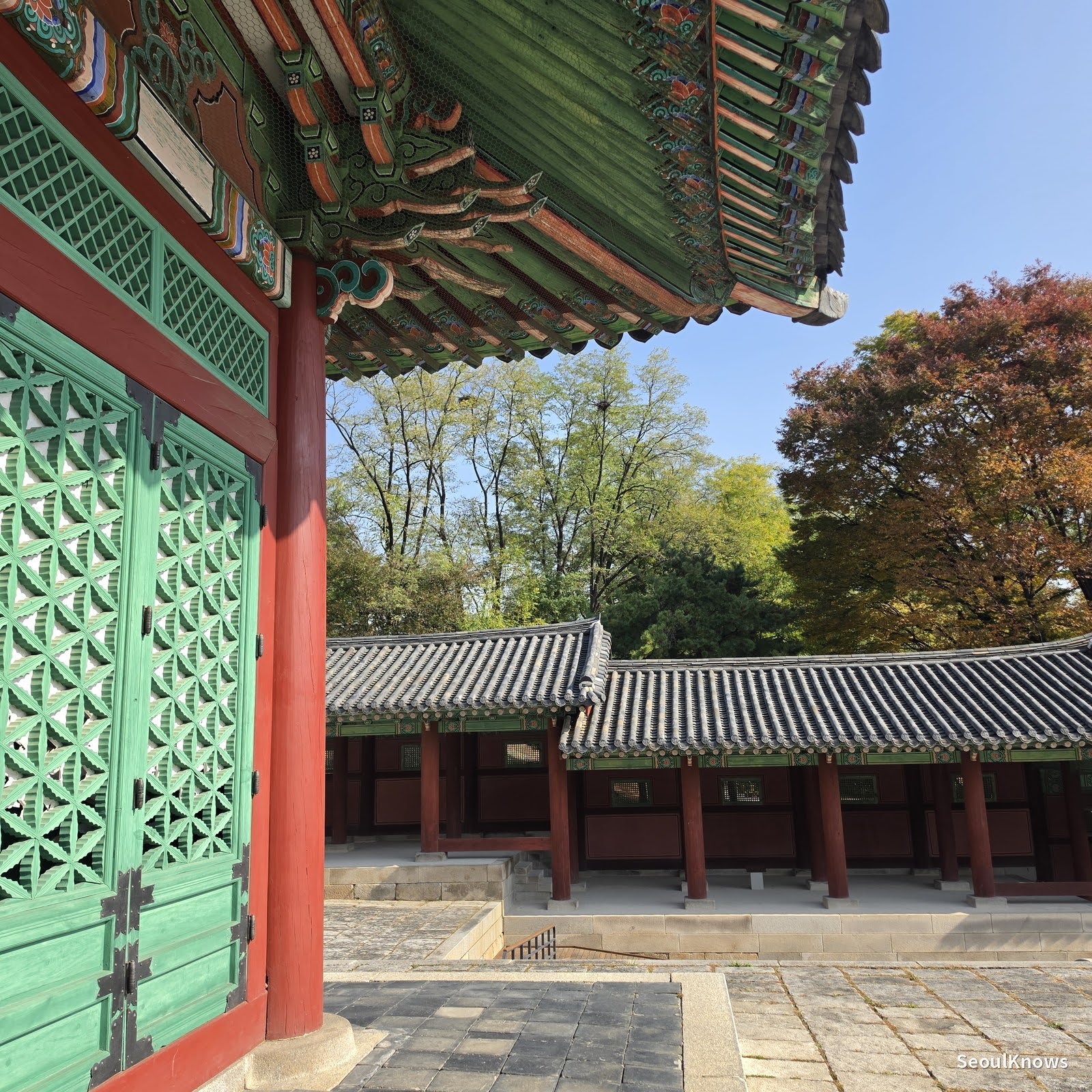
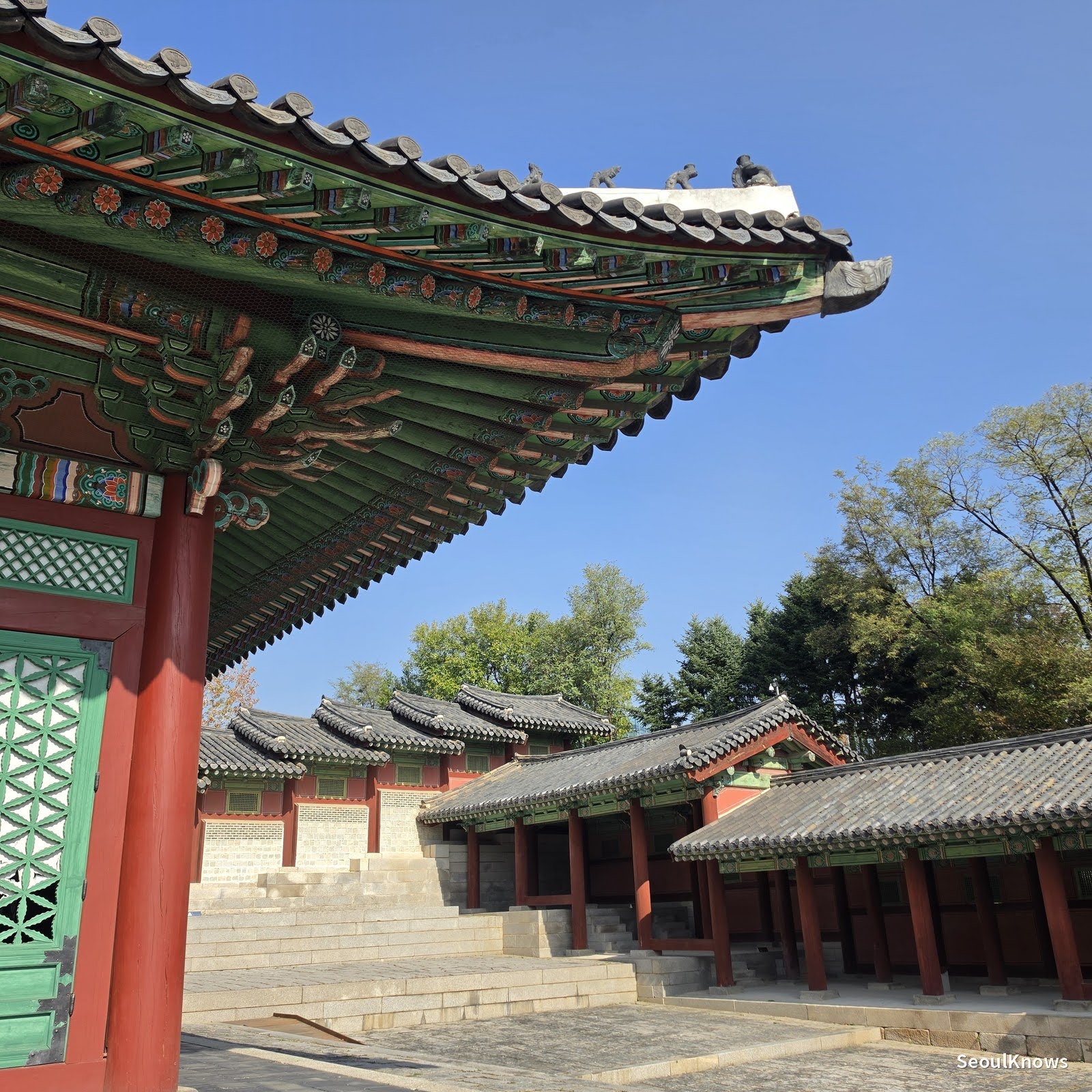
One detail is genuinely distinctive: the covered walkways linking the halls survive better here than at the other palaces, so you can see how the buildings were actually connected.
The skyline behind the roofline
At Gyeongbokgung the backdrop is Bugaksan and the illusion holds. At Gyeonghuigung it doesn’t. Office towers, the Seoul Museum of History and the Kangbuk Samsung Hospital block stand right above the tiles.
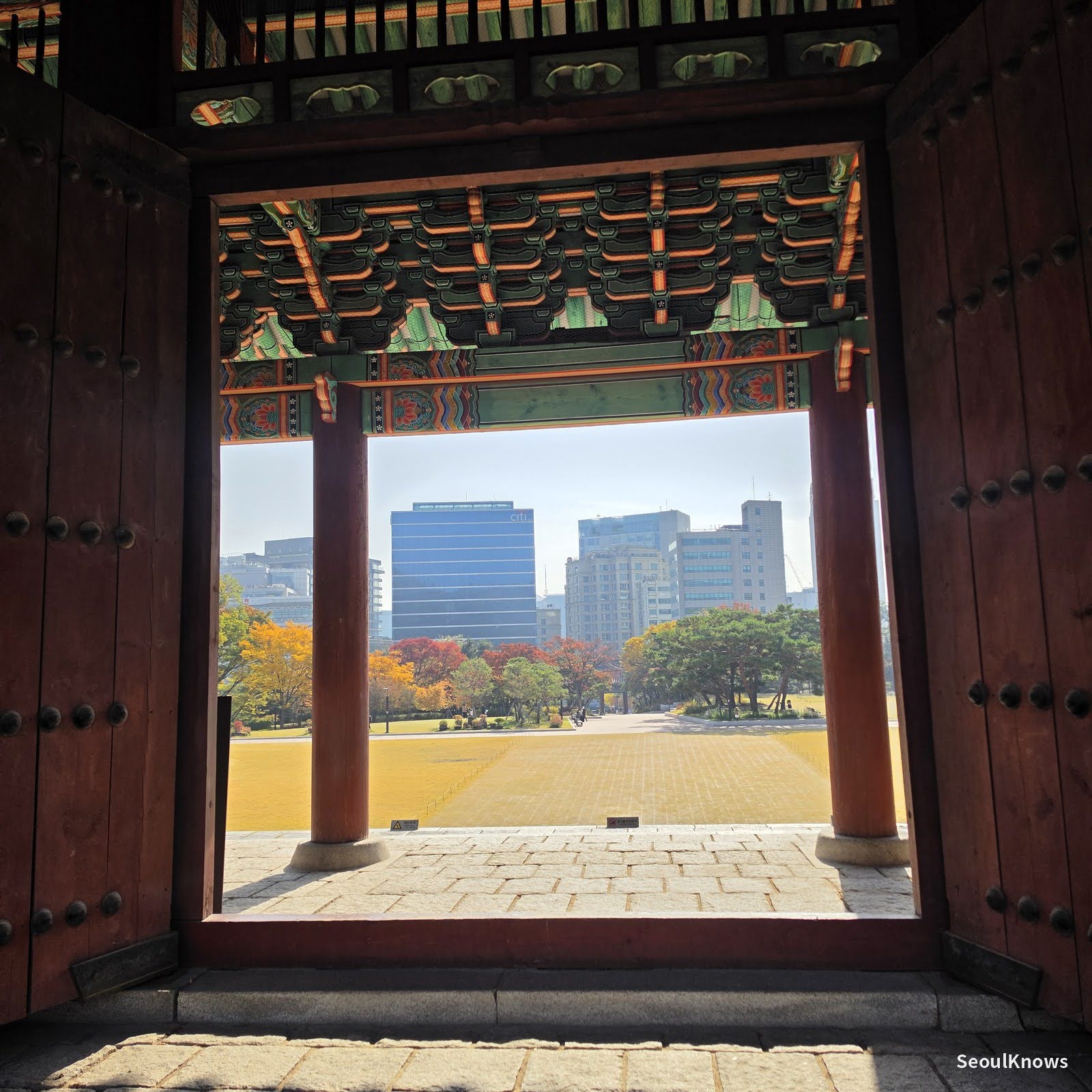
Most reviews treat that as the palace’s failure. I liked it. A Joseon courtyard with glass and steel stacked up behind it is a fair picture of what central Seoul actually looks like, and it is the one place you can frame old roofline and modern skyline in a single shot without working for it.
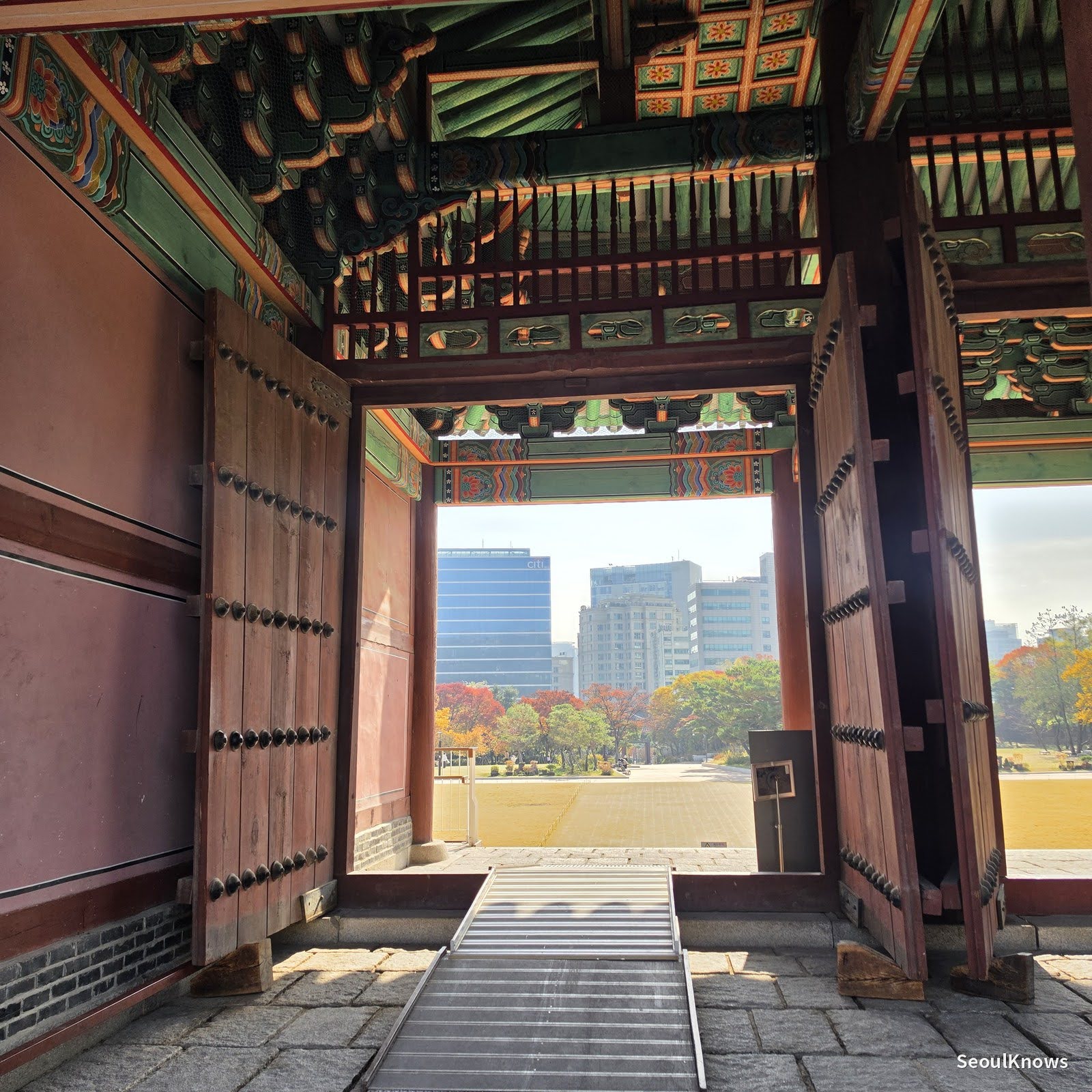

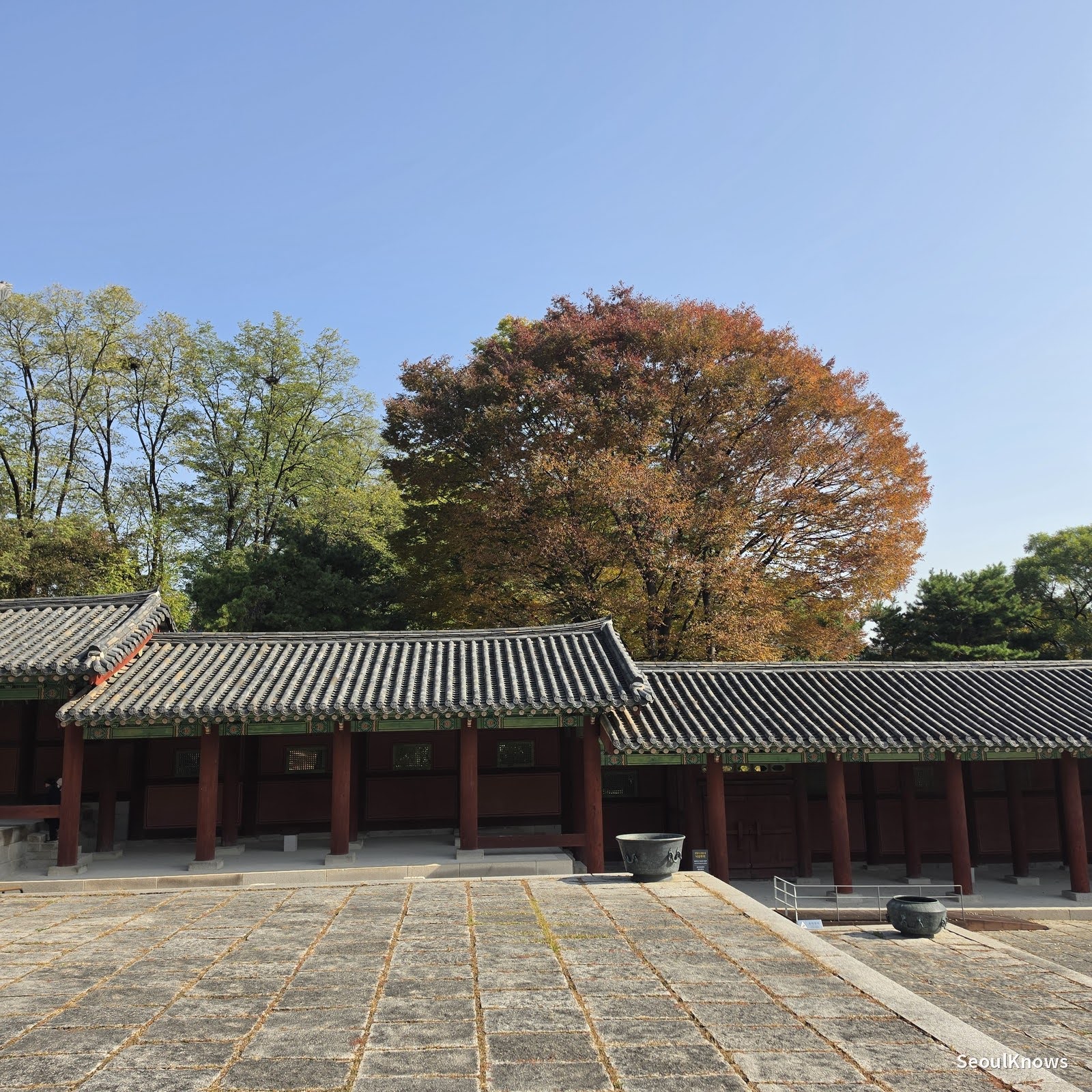

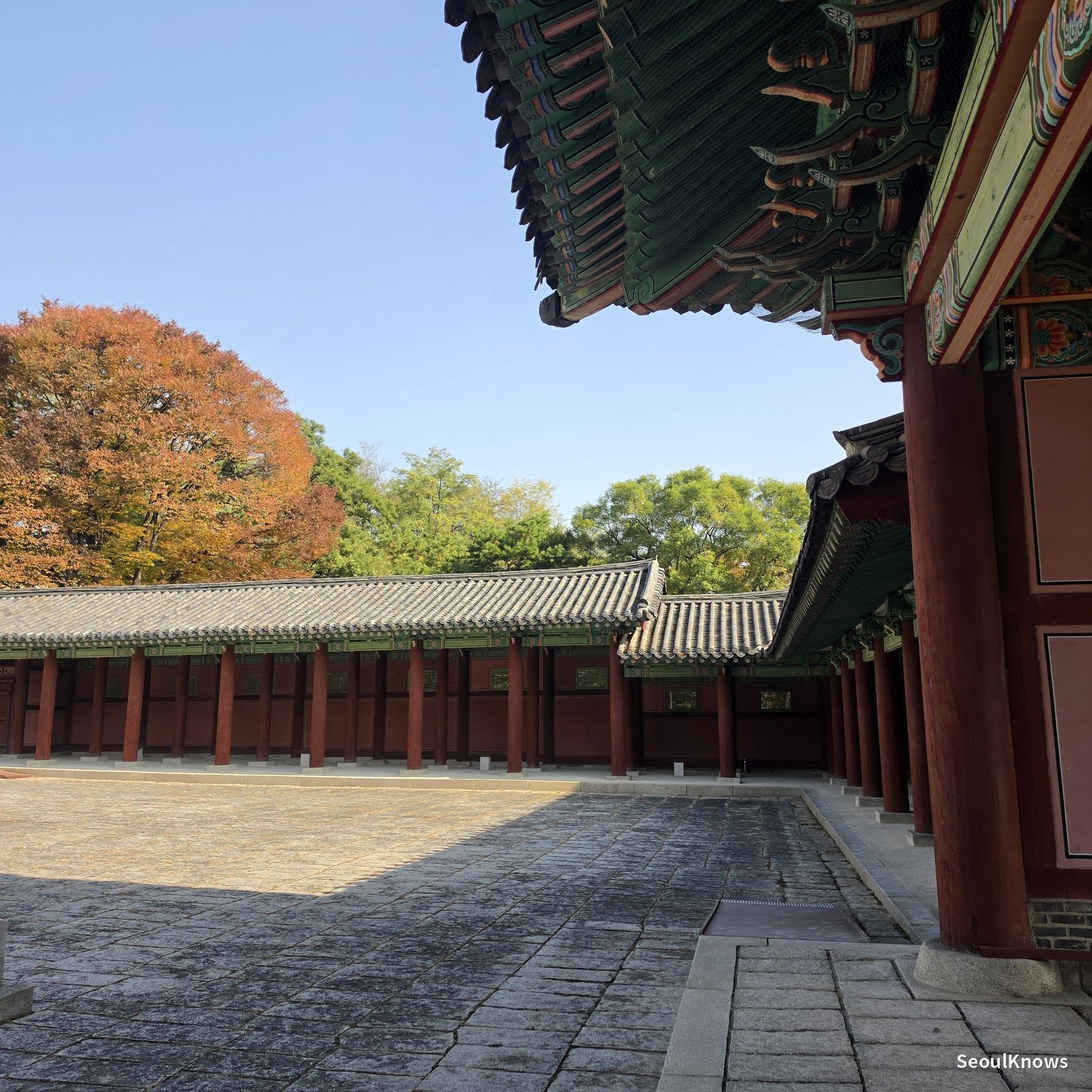
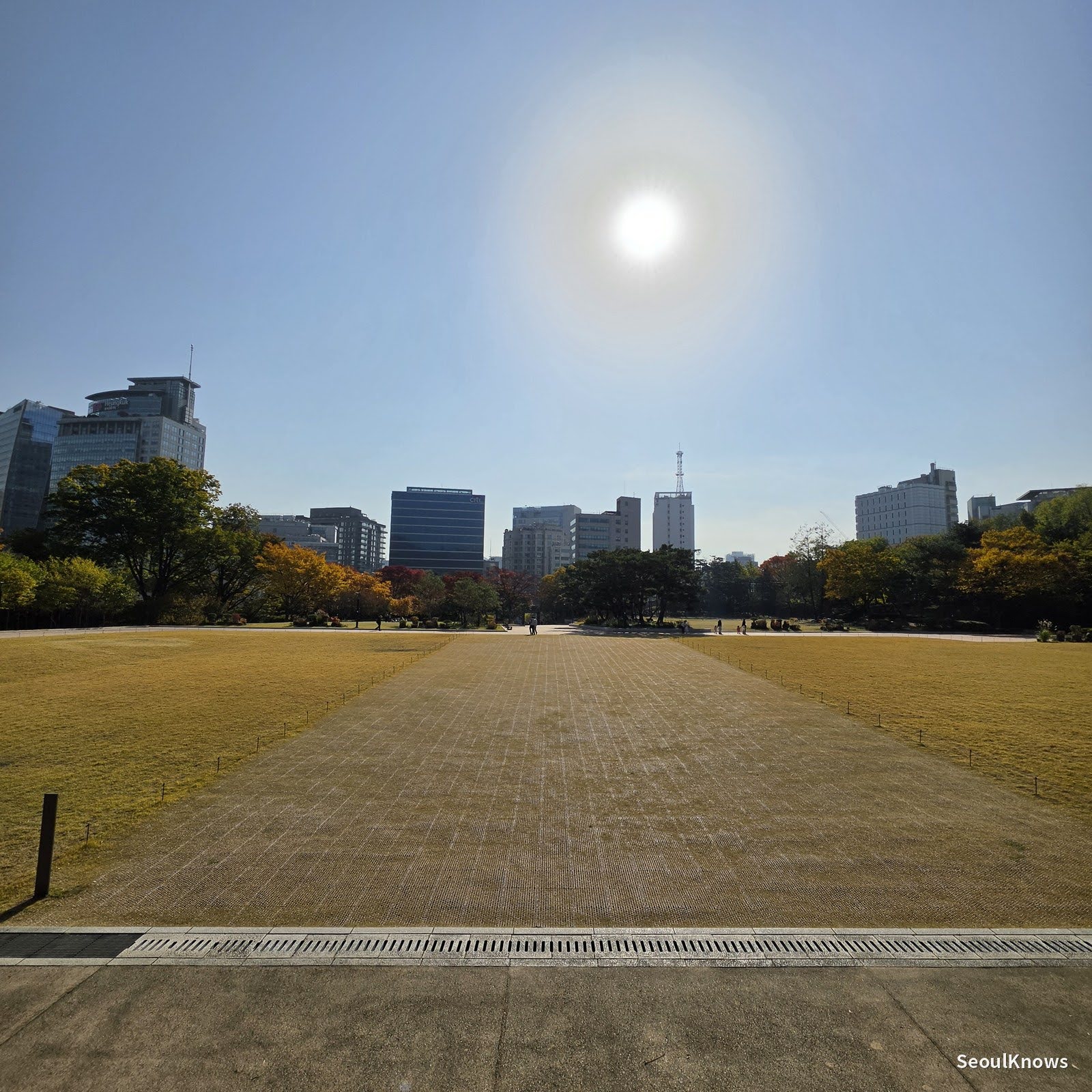
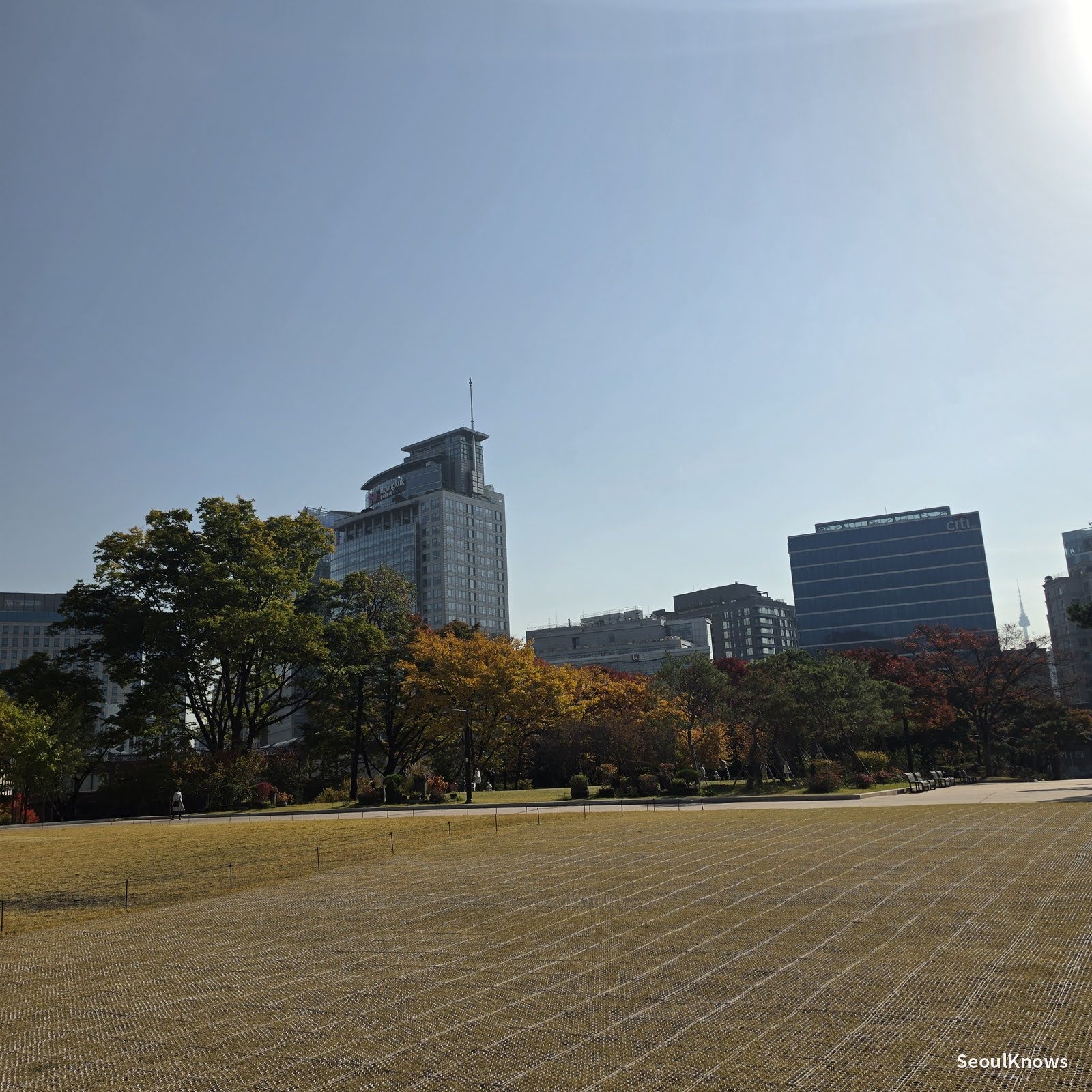
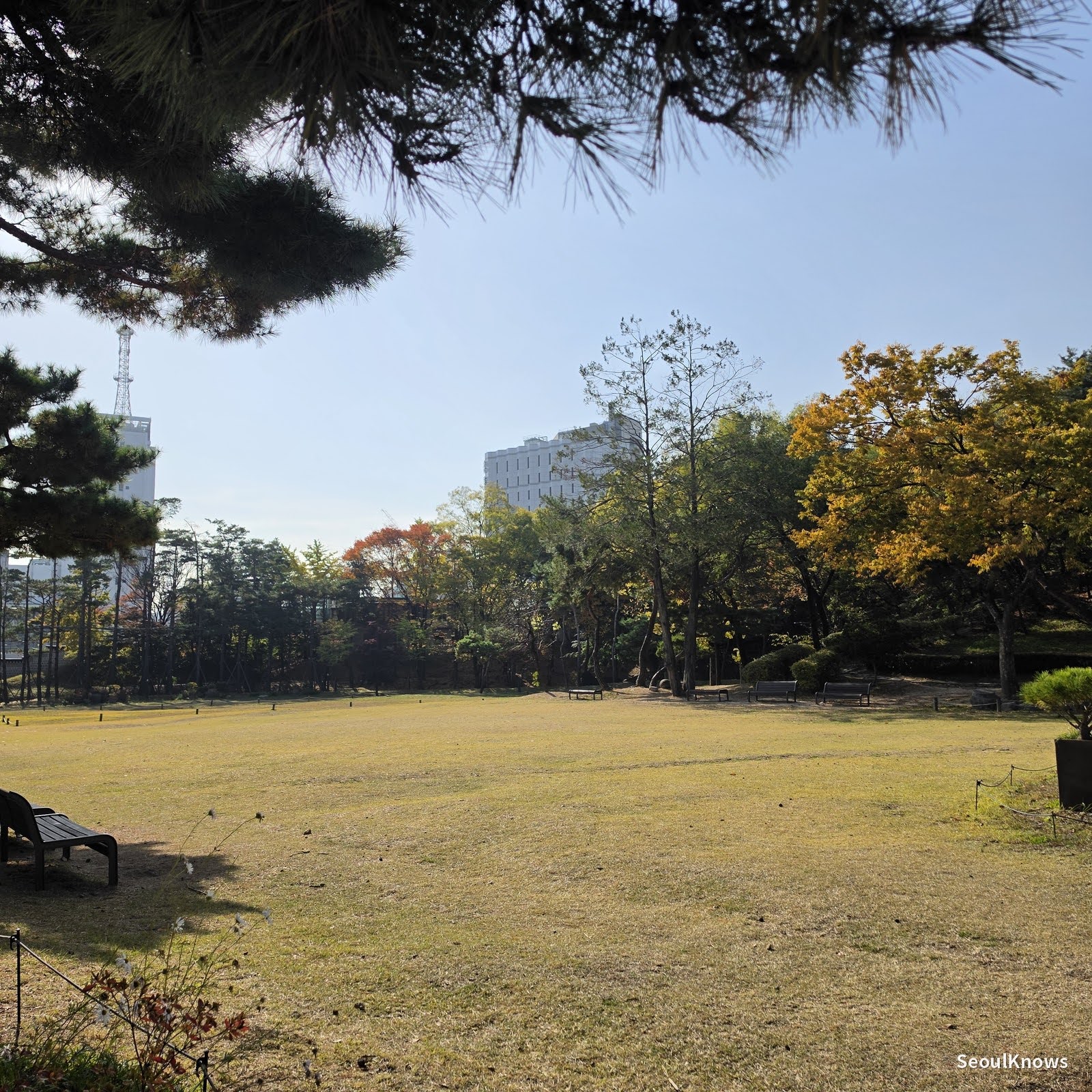
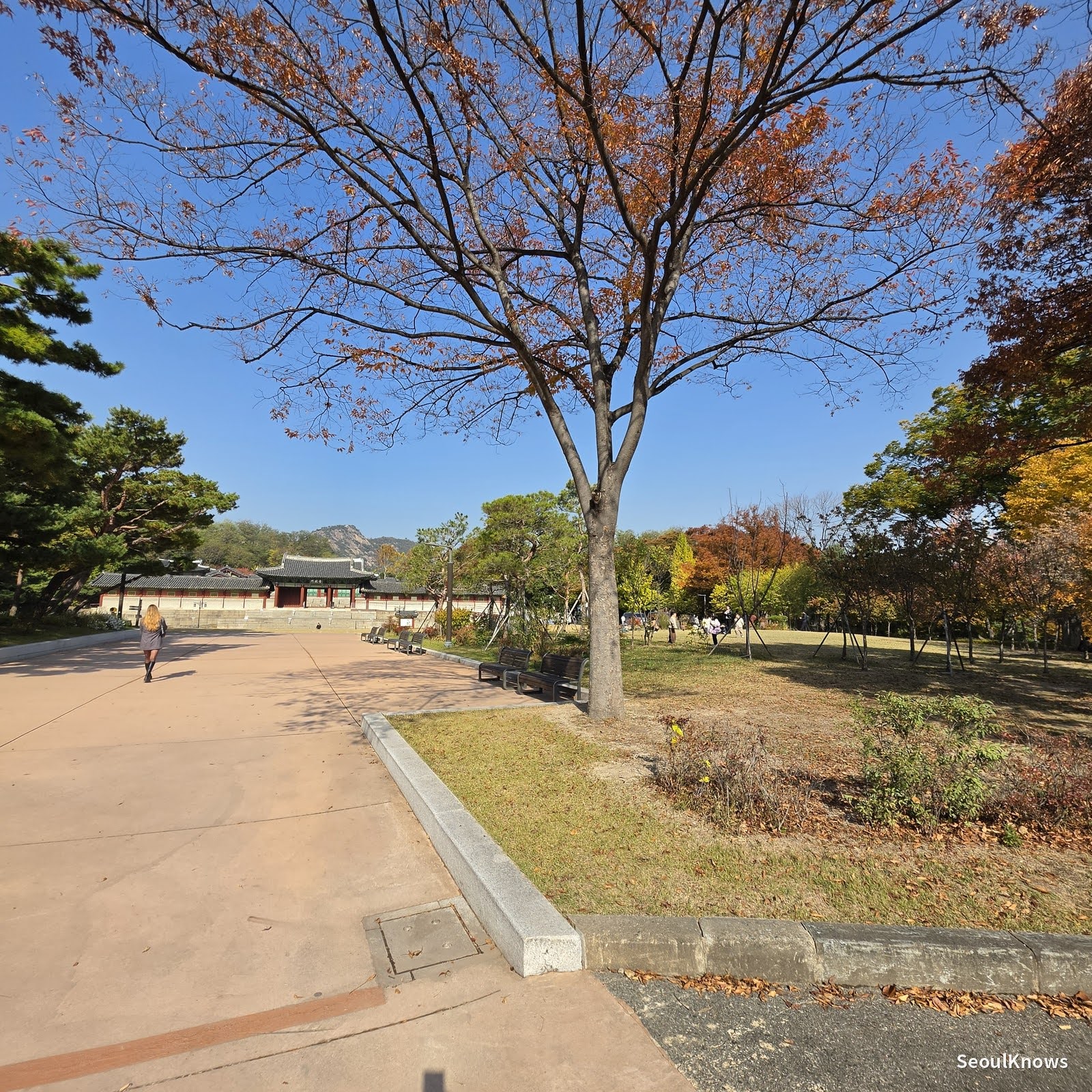
The lawn is where the Central Park feeling kicks in
Walk back out past Heunghwamun and the ground opens into a wide lawn with benches and old trees, with the business district standing up behind the treeline. On a clear day N Seoul Tower is visible from here. It is a public park, so unlike the palace itself it has no closing time and no Monday closure.


Two more free things on the same block
This is the part most English guides leave out, and it is what turns a forty-minute palace into a decent half-day.
Seoul Museum of History is beside the palace gate and is free. It traces the city from Joseon-era Hanyang to the present, which helps if you are palace-hopping and starting to blur them together. Closed Mondays, like the palace.
Gyeonggyojang is the one almost nobody finds. A 1938 Western-style mansion, it was the residence of Kim Koo, leader of the Korean Provisional Government, and the room where he was assassinated in 1949 is preserved. It is also free, and it sits inside the grounds of Kangbuk Samsung Hospital, two minutes from the palace. You walk past an ambulance bay to reach it.

Palace, museum and Gyeonggyojang together cost nothing and fill about three hours.
Where Gyeonghuigung fits among Seoul’s five palaces
Most people arrive in Seoul knowing there are five palaces and not much else. Here is the practical shape of it, because the prices are small but the closed days are staggered and that is what actually ruins itineraries.
| Palace | Adult entry | Closed | Known for |
|---|---|---|---|
| Gyeongbokgung | 3,000 won | Tuesday | The big one. Guard ceremony, largest grounds. |
| Changdeokgung | 3,000 won (+5,000 for Huwon) | Monday | UNESCO listed. The Secret Garden needs a separate timed ticket. |
| Changgyeonggung | 1,000 won | Monday | Connected to Changdeokgung. Quieter, good greenhouse. |
| Deoksugung | 1,000 won | Monday | Open late. Western-style buildings, stone-wall walk. |
| Gyeonghuigung | Free | Monday | Smallest and emptiest. Skyline views, no crowds. |
Two things fall out of that table. First, Monday is the dead day for four of the five, and Gyeongbokgung closes Tuesday instead, so if you land on a Monday, Gyeongbokgung is your palace, and if you land on a Tuesday, everything except Gyeongbokgung is open. Second, the Integrated Palace Ticket costs 6,000 won, covers the four paid palaces plus Jongmyo Shrine, and is valid six months. Those five sites cost 9,000 won separately, so it only pays off from the third one onward, and it does not include Changdeokgung’s Huwon garden, which trips up a lot of visitors.
Gyeonghuigung sits outside all of that. It is free, it needs no ticket, and it is the only one you can add to a day without doing any arithmetic.
When to go
Weekday mornings, if you have the choice. The palace opens at 9:00 and the first hour is close to empty; by late morning on my visit there were still only a handful of people in the main courtyard. Late October through mid-November is the best-looking window, when the maples around the corridors and the park lawn turn. Winter is stark but the low sun on the painted eaves is good, and the whole site is open ground, so there is nowhere to shelter if the weather turns.
Quick facts
- Hours: 09:00–18:00. Last entry 17:30.
- Closed: Mondays, and January 1.
- Admission: Free. No ticket, no reservation.
- Time needed: 40 minutes for the palace; about 3 hours with the museum and Gyeonggyojang.
- Nearest station: Seodaemun (Line 5) Exit 4, 10 minutes on foot.
- Free guided tour: Fri–Sun afternoons, meets at Sungjeongmun, about 40 minutes.
- No food or drink may be brought in or consumed inside the palace grounds.
- Good for: photographers, hanbok photos without crowds, a quiet hour in central Seoul, travellers who have already done Gyeongbokgung.
- Not good for: a first and only palace visit, anyone hoping for a guard ceremony.
As of early November 2026, the side path looping up behind the halls was closed for construction. The main courtyard and halls were open as normal.
Frequently asked questions
Is Gyeonghuigung Palace worth visiting?
If it is the only palace you will see in Seoul, no. Go to Gyeongbokgung or Changdeokgung. If you are already in Gwanghwamun, or you have done the big palaces and want one without crowds, yes. It is free and takes under an hour.
Is there a changing of the guard ceremony at Gyeonghuigung?
No. Reviewers sometimes mention one, but they are describing Gyeongbokgung, where it runs daily at Gwanghwamun gate.
Do I need a ticket or the Royal Palace Pass?
Neither. Entry is free and there is no ticket booth. The combined pass covers the four palaces that charge admission.
Is there an English guided tour?
A free 40-minute guided tour meets at Sungjeongmun on Friday, Saturday and Sunday afternoons, and the timetable is posted in both Korean and English. Call ahead on +82 2-735-5733 to check English availability for the day you want.
Can I wear hanbok at Gyeonghuigung?
Yes, and it is the quietest palace for it. There is no free-entry benefit, since entry is already free, and no rental shop on site.
Is the palace original or rebuilt?
Mostly rebuilt in the 1980s and 1990s, on the original foundation stones. The original Sungjeongjeon survives at Dongguk University as Jeonggakwon. Seoam, the rock behind Taeryeongjeon, is original to the site.
How long does it take, and what should I combine it with?
About 40 minutes alone. Pair it with the Seoul Museum of History and Gyeonggyojang, all three free, for roughly three hours, then walk fifteen minutes east to Gwanghwamun Square.
The bottom line
Gyeonghuigung is not a replacement for Gyeongbokgung and it is not a hidden masterpiece. It is a fragment of a palace that was pulled down twice over, sitting in the middle of a business district. But it costs nothing, it is empty on a weekday morning, and the collision of tiled roof and office tower is a view you won’t get at the restored palaces.
Go in the morning, give it an hour, and keep walking to the museum and Gyeonggyojang.
Written by WY, a Seoul-based local sharing honest, first-hand guides to Korea. Every guide here is a place I’ve actually been to, written from my own visit, my own photos. More about me →