
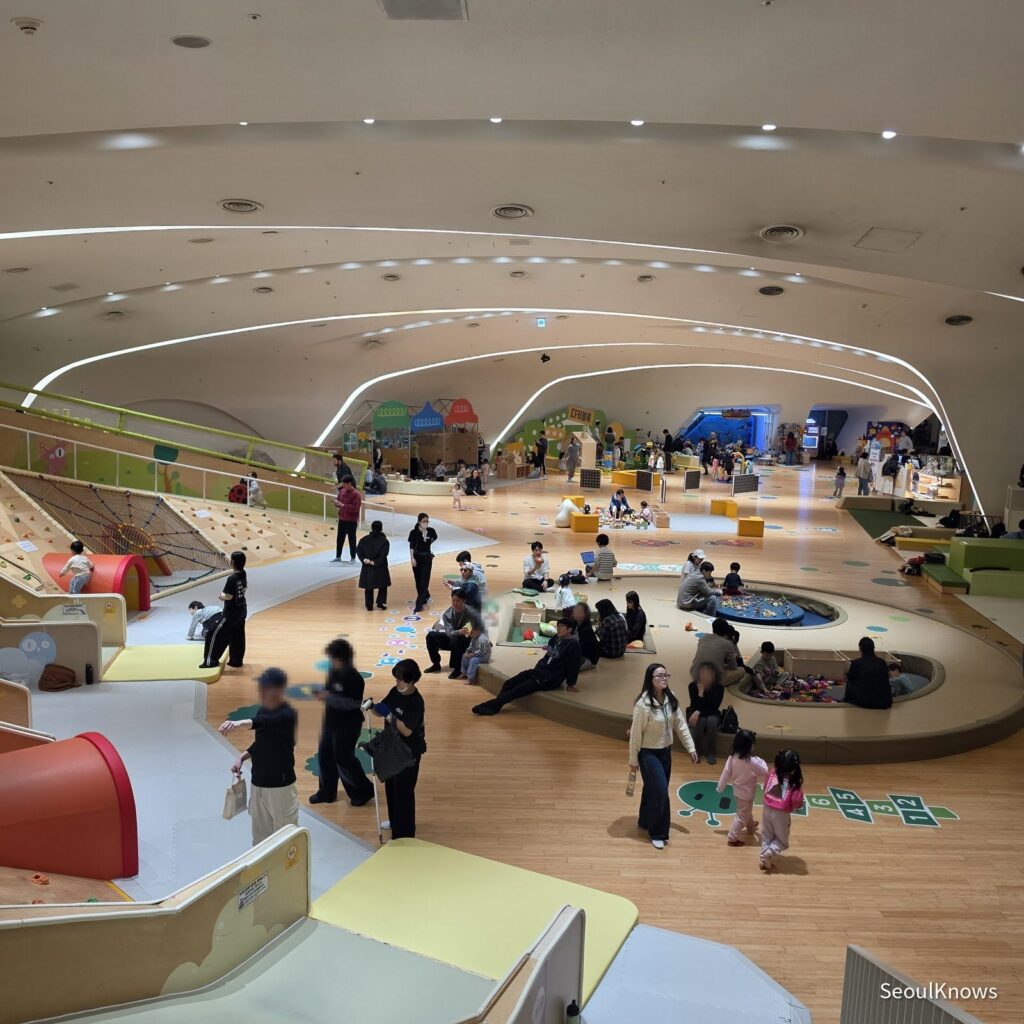
A Korean kids cafe is one of the few local things that is hard to reach if you are only in Seoul for a week. Most of them sit in residential neighbourhoods, take bookings through Korean-only apps that want a Korean phone number, and run on rules nobody writes down in English. So when a friend came over from abroad with his child and asked where to take her on a grey Saturday, we ended up at DiKi DiKi, on the fourth floor of the DDP.
That was not the first plan. He was staying near Dongdaemun, and the obvious option looked like one of Seoul’s public indoor playgrounds: 2,000 won a child, adults free, more than 200 of them. They are built for residents, though. Booking runs through a Korean-only city portal that wants Korean identity verification, an ARC or a Korean phone in your own name. A family here for ten days has neither. So we looked for something walkable from his accommodation instead, and DiKi DiKi came up on the fourth floor of the DDP, ten minutes away.
I have been walking past that building for years. I had no idea there was a playground that size inside it, and I do not think many people who live here do either.
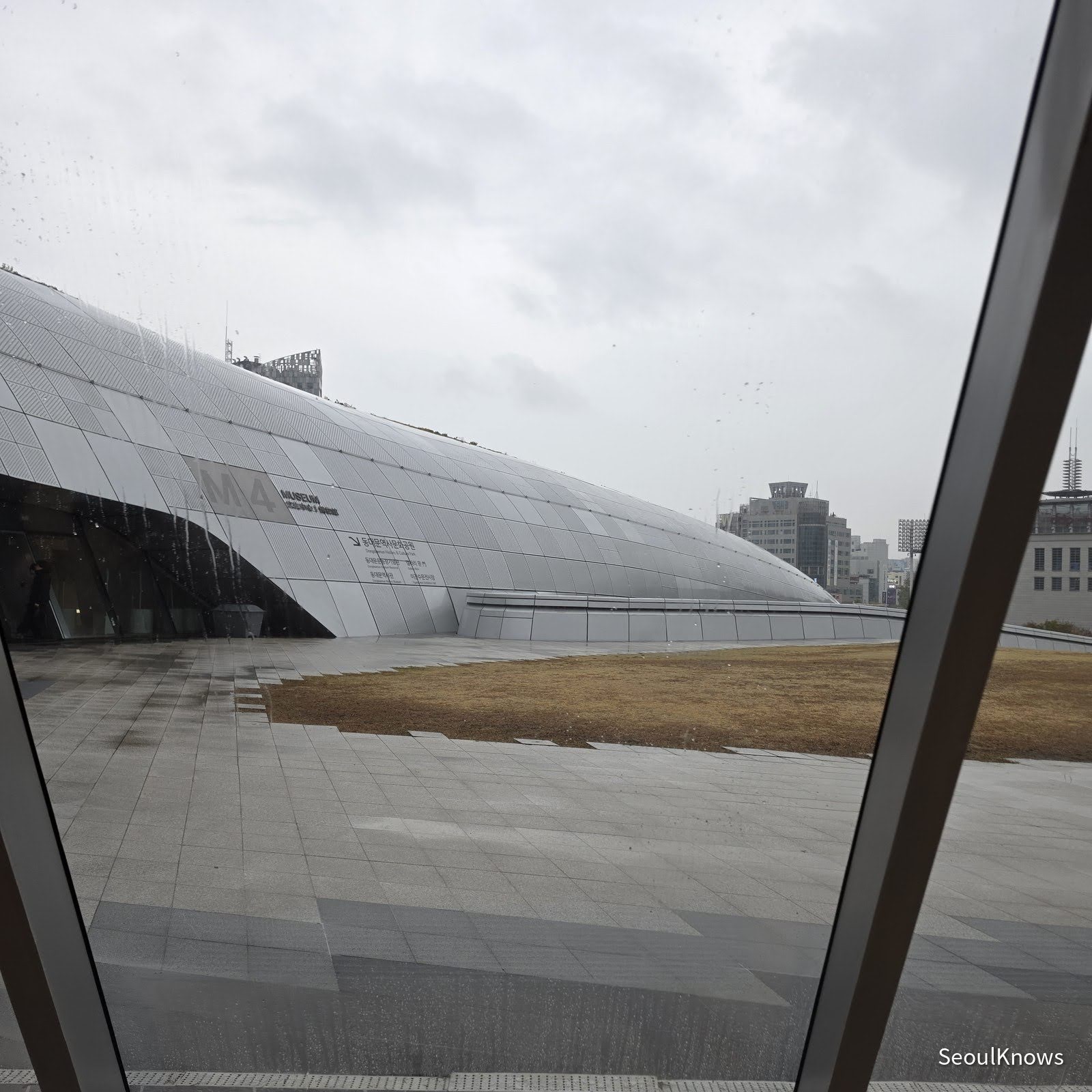
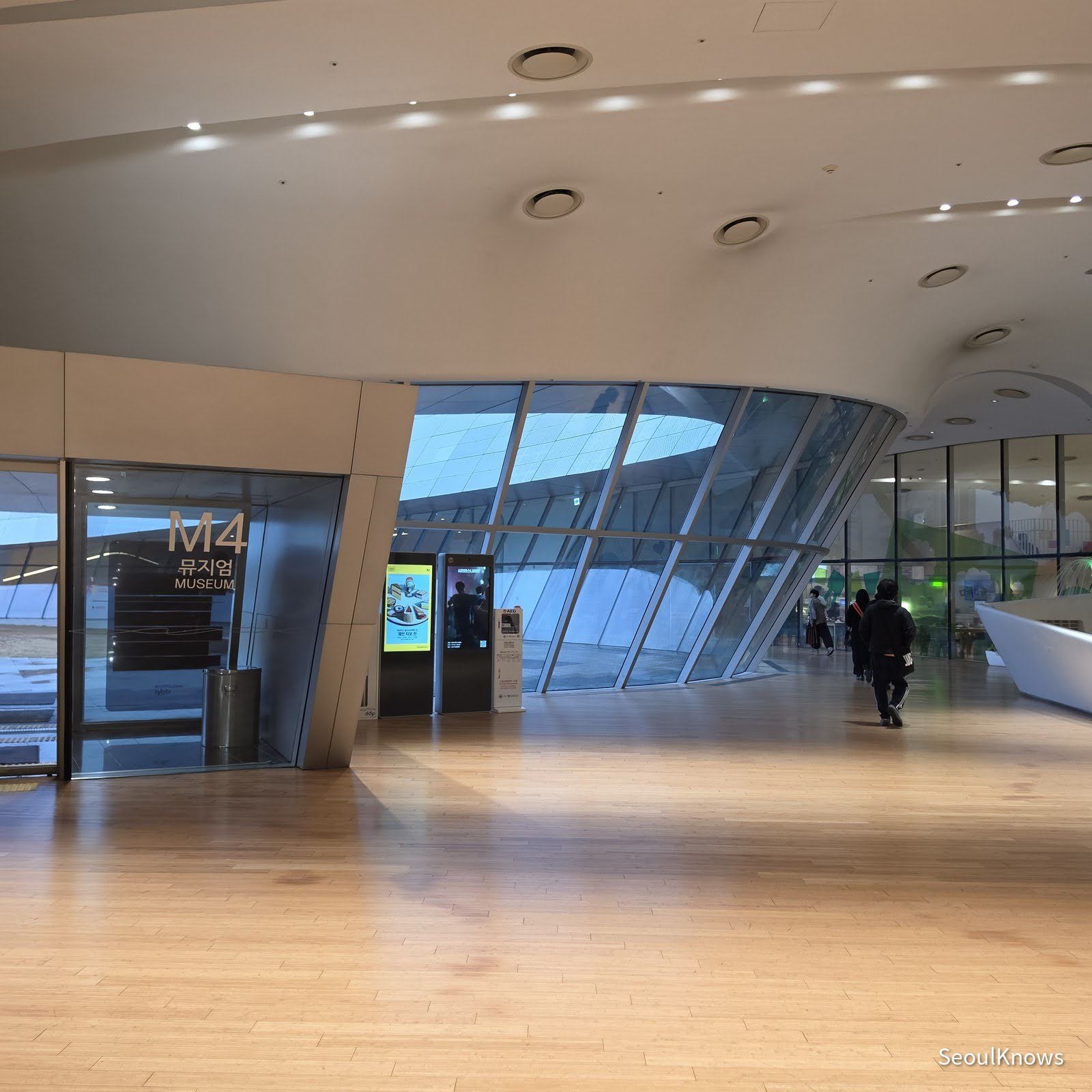
It worked. The place is good, and it is also the one kids cafe in Seoul that a visitor can walk into without help. The ticket kiosk has an English option. The signs are bilingual. It sits on top of a station served by three subway lines. And we were not the only foreign family in there by a long way.

We went in at around half past four on a Saturday and came out at closing. We paid our own way. Here is what it costs, how entry works, what is inside, and when to go.
Prices and hours below are what was on the board on 1 November 2026. Other English listings for this place have older numbers, so check before you go.
A quick word on Dongdaemun and the DDP
Dongdaemun is the late-night end of central Seoul: wholesale fabric markets, shopping towers that trade until dawn, and the old city wall running behind them. The DDP is the silver building in the middle of it, finished in 2014 to a Zaha Hadid design, and most visitors photograph the outside and walk on.
Four floors up, inside the Museum wing, is the playground. It is a ten minute walk from the Dongdaemun hotels and it is directly over a station on Lines 2, 4 and 5, which is why it works for a family that is not staying out in the suburbs.
What is a Korean kids cafe?
A kids cafe (키즈카페) is an indoor playground you pay for by the hour, with a cafe attached so the adults have somewhere to sit. They exist because Korean apartments are small, the winter is long, the summer is worse, and a child still has to run around somewhere.
Two things about the name mislead people. It is not a cafe you drop into: it is a timed, ticketed admission with an age limit. And it is not childcare. You stay with your child the whole time.
DiKi DiKi is at the fancier end of the category. It is inside the Dongdaemun Design Plaza, the Zaha Hadid building, and it leans design-museum rather than soft-play franchise. The ceiling curves away above you, the hall is long and open, and the equipment is mostly wood, card and natural shapes instead of ball pits and licensed characters.

Do adults pay at a Korean kids cafe? Yes.
This is the thing visitors get wrong most often, helped along by travel forum answers claiming parents get in free. At DiKi DiKi they do not, and at most Korean kids cafes they do not.
The board on the day:
Child (24 months to 8 years): 18,000 won, two-hour session
Each adult: 5,000 won
Over two hours: 1,500 won per 10 minutes, charged per child, settled on the way out
Hours: Tuesday to Sunday, 10:30 to 18:30
Last admission: 17:30
Capacity: 170 children at a time


Two rules that are posted in English on the kiosk and still surprise people. Every adult pays. And a maximum of two adults per child may come in, so the grandparents-plus-both-parents plan does not work.
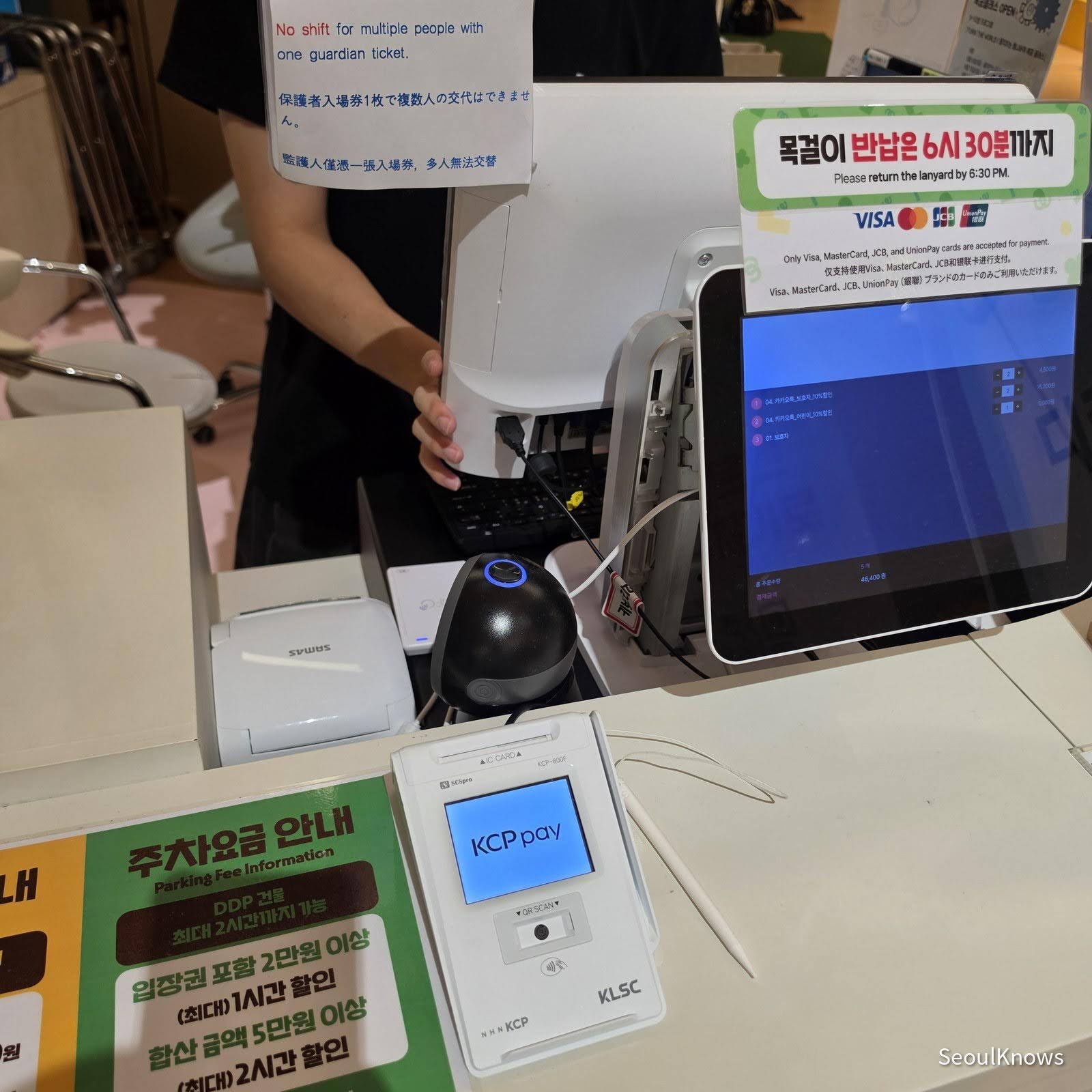
There is also a line on the counter sign that reads, in English, “No shift for multiple people with one guardian ticket.” One adult ticket is one adult, not a pass to tag in and out with your partner.
It is closed on Mondays
Its own heading because some Korean blog posts about this place say otherwise. The official site and the leaflet they hand you at the door both say Tue to Sun. It also closes on the days of Seollal and Chuseok.
Check the rest of your itinerary while you are at it. Gyeongbokgung closes on Tuesdays, the other palaces and most museums on Mondays.
Honest Seoul tips, once a week. Get the newsletter →
When to go
We went in at about 16:30 on a Saturday, with last admission at 17:30 and closing at 18:30. The first hour was a normal weekend: busy, loud, a queue at the slide. By six the hall had thinned out and our friend’s daughter had the big slide more or less to herself for the last stretch. If you want a quieter session, the late slot gets you one.

Two things to weigh. You cannot run over at that hour, because the building closes. And the paid classes run late morning and early afternoon, so by half past four they are finished. We knew that and went anyway, because our friend wanted a playground and not a timetable. Decide which of those you want before you pick a time.
Can a tourist book in advance?
Probably not, and it mostly does not matter.
Advance tickets sell through Korean resale platforms at around ten percent off, and a sign at the entrance offers a further discount for adding their KakaoTalk channel. Both assume you can complete a Korean sign-up, which usually means a Korean phone number. Naver has added passport verification, but it does not cover every flow.
Two reasons not to worry about it. Advance tickets cannot be bought and used on the same day anyway, so a discount you find at 3pm is worth nothing at 4pm. And walk-in worked fine for us on a Saturday. Plan to pay full price at the kiosk.

Paying: which cards work
The kiosks are at the entrance and the language menu offers Korean, English, Japanese and Chinese. The card logos on the machine are Visa, MasterCard, JCB and UnionPay, and ours went through without drama.
One thing to note: a sign on the kiosk says Seoul Pay and regional gift vouchers are not accepted. If you have been paying for things with a Korean local-currency voucher, it will not work here.

Getting in: the beacon and the barefoot rule
Entry is a short sequence and the sign at the rope walks you through it in both languages.
Swap the ticket for a lanyard. Each child gets a necklace with a beacon inside it. Sensors around the hall track which zones the child spends time in, and the system can produce a short play report from it. Lose it and the charge is 30,000 won, and the counter sign reminds you to hand it back by 18:30.

Shoes off. Then the bit that trips people up, because it is the opposite of almost every other kids cafe in Korea: children go barefoot, adults wear socks. The sign says so in English, “Kids must be barefoot for safety.” Most Korean kids cafes run it the other way: grip socks on the child, sold at the door if you forgot, and socks on the adult too. Carry socks for everyone and treat this place as the exception. Lockers for shoes and bags are just inside.


Strollers stay outside. There is a stroller park in the corridor before the entrance and it was full when we arrived, which tells you how many people bring one.

One adult may step out and come back once. Children may not.
One more thing, and it matters more for foreign visitors than for locals: there is a sign next to the price board asking people not to take photographs of other people’s children. Shoot your own child and the equipment, not the room.
What is actually inside
The hall is divided into named zones, and the mix is wider than a standard play centre.
Jungle Hill is the physical end: a long slide, a climbing wall studded with coloured holds, a rope net and tunnels underneath. Staff stand at the top of the slide. This is where the energy goes.


The block floors were the surprise. Large wooden blocks, card house frames, a pegboard wall, a wooden marble run, magnetic shapes, and enough open floor to build something big. Our friend’s daughter spent longer here than on the slide. If your mental image of a kids cafe is a ball pit, this is the part that changes it.

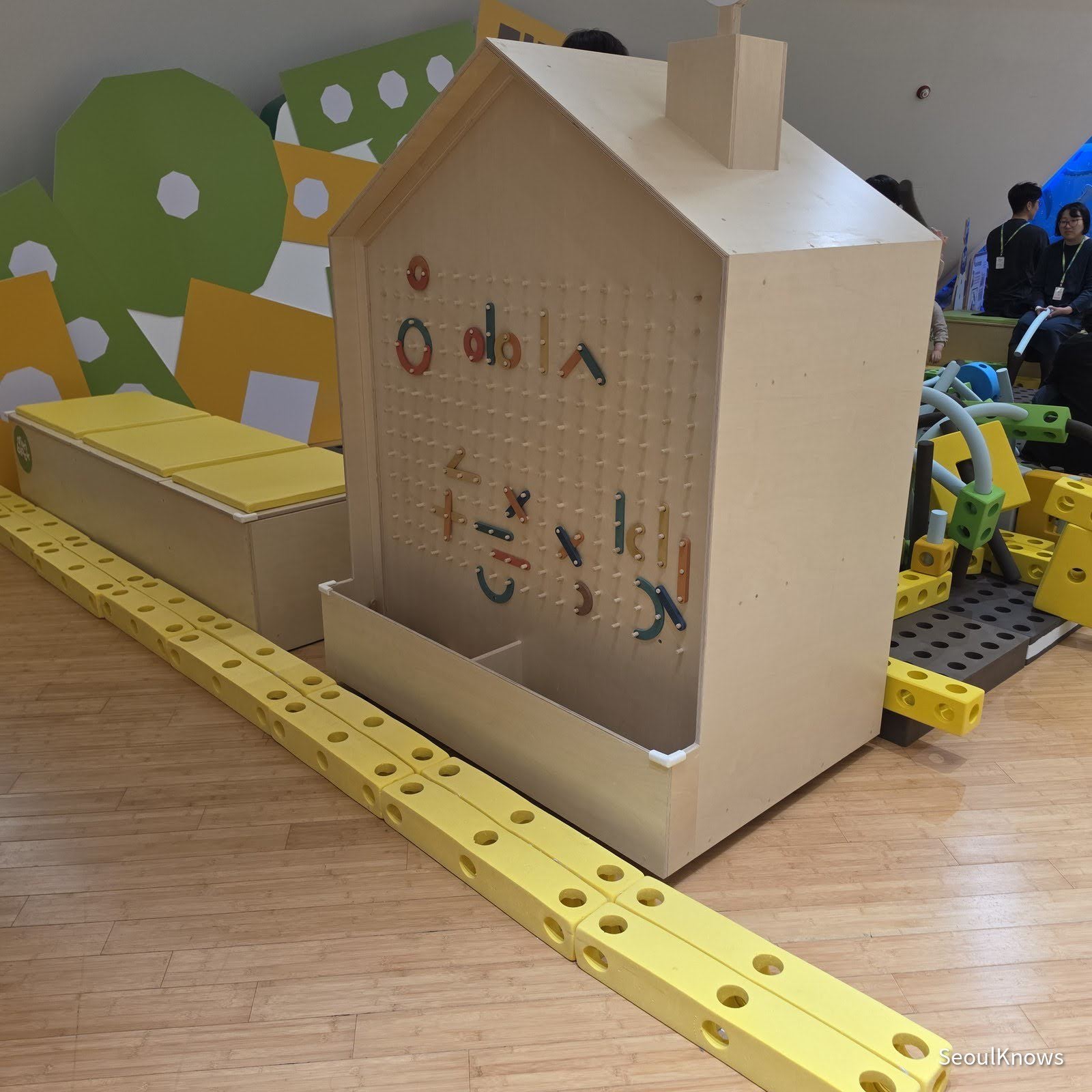
Role play sits in a quieter bay: a shop counter, a kitchen, small furniture and a tea set.


The sensory pit is a shallow square filled with soft fabric vegetables. Cabbages, mushrooms, a loaf of bread. Popular with the under-fours.


The interactive floor projects shapes that react when you step on them, and there is a dim media room with an underwater theme and a space-capsule corner.


DDLAB is the workshop room. It runs paid classes on a fixed weekly timetable rather than drop-in activities, which is the next section.
The paid classes at DDLAB, and what they cost
This changes when you should arrive, so read it before you pick a day.
Each class is tied to a day, an age band and a price. Most are sold as a package: the class plus the child’s two-hour playground ticket in one price. The adult still buys admission separately, every time.
This was the leaflet on 1 November 2026. Classes and prices rotate.


Tuesday and Wednesday, 11:00 to 14:40, ages 5 to 9: a 20-minute paper dinosaur-mask making session, 15,000 won, walk-up, no booking needed.
Tuesday to Sunday, rolling sessions, ages 3 to 8: a natural-clay sensory room called “You and My Universe”. Walk-up possible. The package of 50 minutes in there plus the 2-hour playground ticket is 35,000 won.
Friday 14:00, ages 6 to 10: a drama and movement class, 60 minutes plus the playground, 40,000 won.
Saturday 11:00, ages 5 to 9: sand art and a science session making a snow globe, 45,000 won.
Saturday 14:00, ages 4 to 9: picture books and sand art, 60 minutes plus the playground, 50,000 won.
Sunday 11:00 and 12:10, ages 5 to 7: a woodworking class building a geared toy. One adult must take part, 40 minutes plus the playground, 58,000 won.
Sunday 11:30, ages 5 to 7: a cooking class, 60 minutes plus the playground, 58,000 won.
Sundays in term, ages 6 to 8: a nine-week English musical course, six children per group.
Do the arithmetic. The playground alone is 18,000 won for the child, so the clay room package at 35,000 puts the class itself at about 17,000, and the Saturday picture-book package at 50,000 puts it at about 32,000 for an hour of teaching.
For a visitor, two of them are realistic. Everything else is booked through Naver, and the 10 percent discount lives there too. The dinosaur mask on a Tuesday or Wednesday and the clay room any day are walk-up, so those are the ones you can get into on the day.
The classes are taught in Korean. The making ones travel fine, because a four year old gluing a dinosaur mask does not need much language. The drama and storytelling ones travel less well.
Can the adults actually sit down?
That depends on your child’s age. A Korean kids cafe is a shared room. Toys get taken, two children want the same slide, and someone has to be close enough to step in. With a child of five or six and under you are supervising, not relaxing, whichever venue you pick. From around primary school age you can let them go and drink the coffee.
What DiKi DiKi does is make the supervising easier. The hall is open and the sightlines are long, so you can follow your child from a seat instead of trailing two steps behind them through tunnels. That is a real difference from the places built around tall closed structures. There is raised seating along one side, floor cushions, low tables, and a cafe.
The cafe is called Haetsal Pongdang Jeongwon, which means roughly Sunlight Splash Garden, and it is a proper cafe rather than a vending machine in a corner: a wall of windows, real tables, a kitchen.
Outside food and drink are not allowed, so once you are inside this is your only option.
The nursing room is a separate room with a sofa and a changing bed, not a corner of the toilets.
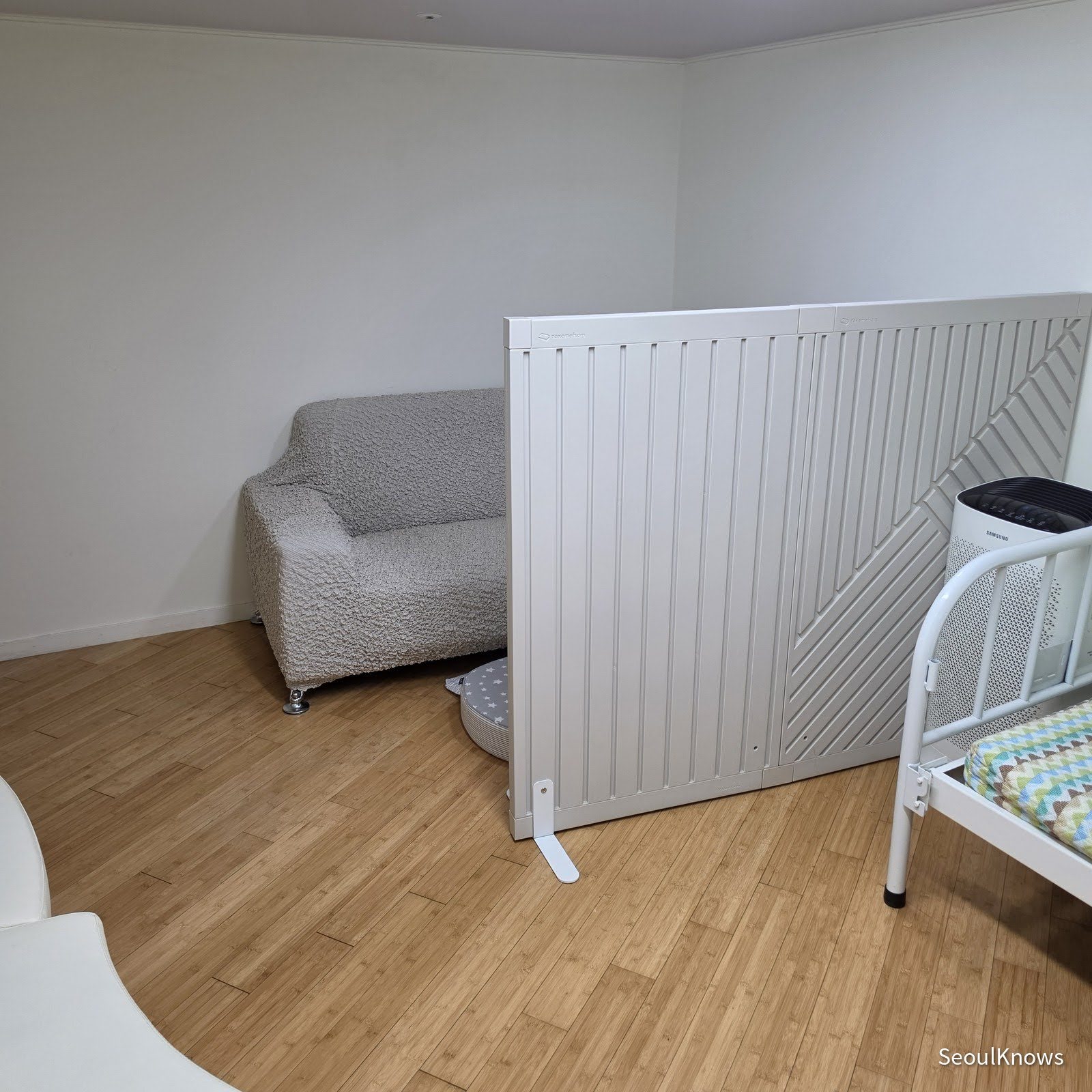

What the cafe sells
The usual complaint about Korean kids cafes is the food: cafe prices for whatever a freezer can manage. Not here. The menu is printed in Korean and English, and the hot food is not nuggets and chips. It is what a Korean child actually eats.

Tteokbokki with fish-cake broth and rice balls, 17,000 won for the set
Tteokbokki with two hotdogs, 14,500 won
Fried chicken and fries, 13,500 won
Hamburg steak with fried rice, 13,500 won, flagged on the board as the popular one
Spicy octopus fried rice, 7,900 won
Shrimp fried rice, 7,900 won
Bulgogi fried rice, 8,500 won
Rice balls on their own, 8,500 won
There is a case for making this the meal rather than a top-up. If your child has been eyeing tteokbokki on a Myeongdong street stall and you were not sure about the chilli or the queue, this is the soft landing: a table, a toilet nearby, and a version cooked for Korean children rather than for tourists.
Coffee is ordinary cafe pricing and slightly under central Seoul. Americano 4,800, cappuccino 5,500, latte 5,800, mocha and caramel macchiato 6,200, and a tiramisu latte at 6,900 that they are clearly pushing.
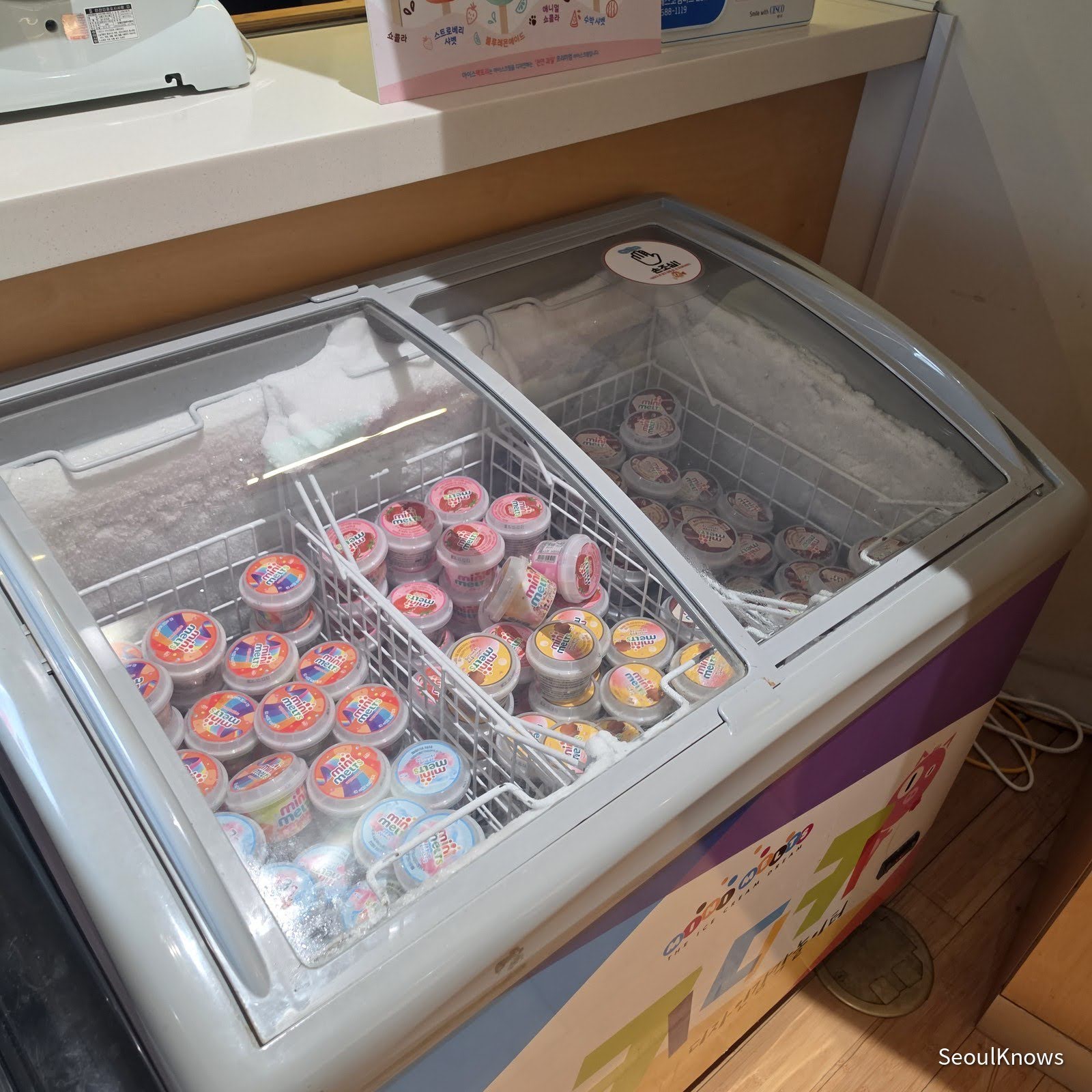
For children: hot chocolate 6,500, royal milk tea 6,900, caffeine-free chamomile, peppermint or lemon-ginger tea 5,000, lemon or grapefruit ade 6,700. There is a bakery counter with a cheese chiffon at 7,000, and two ice cream freezers by the till, which are useful leverage when the two hours are nearly up and nobody wants to leave.
Getting there, and the DDP maze
Address: DDP Museum, 4F, 281 Eulji-ro, Jung-gu, Seoul
Subway: Dongdaemun History & Culture Park Station, Lines 2, 4 and 5. Exit 1 connects into the complex. First time on the Seoul subway? That guide covers the card and the gates.
Phone: 02-2153-0760
The DDP is one continuous silver curve with several differently-named halls inside it, and the first visit is confusing. Hold on to one thing: you want Museum, not Design Lab, and you want the fourth floor. Find the Museum lift and go up. If you end up in Design Lab you are in the right building and the wrong wing.


Driving is the harder version of the same problem. Parking is 400 won per 5 minutes, and the levels do not all connect to the hall you want, so give yourself the time.
The sign at the desk lists tiers, 20,000 won for an hour and 50,000 won for two, with admission and cafe receipts added together. In practice our admission alone was registered for two hours, which covers the session. Keep the receipt and have the car registered at the desk on the way out.
Which ages it suits
The official range is 24 months to 8 years, counted in international age. Korea officially switched to international age counting in 2023, so the number on the sign is the number you think it is.
4 to 6 is the sweet spot. They will use almost everything.
2 to 3 will live on the blocks and the sensory pit and be too small for the climbing frame.
7 to 8 may find it tame if they want speed. This is a building-and-making place, not an adventure park.
The posted range starts at 24 months, though there were children in there who looked younger than that, so a baby sibling may well be fine. It is not in the published rules either way, so if you are travelling with a baby as well, call 02-2153-0760 before you go.
Frequently asked questions
Do I need to book?
Not necessarily. Walk-in works when there is room, and the cap is 170 children at a time. We walked in on a Saturday afternoon without a booking. Weekends and school holidays are the risk, and late afternoon is the safest walk-in window.
What if it is full?
You wait for a slot or come back. There is no standby list.
Will my foreign card work?
Visa, MasterCard, JCB and UnionPay are shown on the machine and ours worked. Carry some cash anyway, as a general rule in Korea.
Does anyone speak English?
The kiosk, the signs and the leaflet are bilingual, which covers everything you need to do. Do not plan on a long conversation at the desk, but you will not need one.
Do I need to bring socks?
For yourself, yes. For your child, not here: children go barefoot at DiKi DiKi. That is the reverse of most Korean kids cafes, where the child needs grip socks and the adult needs socks too, so pack a pair for everyone and expect this place to be the exception.
Can I sit with a coffee and let my child play?
Not with a small one. Under about six you are supervising: these are shared rooms and children collide over the same toy. Primary school age and up, yes. At DiKi DiKi you can at least do it from a seat.
Can I bring the stroller in?
No. Park it in the corridor outside the entrance.
Can one adult bring two children?
Yes. The limit works the other way round: two adults per child maximum, and all of them pay.
What happens if we overstay?
1,500 won per 10 minutes per child, paid at the exit when they scan you out. If you came in at 16:30 it cannot happen, because the building closes.
Can we bring our own snacks?
No. Outside food and drink are banned and the cafe inside is the only option. It is a real menu though: tteokbokki, fried rice and fried chicken alongside the coffee, and it is written in English too.
Can we just turn up and join a class?
Two of them, yes: the dinosaur-mask session on Tuesdays and Wednesdays, and the clay sensory room, which runs Tuesday to Sunday. The rest are booked in advance through Naver, which is where the 10 percent discount is and where a visitor without a Korean phone number tends to get stuck.
Do the class packages include playground time?
For the child, yes. Every package I saw bundles the two-hour playground ticket. The adult’s 5,000 won admission is always separate.
What about Seoul’s city-run kids cafes? They look cheaper.
They are: 2,000 won a child, adults free, more than 200 branches. They are built for residents though. Booking needs Korean identity verification, an ARC or a Korean phone in your own name, and a short-stay visitor has neither. That is the wall we hit. If you live here, our guide to the public playgrounds is the one to read instead.
Is there anything to do nearby afterwards?
The DDP itself is worth a slow walk, and it is better after dark when the shell is lit. Both double-decker tour buses, Seoul City Tour Bus and Tiger Bus, have stops right outside, Hyundai City Outlet is across the road if you want proper shopping, the Dongdaemun malls next door run very late, and the whole area is a short hop from Myeongdong on Line 4.
The bottom line
If you want your child to have a Korean kids cafe afternoon and you are not here long enough to learn the system, this is the one to pick. 18,000 won for the child, 5,000 won per adult, two hours, closed Mondays, last entry 17:30.
Morning for the classes, late afternoon for a quieter playground. The timetable will not let you do both in one visit.
More family guides are in Seoul With Kids, and if this is your first trip, start with First Time in Seoul.
Written by WY, a Seoul-based local sharing honest, first-hand guides to Korea. Every guide here is a place I have actually been to: written from my own visit, my own photos. More about me →