
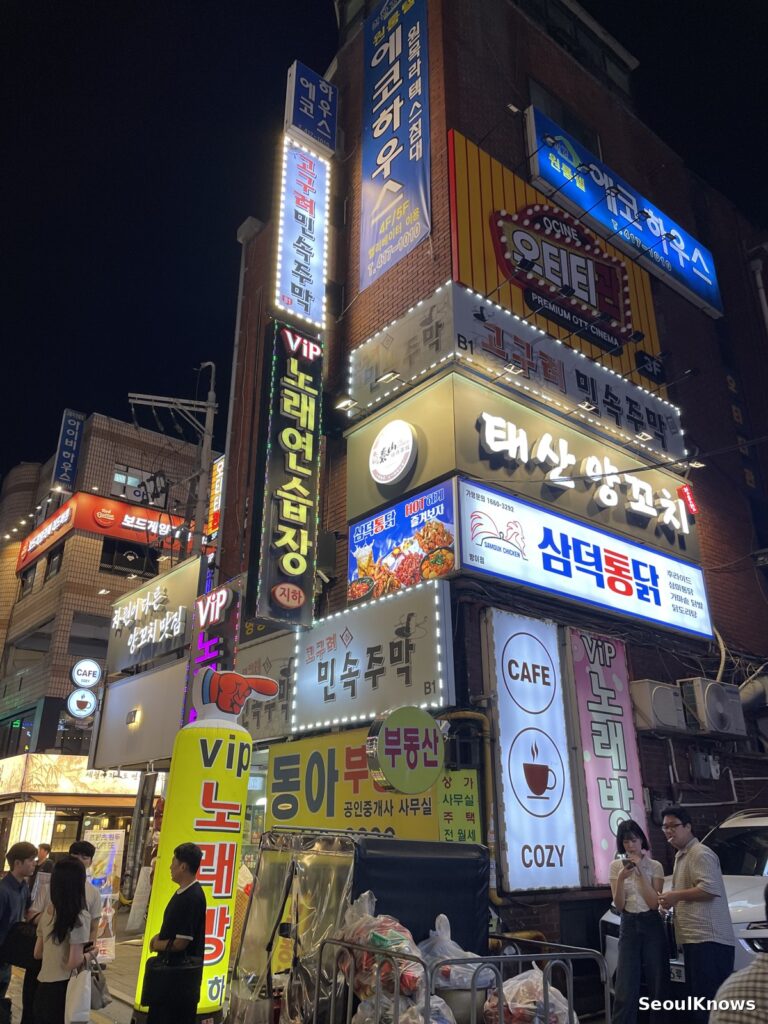
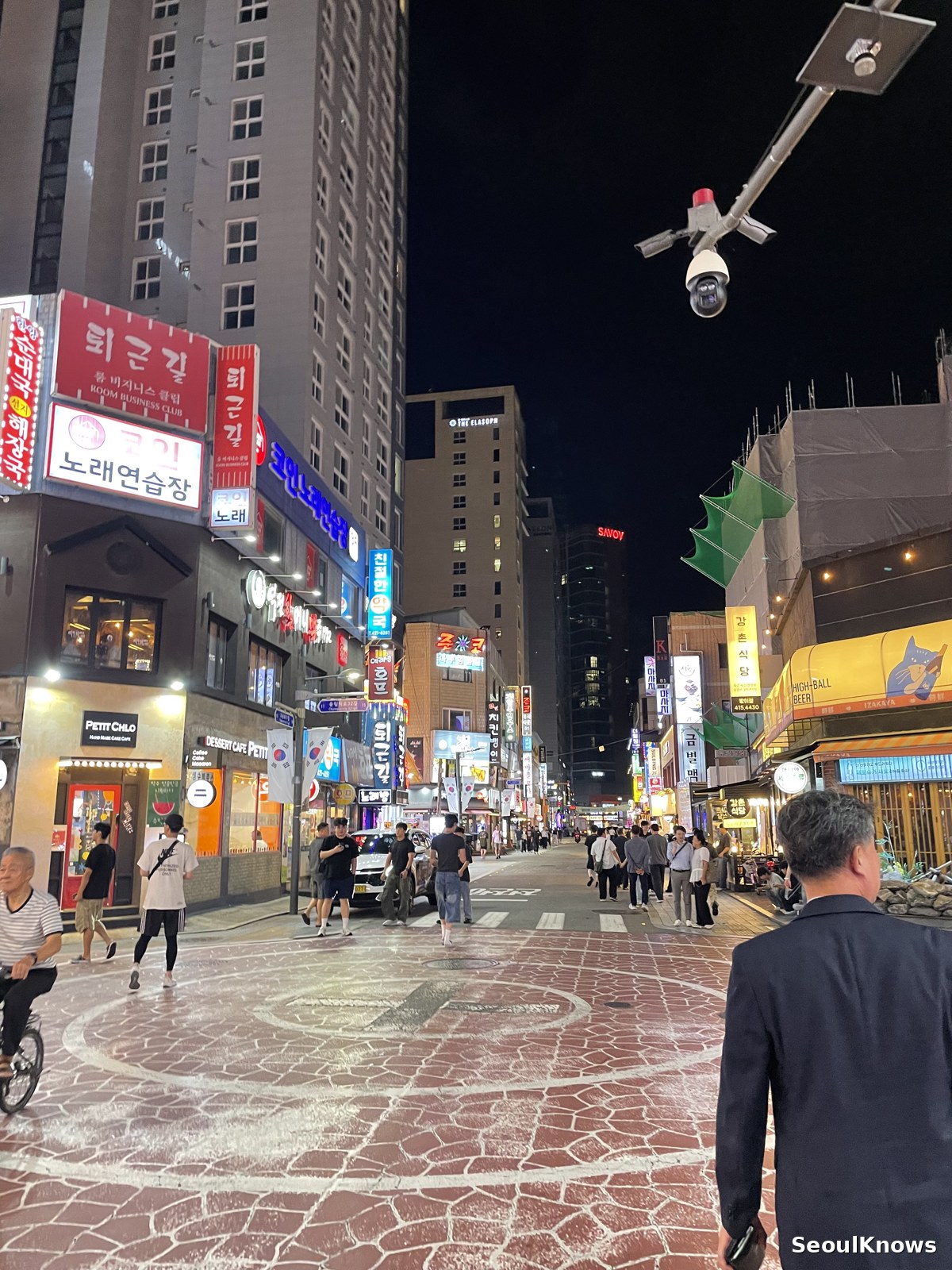
Every Korean city has them: a few blocks where the ground floor is all grilled meat and the buildings are wearing their signs like scales, lit up from six in the evening until the early hours. Hongdae has one, Gangnam has several, and so does the neighbourhood next to wherever you’re staying. If you’ve walked through one and wondered what’s actually happening in those stacked-up rooms, this is the explainer. What the buildings contain, how a Korean night out is structured, and what the motels at the end of the street are for.
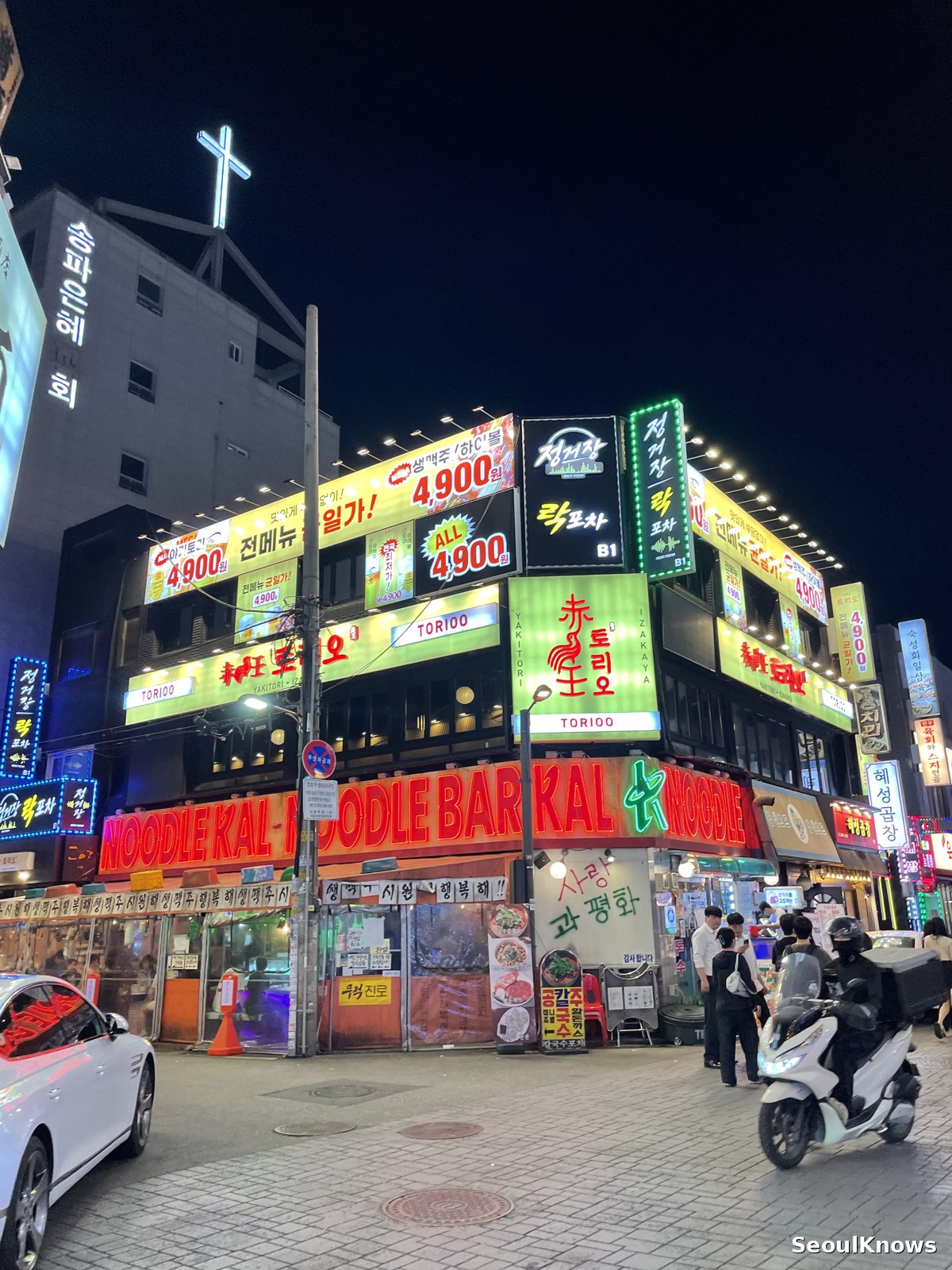
The basic unit: 1-cha, 2-cha, 3-cha
Start here, because everything else follows from it. A Korean night out does not happen in one place. The group moves, and each stop has a number: cha (차), meaning “round.”
- 1-cha (일차) is dinner and the first drinks, almost always a meat restaurant where you grill at the table. Food and alcohol together, never one without the other.
- 2-cha (이차) is a change of venue: an izakaya, a chicken-and-beer place, a pub. Lighter food, more talking.
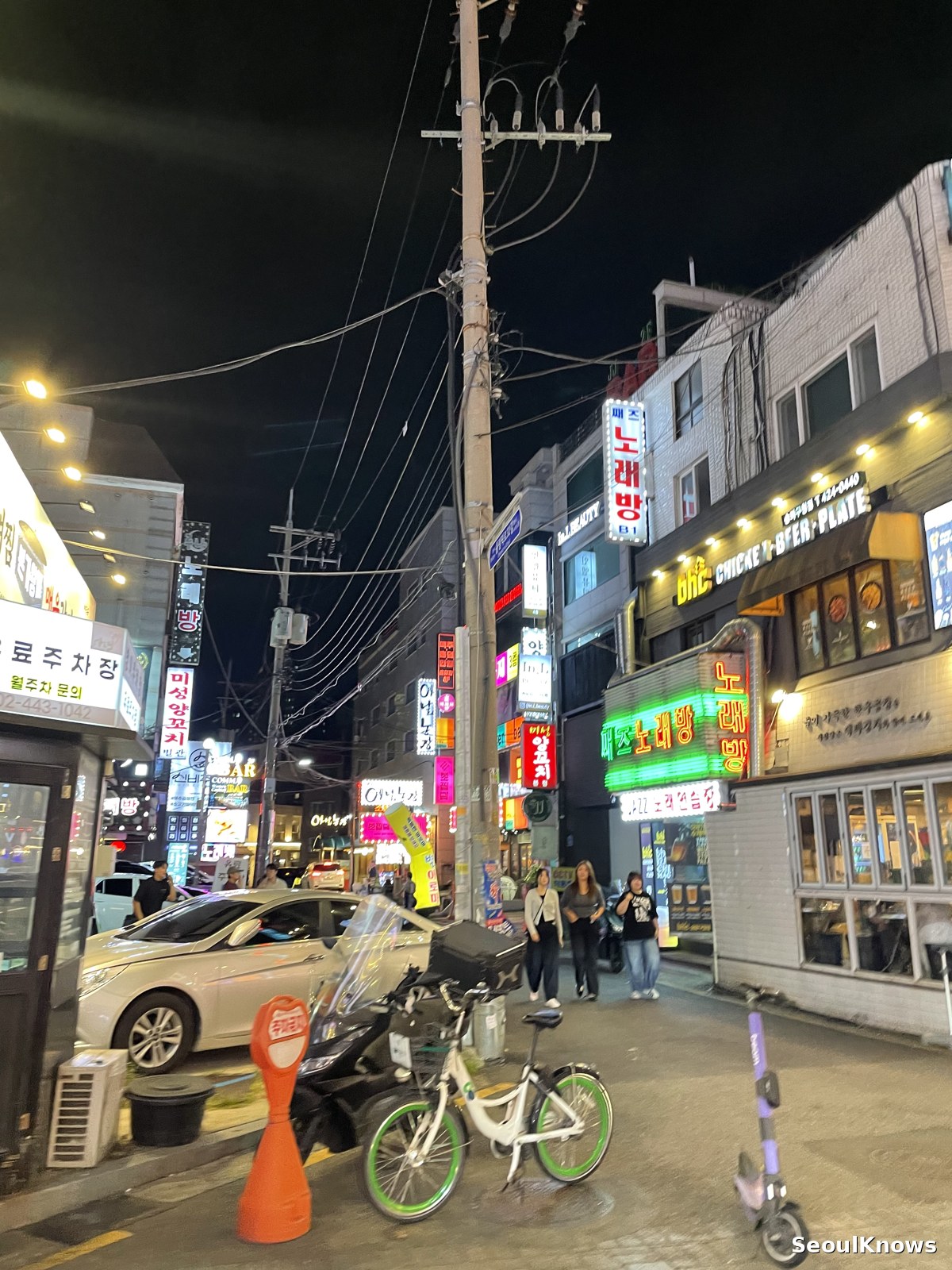
- 3-cha (삼차) is usually noraebang, the karaoke rooms. This is where the night ends, or doesn’t.
Once you know this, the street makes sense. A drinking district isn’t designed for one meal; it’s designed so a group of six can move three times within two blocks without anyone having to decide much. If you’re invited out by Korean colleagues and someone says “2-cha?”, they’re asking whether the night continues. Leaving after 1-cha is completely acceptable, and increasingly normal.
Why the signs are stacked vertically
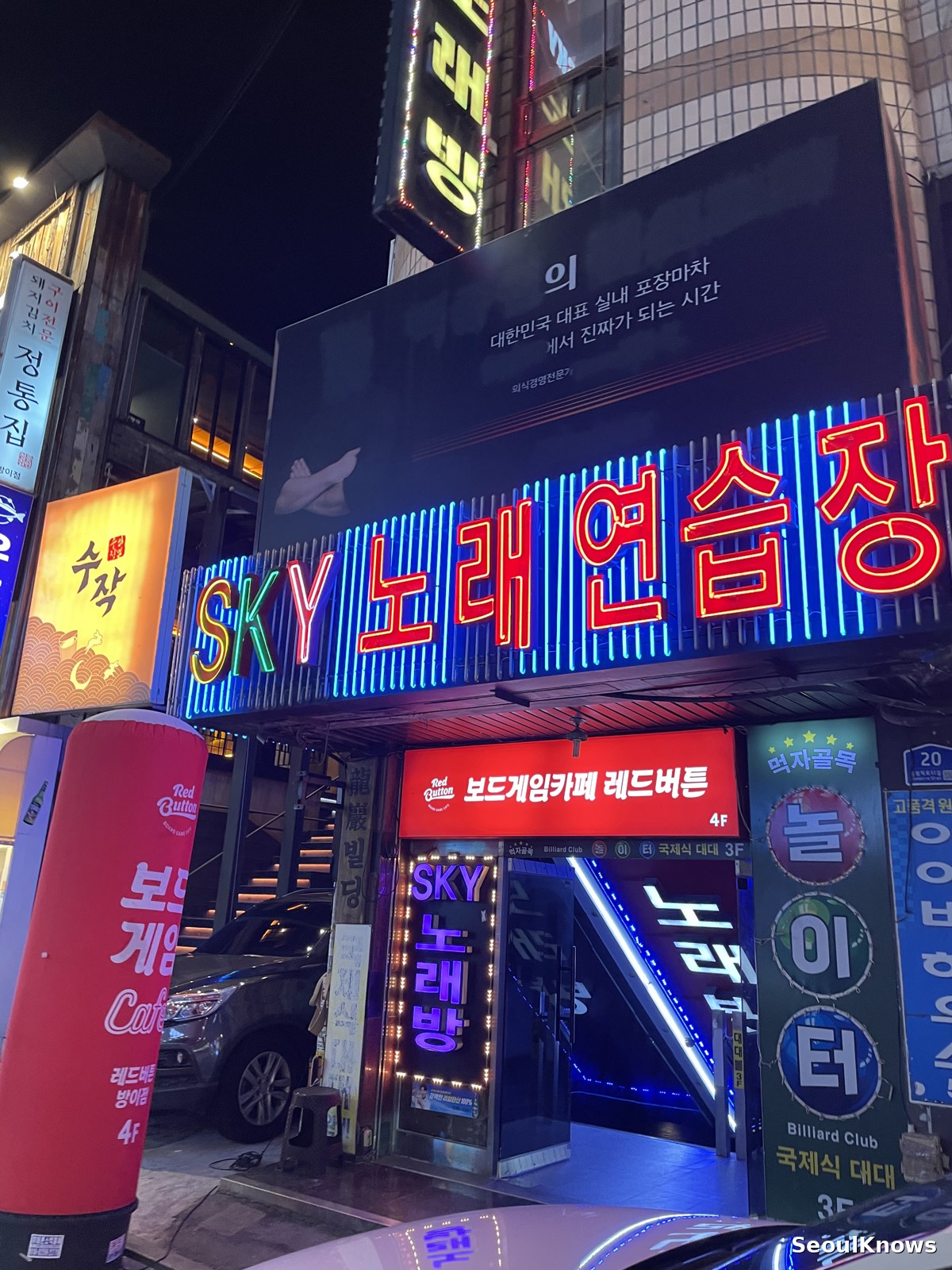
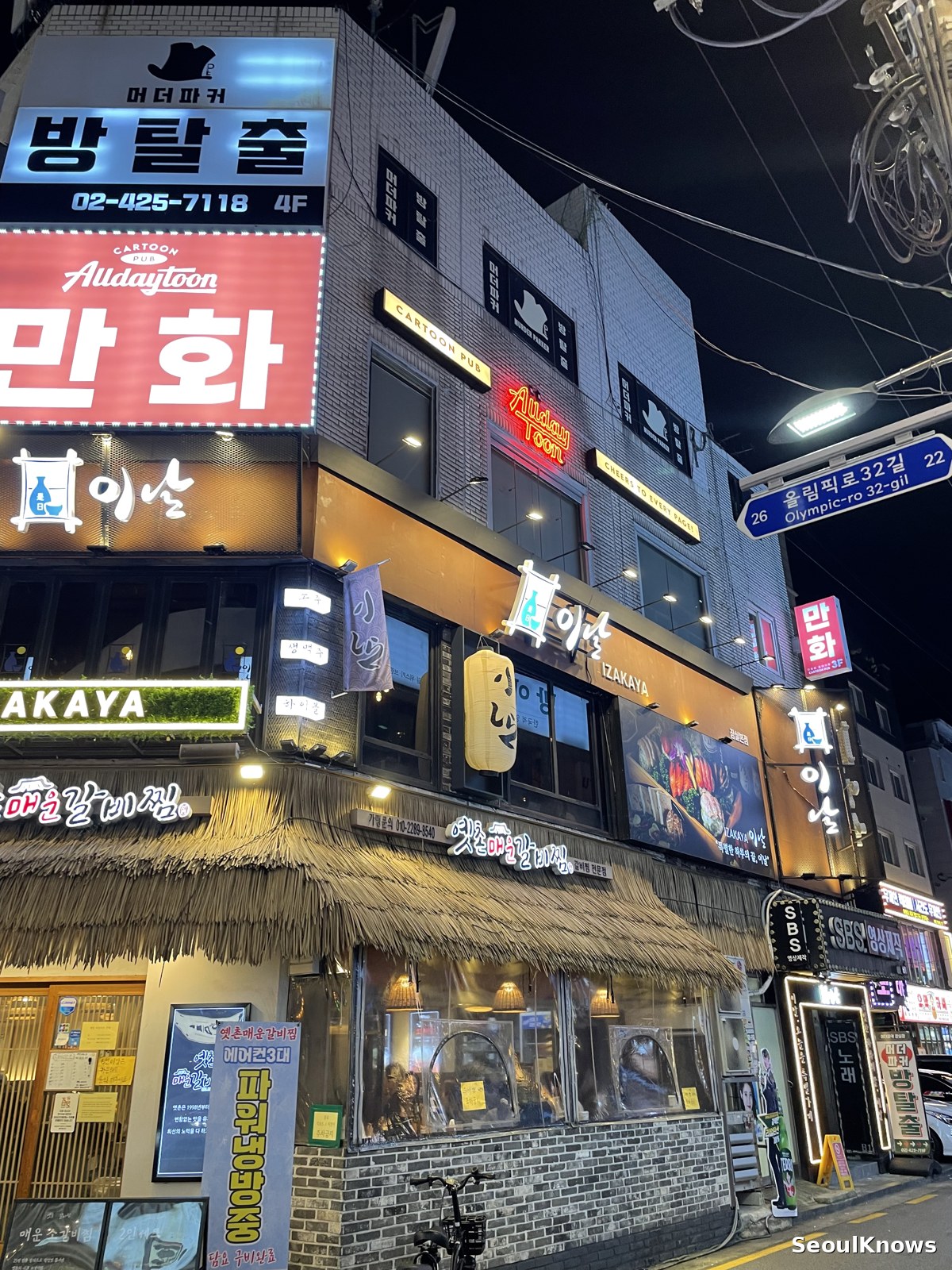
The visual signature of these streets is a building whose entire facade is signage. There’s a practical reason: land is expensive and businesses go up rather than out. A single narrow building might hold a pork restaurant on the ground floor, an izakaya on the second, a billiards hall on the third, a noraebang on the fourth and a study café on the fifth. Each rents its slice of the facade.
The useful takeaway for a visitor: most of the district is invisible from the pavement. If the place you wanted is full, the answer is usually upstairs, not down the street. Read the signs vertically and take the lift.
What’s actually in the buildings
- Gogi-jip (고기집), grilled meat. The default 1-cha. Pork belly (samgyeopsal) is the everyday choice; beef is the expensive one. A grill sits in the middle of the table and either you cook or a staff member does it for you, which they often will without being asked.
- Yangkkochi (양꼬치), lamb skewers. Chinese-Korean restaurants, usually with red signage. The skewers rotate on a small automatic grill in front of you; you dust them with cumin and chilli from the pots on the table. Traditionally paired with baijiu, a strong sorghum liquor.
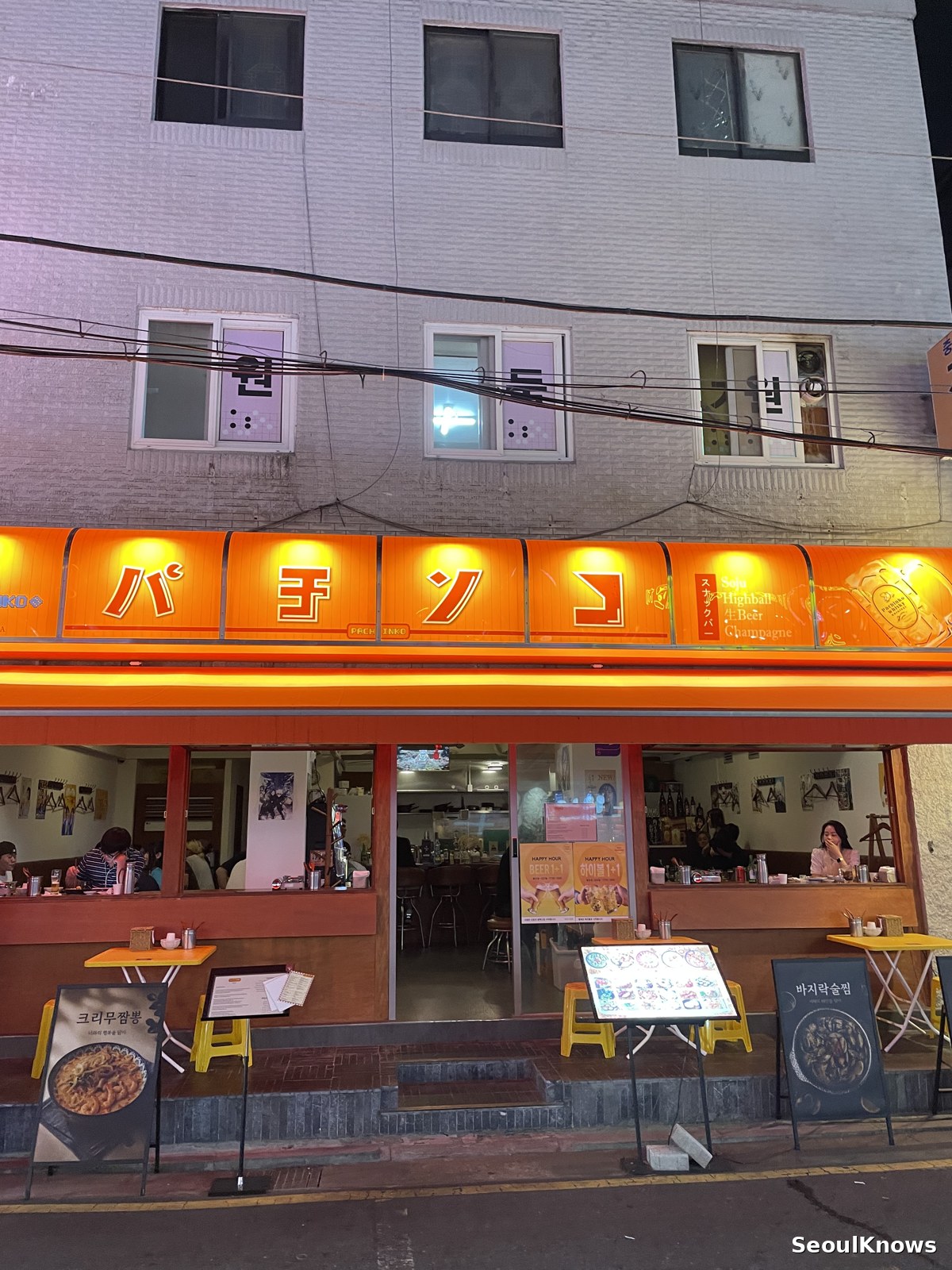
- Izakaya. Japanese-style pubs, darker and quieter. The standard 2-cha when people want to talk rather than shout.
- Chimaek (치맥), fried chicken and beer. The other standard 2-cha, and a national institution in its own right.
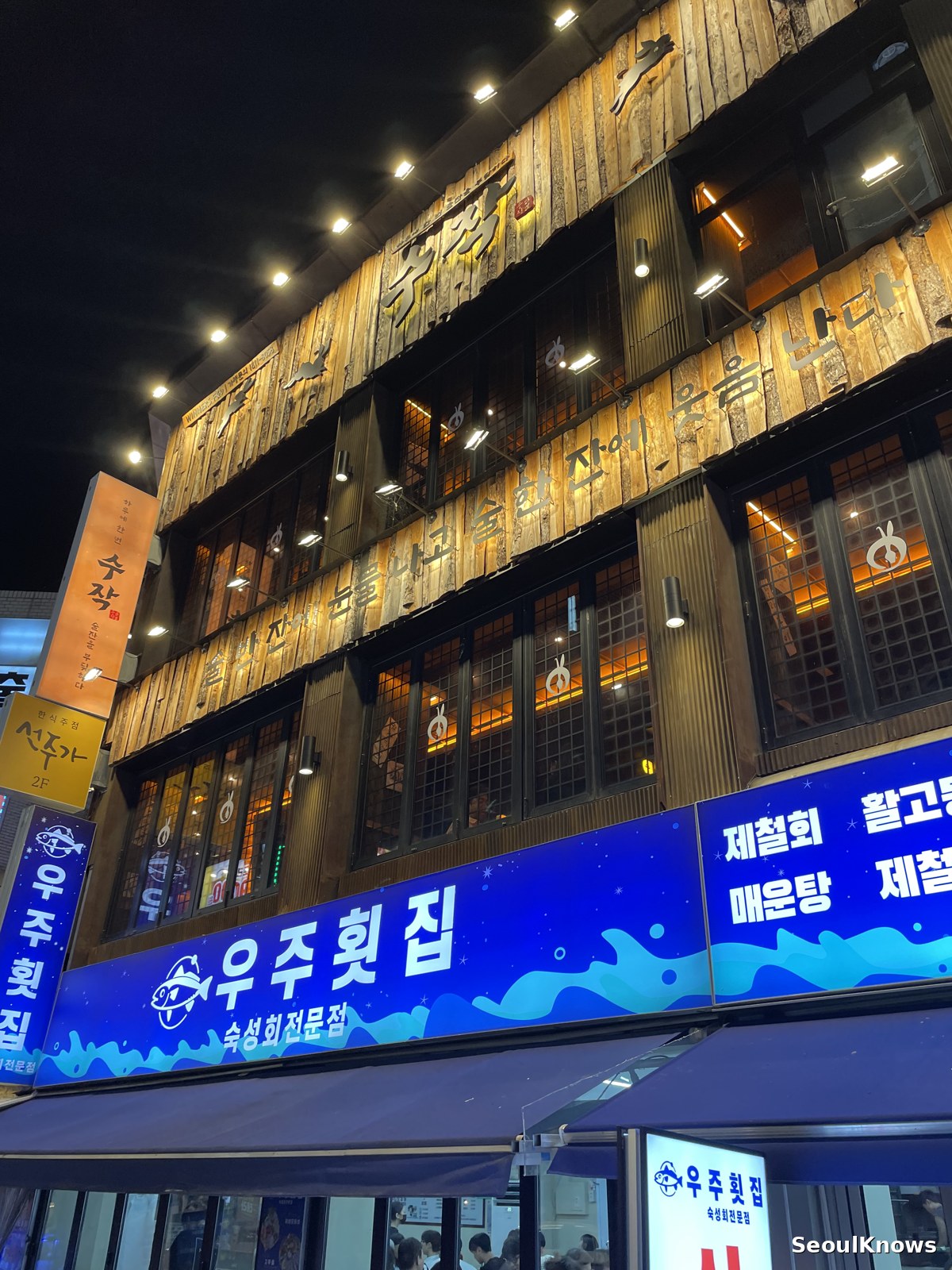
- Hoetjip (횟집), raw fish. Often with tanks in the window. Ordered as a large shared platter rather than by the piece.
- Pojangmacha (포장마차), the orange-tented street stalls, now less common but still around, serving snacks and soju outdoors.
- Noraebang, billiards halls, PC bangs, manhwa (comic) cafés, and 24-hour haejangguk (hangover soup) restaurants for the end of the night.
Noraebang is not a karaoke bar
This trips people up. In Korea you don’t sing to strangers. You rent a private room by the hour for your own group: two microphones, tambourines, a screen, a thick book of song numbers, and a door that closes. Nobody outside hears you.
Rates rise later at night, and rather than discount, most places quietly add “service” time to your booking. There are also coin noraebang, where you pay roughly 500 to 1,000 won a song at a machine, and going alone to one is completely ordinary. English-language songs are well stocked in both.
Ordering, paying, and the small rules
- Water, side dishes and the basic table setting are free, and refills usually are too. You can ask for more kimchi without it appearing on the bill.
- There is no tipping. None, anywhere. The menu price is the price, and leaving money on the table causes confusion rather than pleasure.
- Meat is normally sold from two portions up. A solo diner may be quietly turned away at a grill house; this isn’t rudeness, the equipment assumes a group.
- Call the staff. Press the bell on the table or say “jeogiyo” (저기요). Sitting politely with a raised hand can leave you waiting a long time.
- Pouring. Don’t fill your own glass; fill your neighbour’s and they’ll fill yours. Use two hands when pouring for someone older, and turn your head slightly away when you drink in front of them. Nobody will hold it against a visitor, but doing it lands well.
- Cards work everywhere, including small places. Cash is rarely needed.
The motels at the end of the street
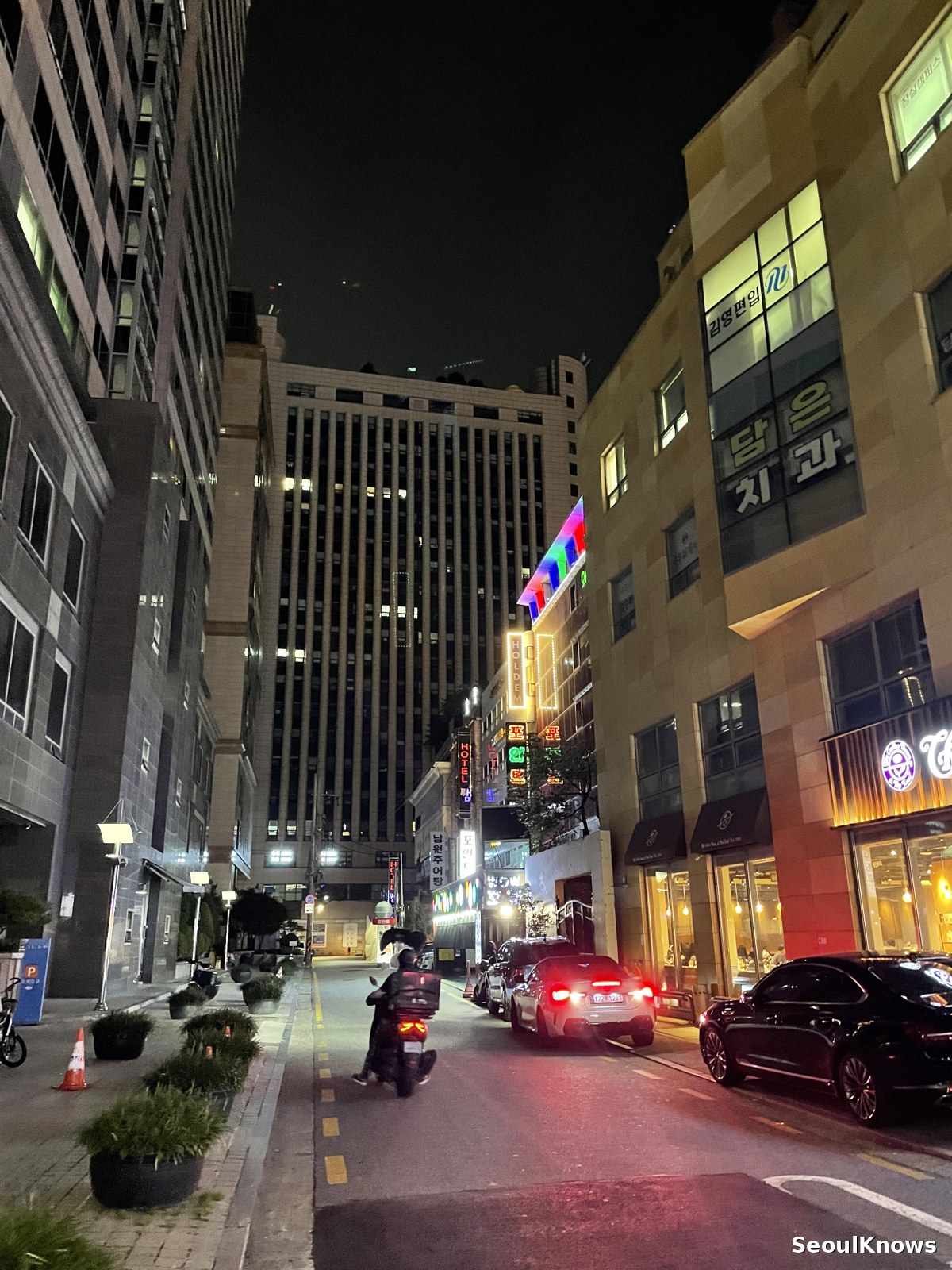
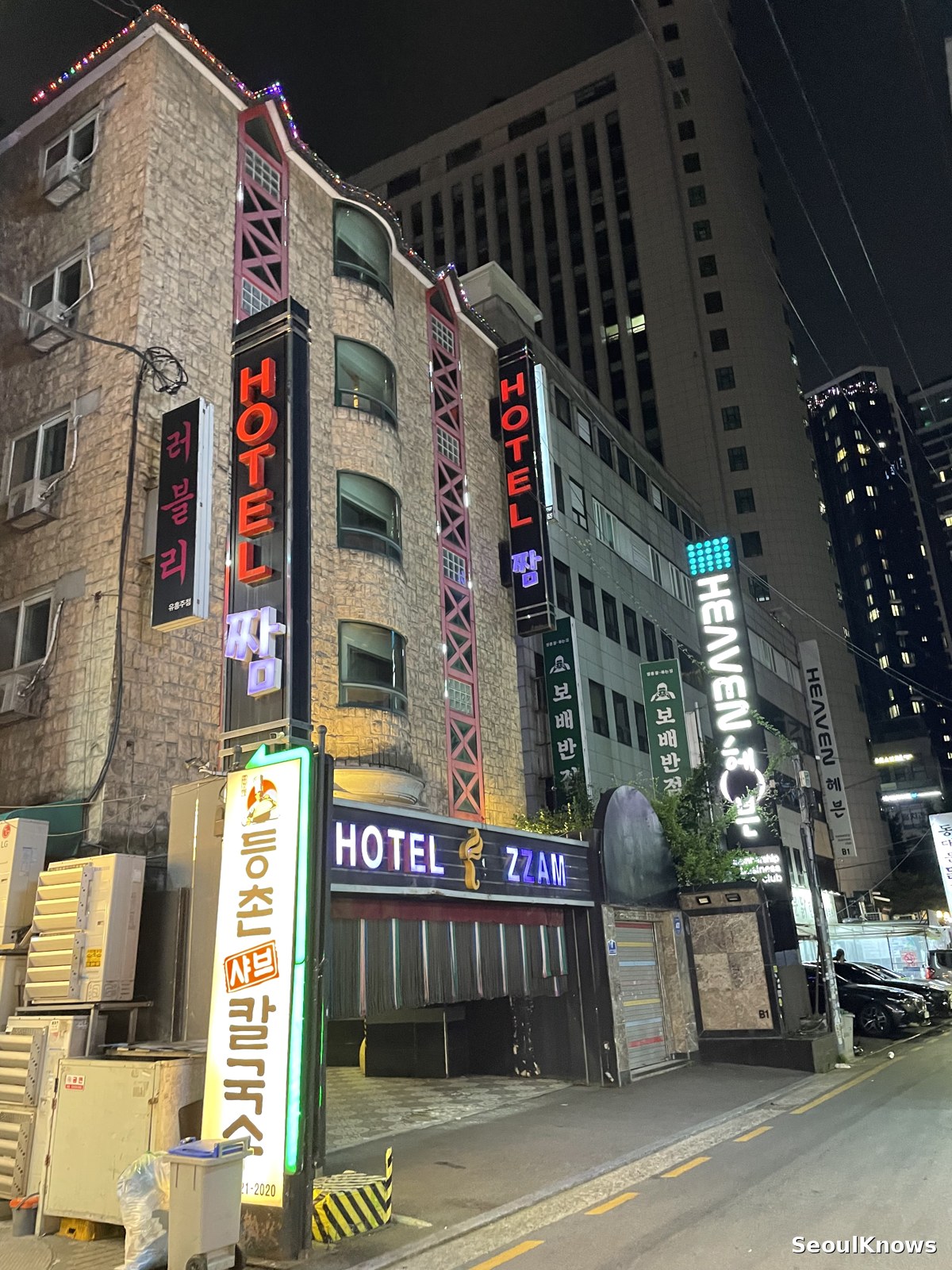
Walk far enough into any of these districts and the signage changes. Restaurants thin out and you start seeing buildings marked only HOTEL or MOTEL, often with a curtain or screen across the car park entrance. This cluster is a standard feature of Korean nightlife geography, and the reason is logistical rather than lurid: the subway stops running around midnight, taxi fares jump afterwards, and a lot of people live an hour away.
What a Korean motel actually is
A small independent hotel, usually a narrow building of several floors, priced well under a business hotel. Yes, many are what English speakers would call love hotels, and discretion is built in: a screened entrance, a kiosk or a small frosted window instead of a reception desk, no questions asked. But the clientele is broad. Workers who missed the last train, drivers resting, students on a trip, friends who want somewhere cheap after a night out.
What you get is often better than the exterior suggests. Rooms tend to be well equipped: a large TV, a computer, a strong shower or a tub, free bottled drinks, toiletries set out, sometimes a games console. Newer properties brand themselves as “hotels” and are genuinely comfortable; older ones vary a lot. Expect roughly 50,000 to 90,000 won a night, more at weekends and in central districts. Asking to see the room before you pay is normal and not considered rude.
Daesil: renting a room for a few hours
The concept with no clean Western equivalent is daesil (대실), a short stay of usually three to five hours at around half the overnight rate. On signs and kiosks you’ll see it printed next to sukbak (숙박), which means an overnight stay. Two prices, two products.
Couples use it, which is the association most people have. So do shift workers sleeping between rotations, long-distance drivers, and people with four hours to kill before a night bus. In practice you walk in, say “daesil” or select it on the kiosk, pay up front and take a key. No reservation, usually no ID, and while older places preferred cash, cards and booking apps like Yanolja and Goodchoice are now standard. It isn’t scandalous; it’s infrastructure, and it’s more useful to understand than to avoid.
Practical things worth knowing
- Safety. These districts are busy, brightly lit and full of office workers, and Korea is a very safe country late at night. Ordinary city awareness is enough.
- Timing. Life starts around 19:00. Thursday to Saturday are the busy nights, and the street stays awake well past midnight.
- Last train. Around midnight in Seoul, earlier in some cities. Plan for a taxi, a night bus, or a room.
- Language. Photo menus are common and translation apps handle the rest. Reservations are rarely needed for two or three people; groups of six or more should book.
- Getting a taxi late. Friday nights are hard. The Kakao T app helps, but expect a wait and a late-night surcharge.
Where to see one
Every district has a different personality, so pick by the crowd you want to be in:
- Hongdae for students, live music and clubs; the youngest and loudest.
- Gangnam and Yeoksam for after-work crowds, bigger budgets and glossier interiors.
- Jongno 3-ga for old-school Seoul: grilled offal, outdoor tables, and drinkers of every age.
- Konkuk University (Konkuk-dae) for the classic student-plus-office mix, and the Yangkkochi Street beside it.
- Bangi-dong in Jamsil for a local, unpolished district that tourists rarely reach, with Seokchon Lake next door for the walk before or after.
Frequently asked questions
What does 1-cha, 2-cha, 3-cha mean?
They’re the rounds of a night out: dinner with drinks, then a second venue, then usually noraebang. The group moves between them. Leaving after 1-cha is fine.
What is a noraebang?
A private karaoke room rented by the hour for your own group, not a stage in a public bar. Coin noraebang charge per song and are normal to visit alone.
Do I tip in Korea?
No. There is no tipping culture in restaurants, bars, taxis or hotels. The listed price is what you pay.
Can I eat at a Korean barbecue restaurant alone?
Sometimes, but many grill houses have a two-portion minimum and are built for groups. Solo diners do better at noodle shops, gimbap places or chain restaurants.
What is daesil (대실)?
A short motel stay of about three to five hours at roughly half the overnight price, listed alongside sukbak (overnight). Used for privacy, but also for naps, resting between shifts and waiting out a few hours.
Are Korean motels safe to stay in?
Generally yes, and they’re far cheaper than hotels. Standards vary by building, so it’s accepted practice to ask to see the room first. Newer ones branded as “hotels” are the safer bet.
Are these areas safe at night?
Yes. They’re crowded, well lit and heavily policed by sheer foot traffic. Normal city sense is all that’s required.
How late does everything run?
Restaurants until roughly midnight, bars and noraebang far later, some 24 hours. The subway is the limiting factor, stopping around midnight.
The short version: read the buildings vertically, expect to move at least twice, don’t tip, don’t pour your own drink, and know that the motels on the corner exist because the trains stop. Once those five things are in place, a Korean drinking street stops looking like chaos and starts looking like a very well-organised evening.
Written by WY, a Seoul-based local sharing honest, first-hand guides to Korea. Every guide starts with a real visit — I went, I paid attention, and I wrote down what I found. More about me →