
If you are raising a small child in Seoul, you already know the arithmetic of a rainy Saturday. A private kids cafe runs roughly ₩15,000–25,000 for two hours, and you still buy the coffee. What most foreign parents never find out is that Seoul runs a network of public indoor playgrounds where the same two hours cost ₩1,000–2,000 per person, the equipment is newer than most private cafes, and the staff include licensed childcare teachers.
They are almost invisible in English. The listings, the rules and the booking pages are Korean-only, and the two separate systems that run them are easy to confuse even for Koreans. This guide explains how the whole thing works, then walks through one playground in detail — Dogok Children’s Indoor Playground in Gangnam — so you can see exactly what you are signing up for before you try to book.
There are two systems, not one
This is the single most useful thing to understand, and it is the reason people give up halfway. Seoul’s public indoor play spaces come from two different levels of government, and they are booked on two different websites.
1. Seoul-type Kids Cafe (서울형 키즈카페) — a Seoul Metropolitan Government programme. Standardised, city-wide, booked on one central portal.
2. District-run indoor playgrounds (자치구 어릭이 실내놀이터) — built and run by your individual district office (gu). Each district sets its own hours, fees and booking window, and you book on that district’s own website.
Dogok, the example in this guide, is the second kind. If you searched only the city portal you would never find it. Conversely, if you only know your district’s playgrounds, you are missing more than two hundred city-run venues.
System 1: Seoul-type Kids Cafe
Seoul started this programme in May 2022 with a single branch in Hyehwa-dong, Jongno. As of 2026 the city reports 216 branches, with a plan to reach 404 by 2027. More than 1.45 million visits have been logged.
What makes it worth seeking out is that the standards are set centrally rather than left to each operator. Seoul’s own service description commits to:
• a minimum of 7㎡ of space per child, so sessions never feel like a scrum
• a licensed childcare teacher on staff, not just a monitor
• a ceiling of ₩5,000 for one child plus a guardian
• opening Tuesday to Sunday, including public holidays
• play equipment replaced on a cycle, and age bands set by the size of the room
In practice the facility pages on the city portal list ₩2,000 per child for an individual booking, with accompanying adults free. Charging only began in January 2024; before that it was free.
Ages: the branches I checked list ages 0–6 by Korean “year age” — for 2026 that means children born 2020 through 2026. Elementary-school children are not eligible.
Where to book: the Our Neighbourhood Kium Portal, umppa.seoul.go.kr/icare. The site is Korean-only.
When to book — this part trips people up. Since 14 April 2026 the city staggers the booking opening by district group to stop the server melting. Every Tuesday:
• 09:00 — Gangnam, Gangdong, Gangbuk, Gangseo, Gwangjin, Guro
• 11:00 — Gwanak, Geumcheon, Nowon, Dobong, Dongdaemun, Dongjak
• 13:00 — Mapo, Seodaemun, Seocho, Seongdong, Seongbuk, Songpa
• 15:00 — Yangcheon, Yeongdeungpo, Yongsan, Eunpyeong, Jongno, Jung, Jungnang
The group is decided by where the kids cafe is, not where you live. From 15:00 all groups are open to everyone.
No-show penalty: harsher than you would expect. Miss a booking without calling and you are locked out of every Seoul-type Kids Cafe for 30 days. You can cancel online up to 30 minutes before your slot, and if you phone the branch within 30 minutes of the start time it is not counted as a no-show.
There is also a seasonal outdoor spin-off, Yeogijeogi Seoul-type Kids Cafe — 30 pop-up sites at Jamwon, Yeouido and Ttukseom Han River parks, Seoul Botanic Park and elsewhere, running weekends in April–June and September–November. Same portal, same account.
System 2: your district’s own playground
Separately, most districts build their own indoor playgrounds inside libraries, community centres and welfare buildings. Gangnam runs three — Dogok, Segok and Ilwon — all booked through the Gangnam-gu website under Communication & Participation → Reservation.
These tend to be cheaper than the city ones, more physical, and much harder to book, because a single district office is serving a whole district from two or three rooms. Rules vary by district: fees, age limits, how far ahead the booking window opens. There is no central list — you have to check your own district office’s site.
The honest part: booking these in Korean
I am not going to pretend this is frictionless. Every one of these systems is Korean-only, and both require an account with Korean identity verification before you can reserve anything.
What actually helps:
Mobile phone verification usually works with an ARC. If your Korean phone line is registered in your own name, carrier identity verification is generally open to foreign residents — KT states explicitly that foreigners eligible for mobile identity verification can use its PASS service. SKT and LG U+ only state that the line must be in your own name. If your phone is on a company plan or a friend’s name, this is where you will get stuck.
Dial 120 for English. The Seoul Dasan 120 call centre runs a foreign-language service covering the city and all 25 districts — English, Chinese, Japanese, Vietnamese and Mongolian, weekdays 09:00–18:00. From a Seoul number dial 02-120, then 9, then 1 for English (from abroad, +82-2-731-2120). They handle district administration questions, so they are a reasonable first call when a booking page defeats you.
Do not expect an English version of the district site. Gangnam-gu’s only English link points to its tourism portal, not a translation of the civil-service site. Browser translation on the reservation pages works well enough — the calendars are mostly numbers.
Call the playground directly. In my experience the staff at these places are used to fielding questions and will tell you plainly whether a slot is open. Dogok’s number is 02-2176-0591.
A worked example: Dogok Children’s Indoor Playground
I took my 36-month-old here on a weekday afternoon. He has unusually developed gross motor skills and more energy than any single apartment can absorb, and finding somewhere to genuinely tire him out had become a weekend project. This is a district-run playground, so everything below is Gangnam’s rules rather than the city’s.
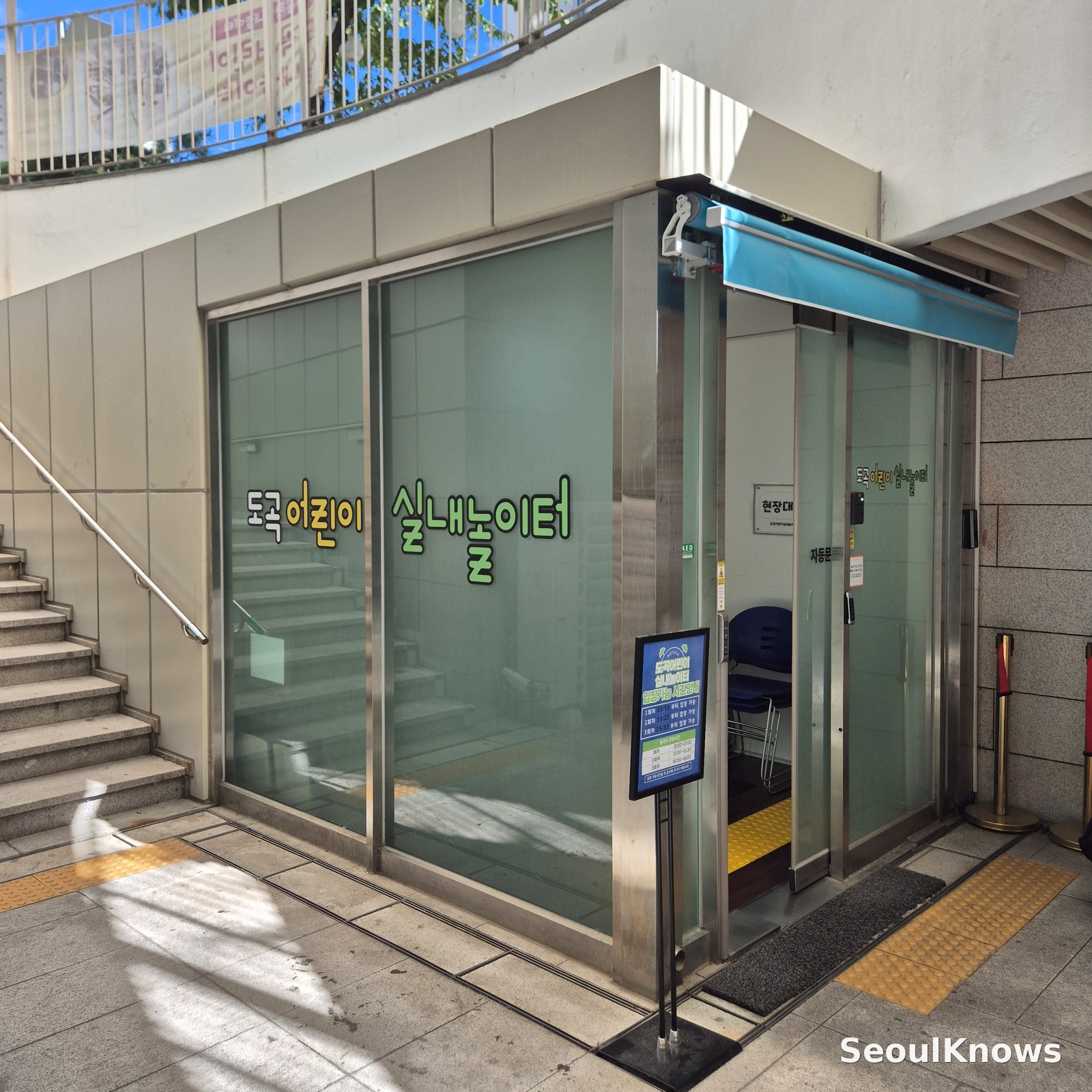
It sits in the basement of Dogok Information & Culture Library, at 57 Dogok-ro 18-gil, Gangnam-gu — the same building as the Dogok 1-dong community centre. The nearest station is Maebong (Line 3). Sessions run 10:00, 13:30 and 16:00, two hours each. Closed Mondays and public holidays, except Children’s Day.
What it actually costs (the number online is wrong)
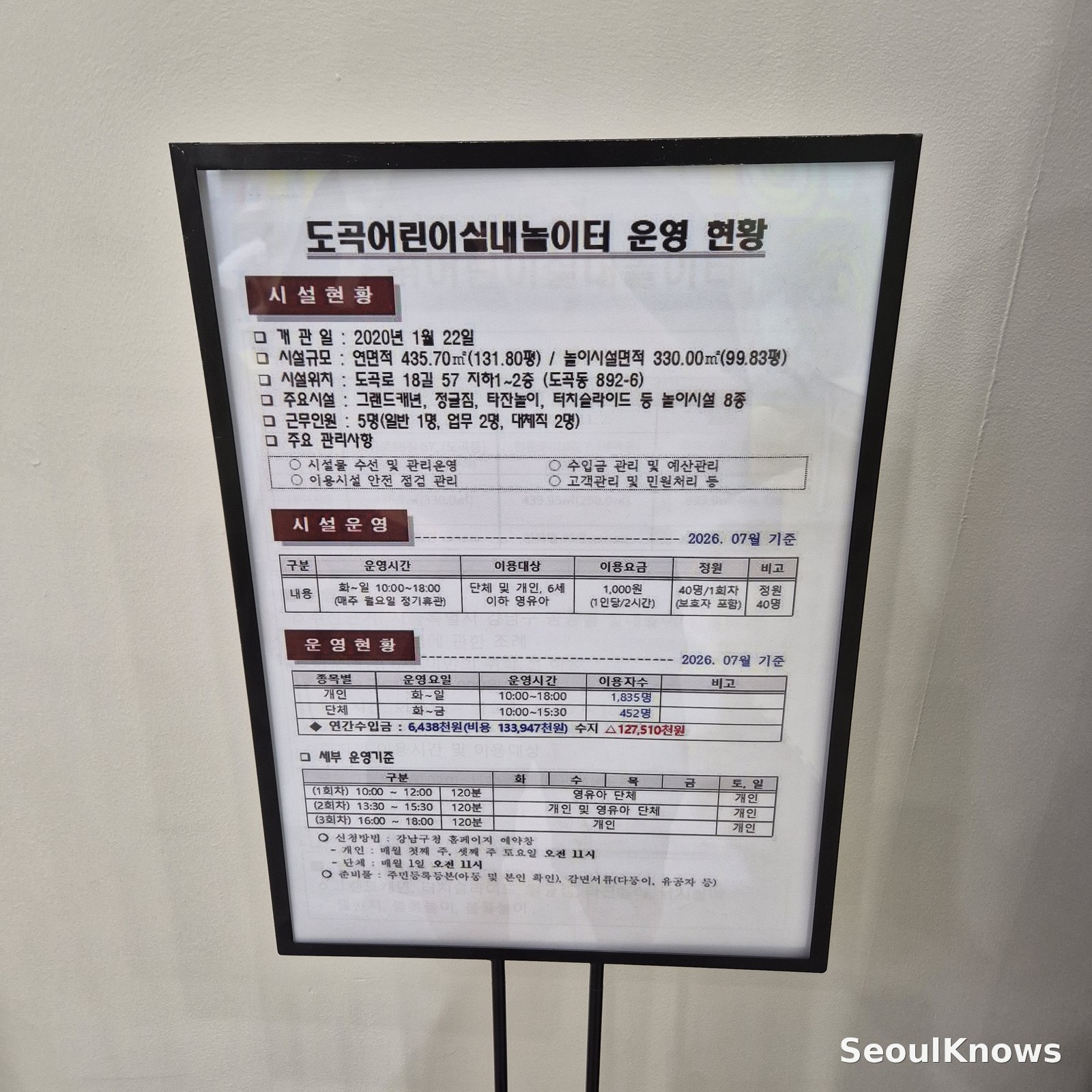
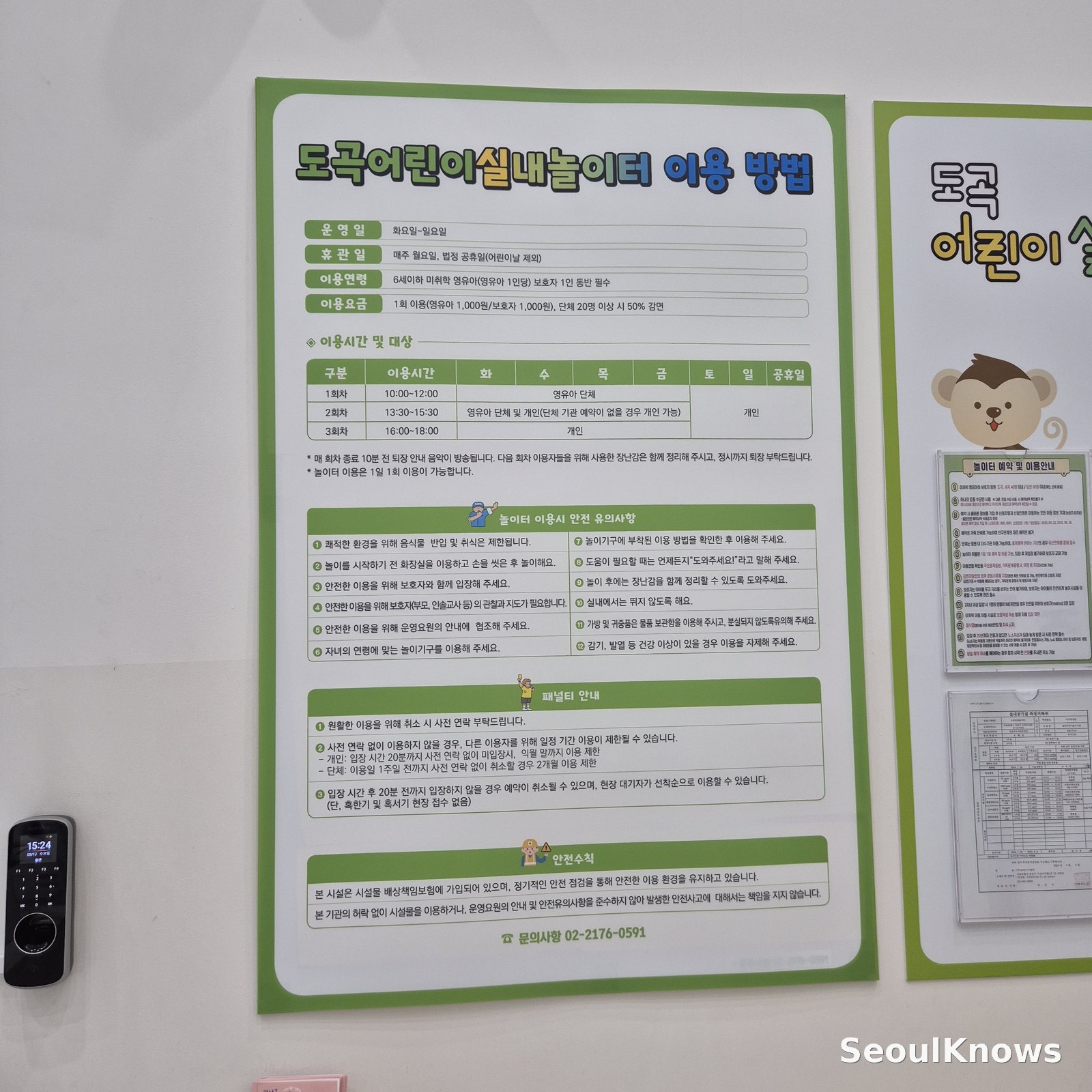
Search in Korean and you will mostly see “₩1,000 per session.” That is only half the fee. The notice board on site reads: ₩1,000 per infant, ₩1,000 per guardian.
In other words you pay ₩1,000 for each person who walks in. One child plus one adult is ₩2,000. Two children plus two adults is ₩4,000. Groups of 20 or more get 50% off. Card only — no cash, no Apple Pay.
Even at the corrected price this is remarkable value for two hours. But turning up with a ₩1,000 note in your pocket makes for an awkward moment at the desk.
Weekday sessions are reserved for groups
The board also explains something the search results never do: who a session is for depends on the day.
Tuesday to Friday, the 10:00 session is for daycare and kindergarten groups only — individuals cannot book it at all. The 13:30 session gives priority to groups and opens to individuals only if no group has booked that day. The 16:00 session is open to individuals on weekdays. On Saturdays, Sundays and public holidays all three sessions are for individuals.
I went on a weekday 13:30 and got in only because no group had claimed it. Checking the live booking calendar bears this out: weekday 10:00 slots simply never appear, and 13:30 appears on some days and not others. If you need certainty on a weekday, take 16:00.
Booking: 1st and 3rd Saturday, 11:00
Individual bookings open on the Gangnam-gu site on the first and third Saturday of each month at 11:00. Gangnam staggers its three playgrounds across different times, so 11:00 is Dogok’s.
Capacity is 40 per session including guardians, which works out to 20 children on the individual booking calendar. Rules worth knowing before you fill the form in:
• One booking per family; you cannot book on someone else’s behalf
• The headcount field is children — enter every child’s name; the guardian count is a separate field below
• One guardian must accompany each child — this is mandatory, not optional
• One session per day
• Preschool children only; children born in 2019 are no longer eligible
• Bring a resident registration extract to verify the child’s age, and socks for everyone, adults included
Parking is the real obstacle
Other reviews say parking was easy. On my visit the lot was completely full. I circled it, gave up, parked to one side and waited until a car finally left.
The reason is structural: there is no dedicated playground car park. You share the library’s lot with library users and people visiting the community centre, so it fills independently of the playground schedule.
This matters more than an ordinary parking gripe, because of the penalty below: if you are more than 20 minutes late, your booking can be cancelled. Losing a slot to a parking queue would be a genuinely bad afternoon. Come 20–30 minutes early, or take the subway.
No-show penalty, and the standby door it opens
The penalty notice on site is blunt. Fail to show without calling and you are restricted until the end of the following month. The Gangnam-gu booking page puts it even more strongly: in the event of a no-show, all of your existing reservations are cancelled through the end of the next month. If you cannot make it, phone.
The flip side is genuinely useful, and it is the part almost nobody writes about in English. Two official sources say you can turn up without a booking and wait:
Gangnam-gu’s reservation page: “For walk-in registration, you may wait in the waiting area outside the playground. In the event of a no-show or cancellation, entry is possible in order.”
The on-site penalty notice: “If a booking holder has not entered within 20 minutes of the start time, the reservation may be cancelled and people waiting on site may enter on a first-come basis. (Not available during extreme cold or extreme heat periods.)”
So there is a designated waiting area outside the playground — not just hovering in a corridor — and with 20 children booked per session, a spot or two often opens. Two caveats: the cancellation only processes 20 minutes after the session starts, so budget for that wait, and walk-in registration is suspended in midsummer and midwinter. Call 02-2176-0591 first to check whether standby is running that day.
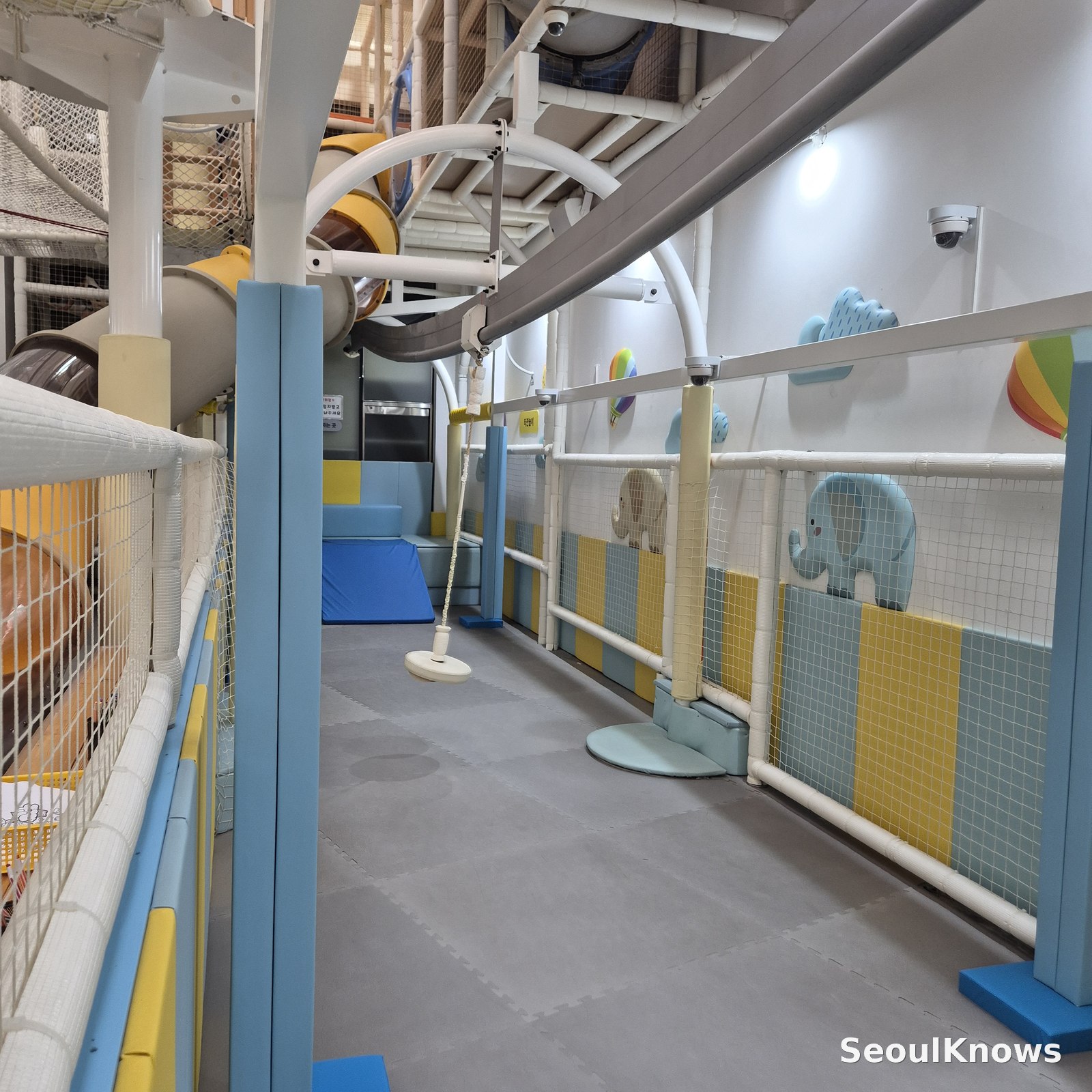
Inside: built for burning energy
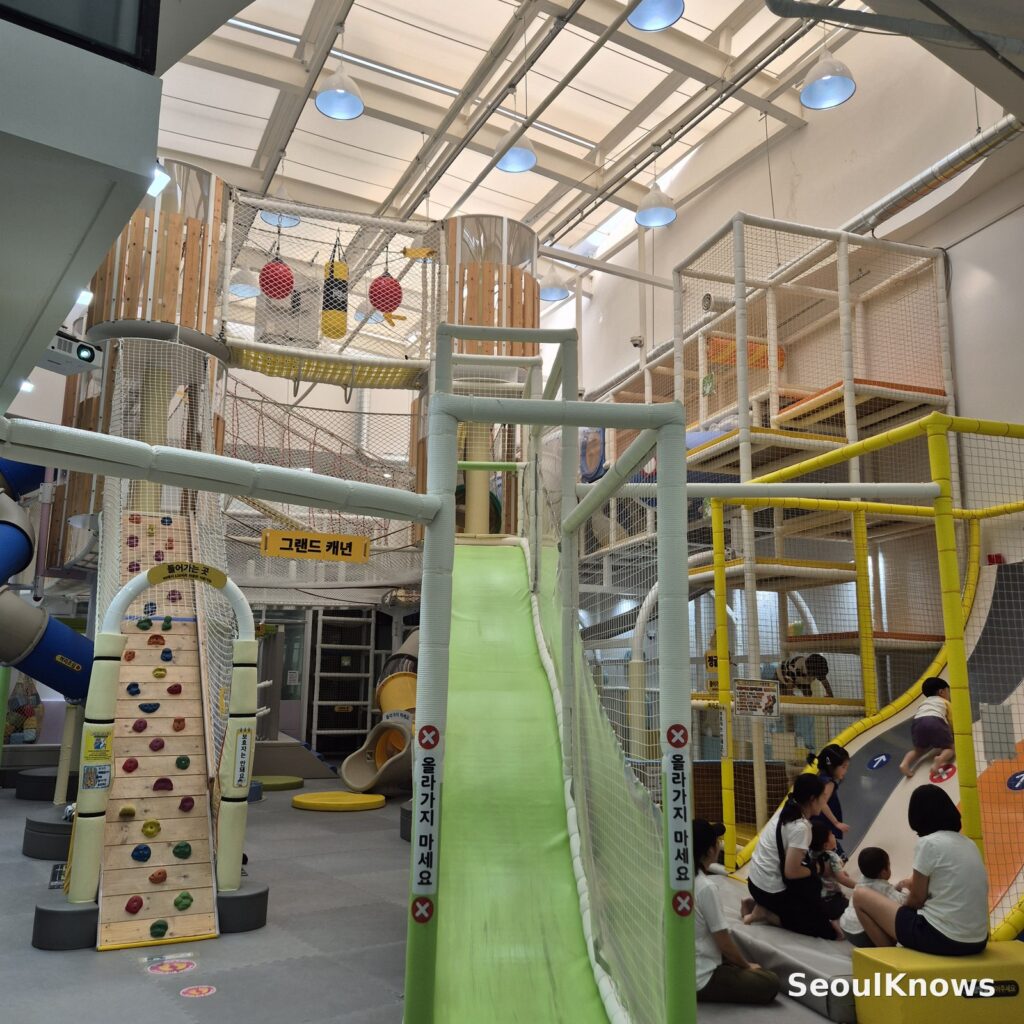
Dogok is a physical playground rather than a soft-play room. Eight installations, most of them climbing-based, and the online consensus is that it suits ages five to seven. I arrived braced for my three-year-old to be too small for everything.
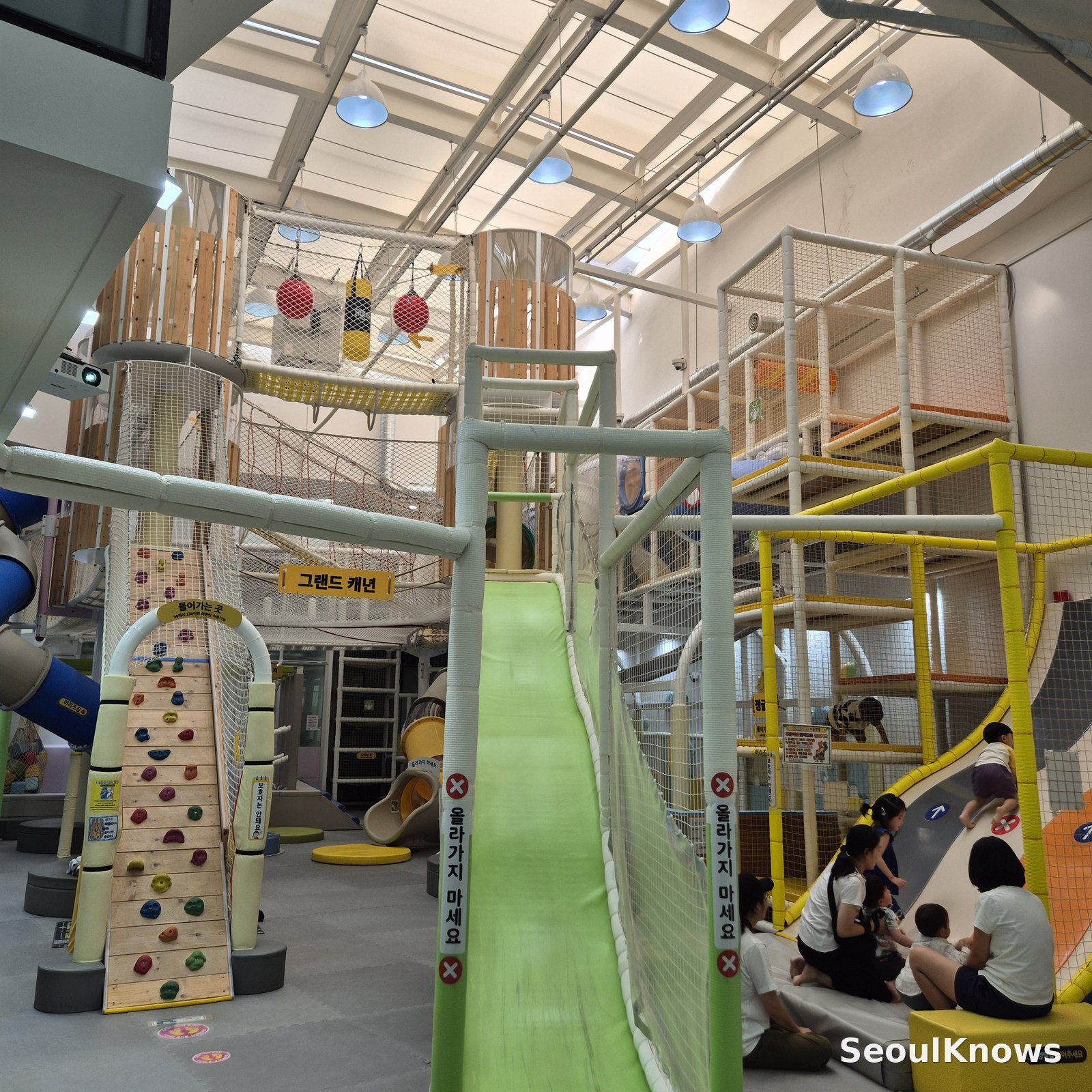
He used all of it. Every single piece. Whatever the recommended age says, a confident 36-month-old with decent gross motor control can climb this place from end to end — and he burned off energy no apartment has ever absorbed. Bedtime that night took about four minutes.
The centrepiece is the Grand Canyon, a rope structure you climb up through, where the only way down is a slide. From a small child’s point of view that is a real expedition, and he repeated it until his legs gave out.
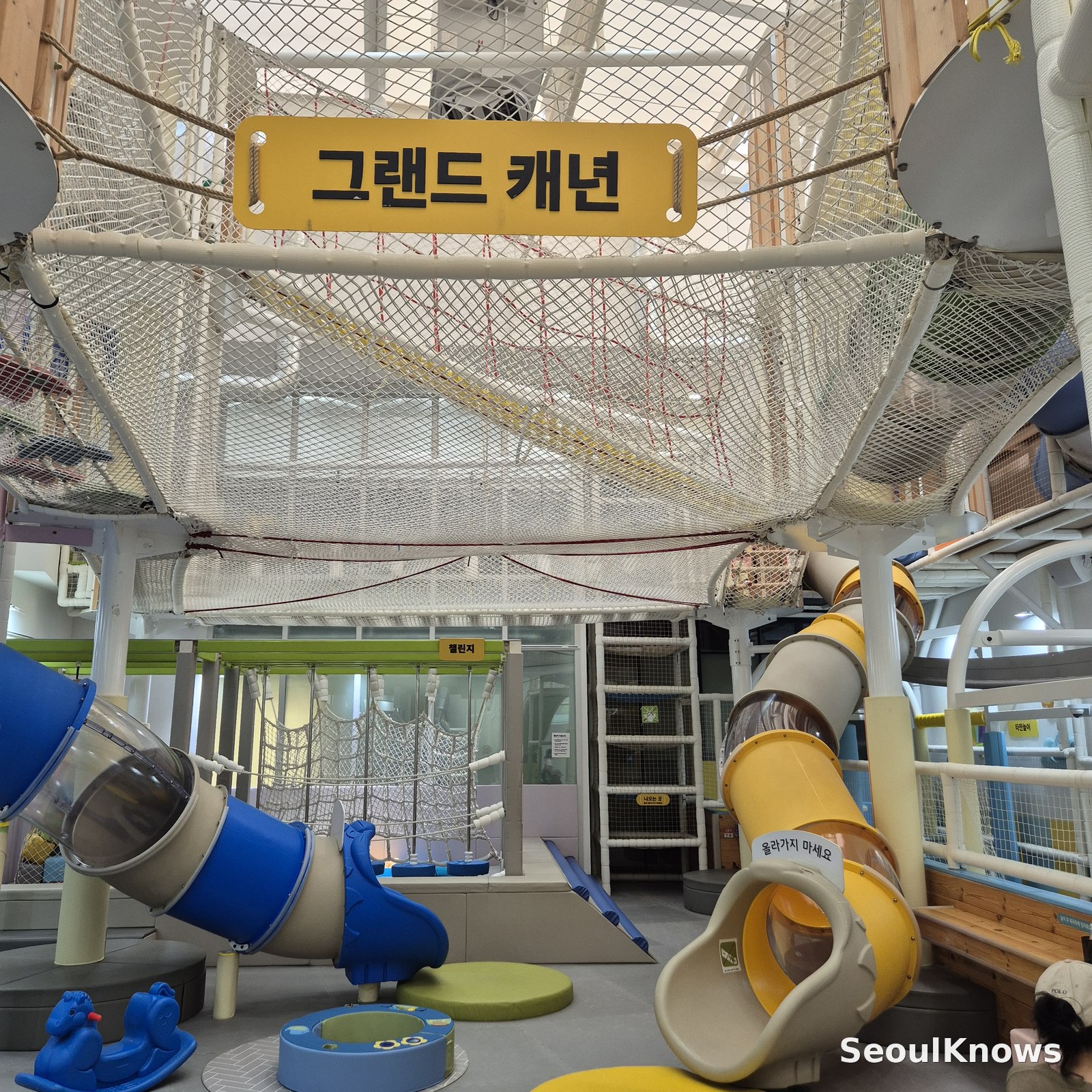
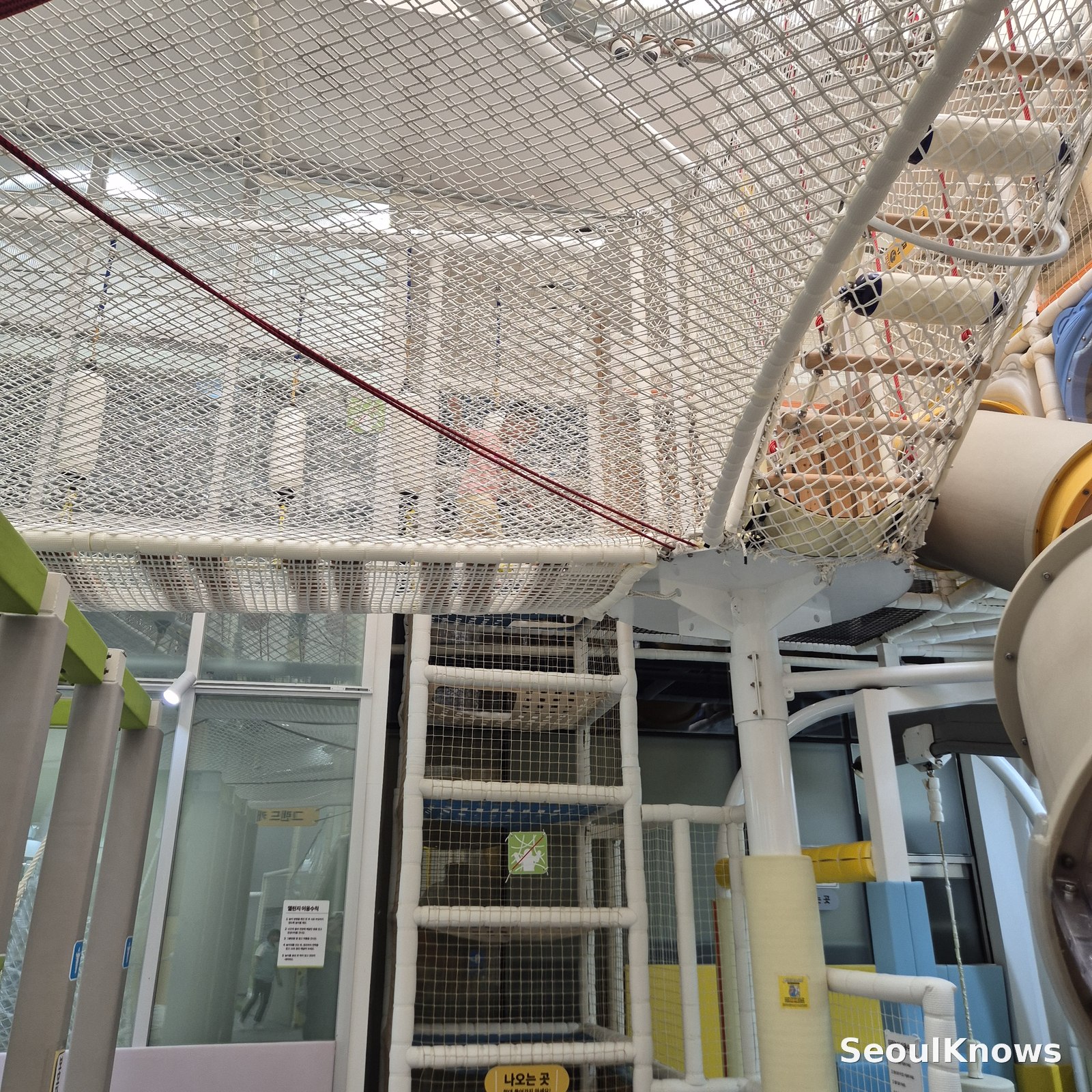
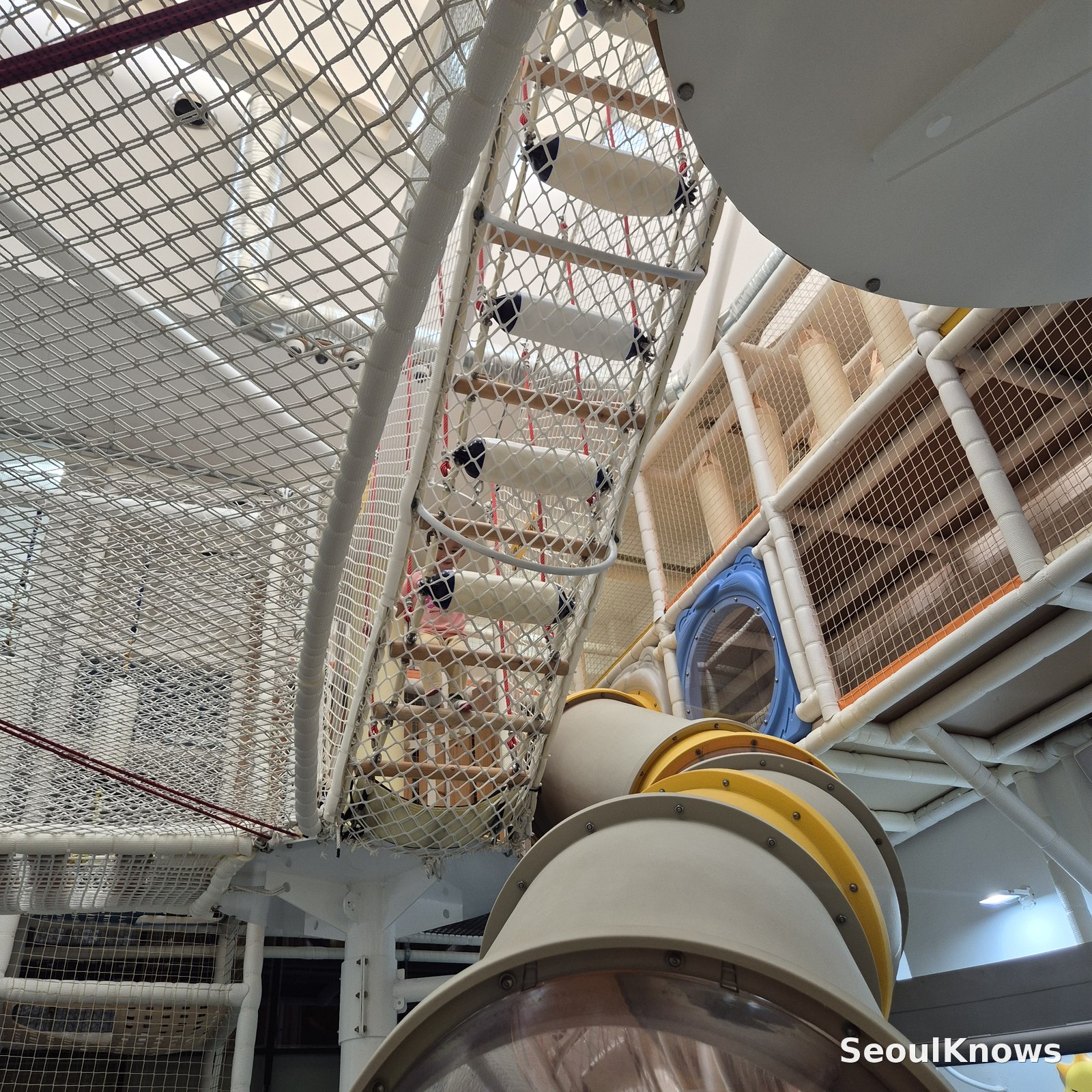
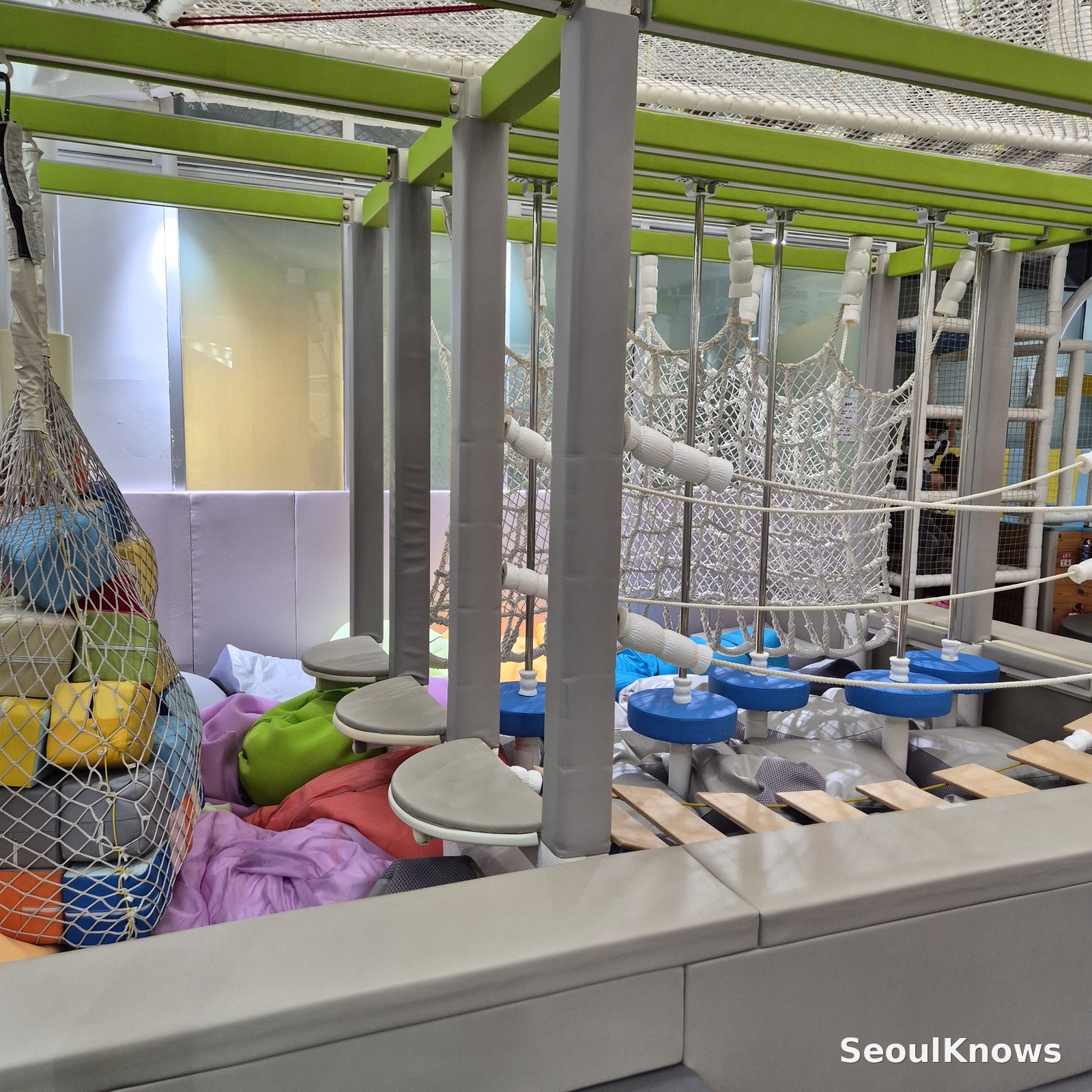
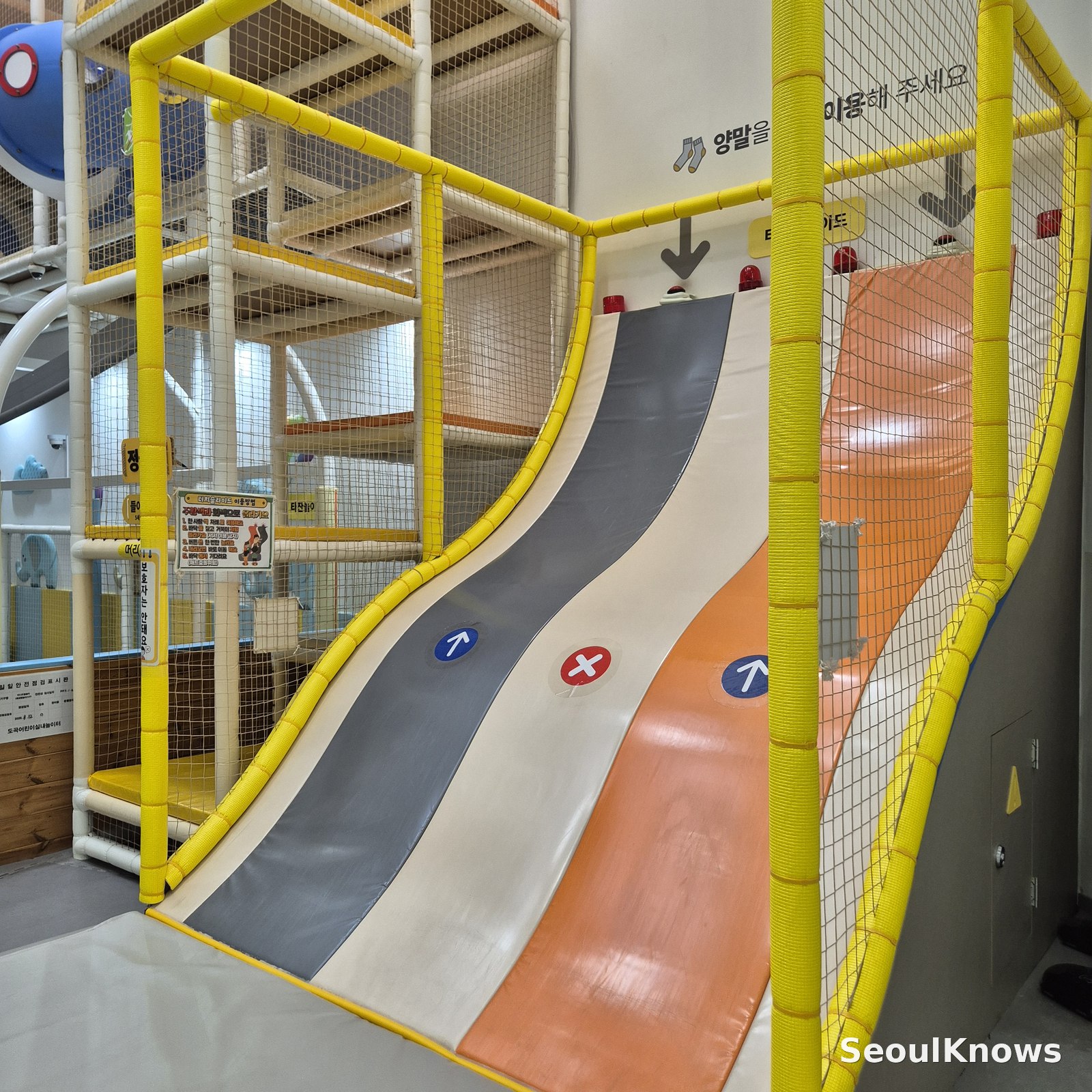
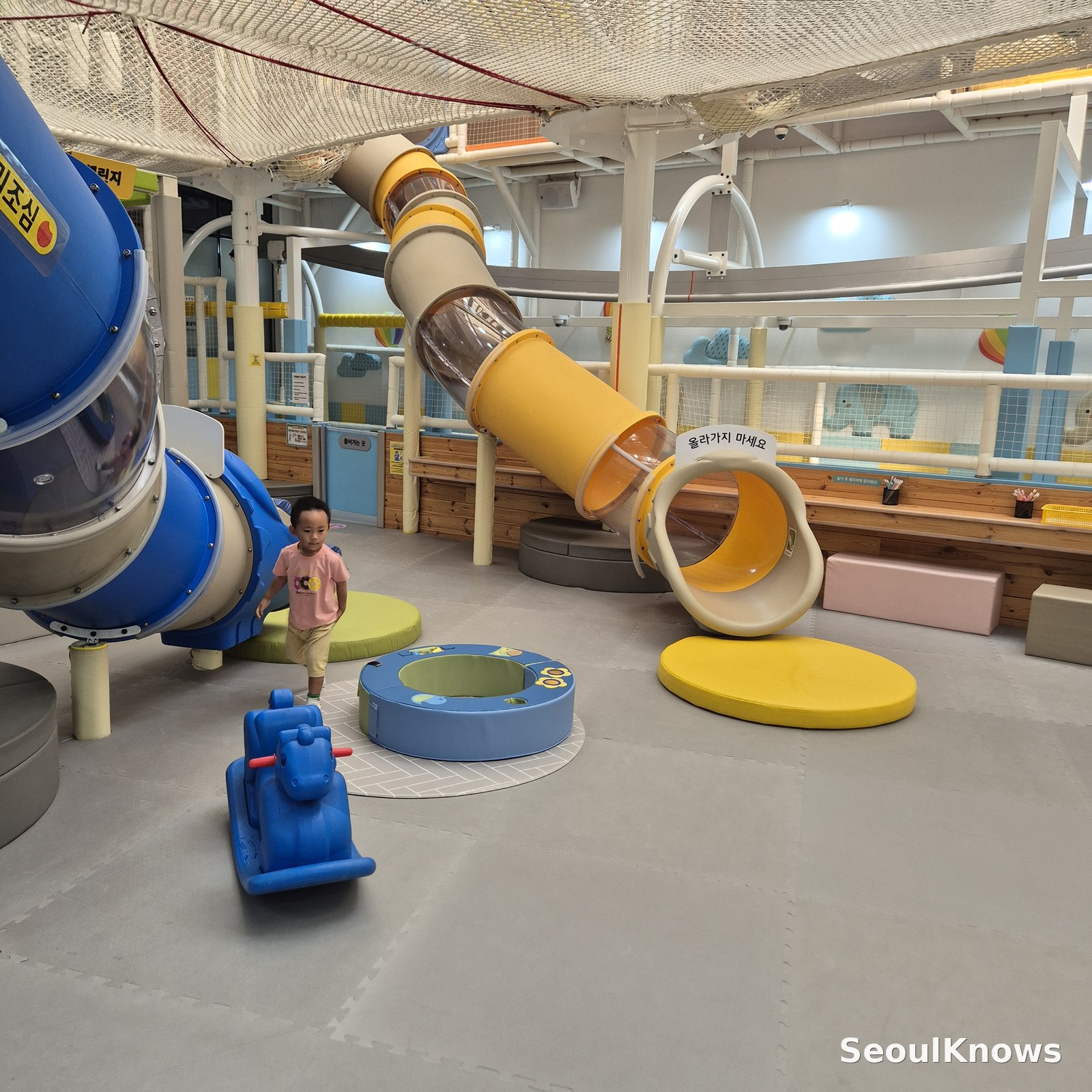
There are several slides and they are deliberately different from one another — a wide roller slide, an enclosed tube, a touch slide with a button at the top that makes a sound when you hit it. My son worked out the button within minutes and then climbed purely to press it again.
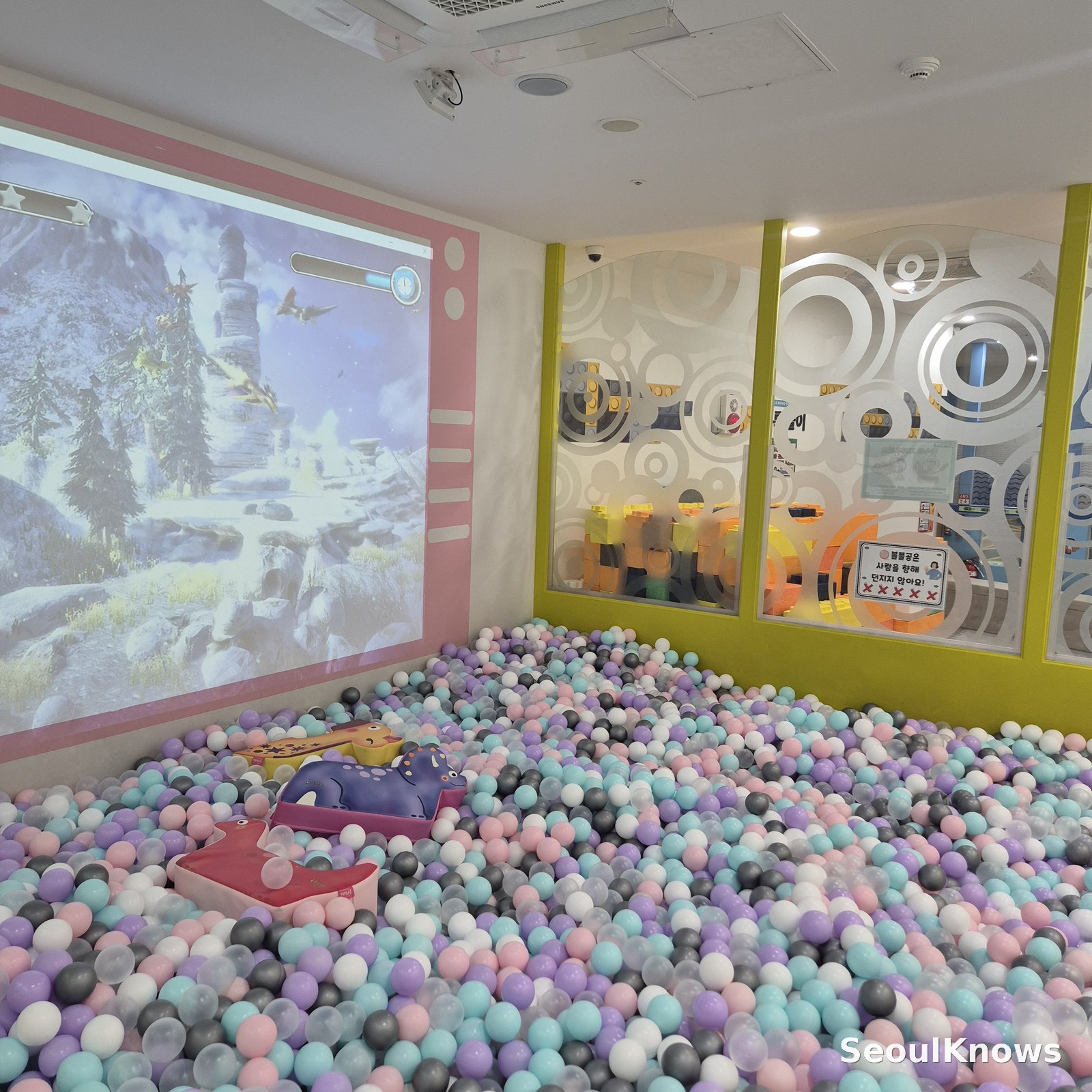
The ball pit has a projection game wired into it — you throw balls at the screen. It doubles as the recovery zone: run until you are wrecked, fall into the balls, repeat.
One honest caveat. My son is fearless, which is why the age guidance did not matter for him. A cautious or height-shy three-year-old would need an adult climbing alongside on the bigger structures, and the on-site notice does ask parents to keep children to age-appropriate equipment.
There is a calm half too
It is not all sprinting. One side of the room is a sit-down zone — a magnetic fishing pond, a colouring table, a play kitchen, a road mat with cars. Children drift over there naturally when they need to catch their breath, which is a good sign of how the space is laid out.
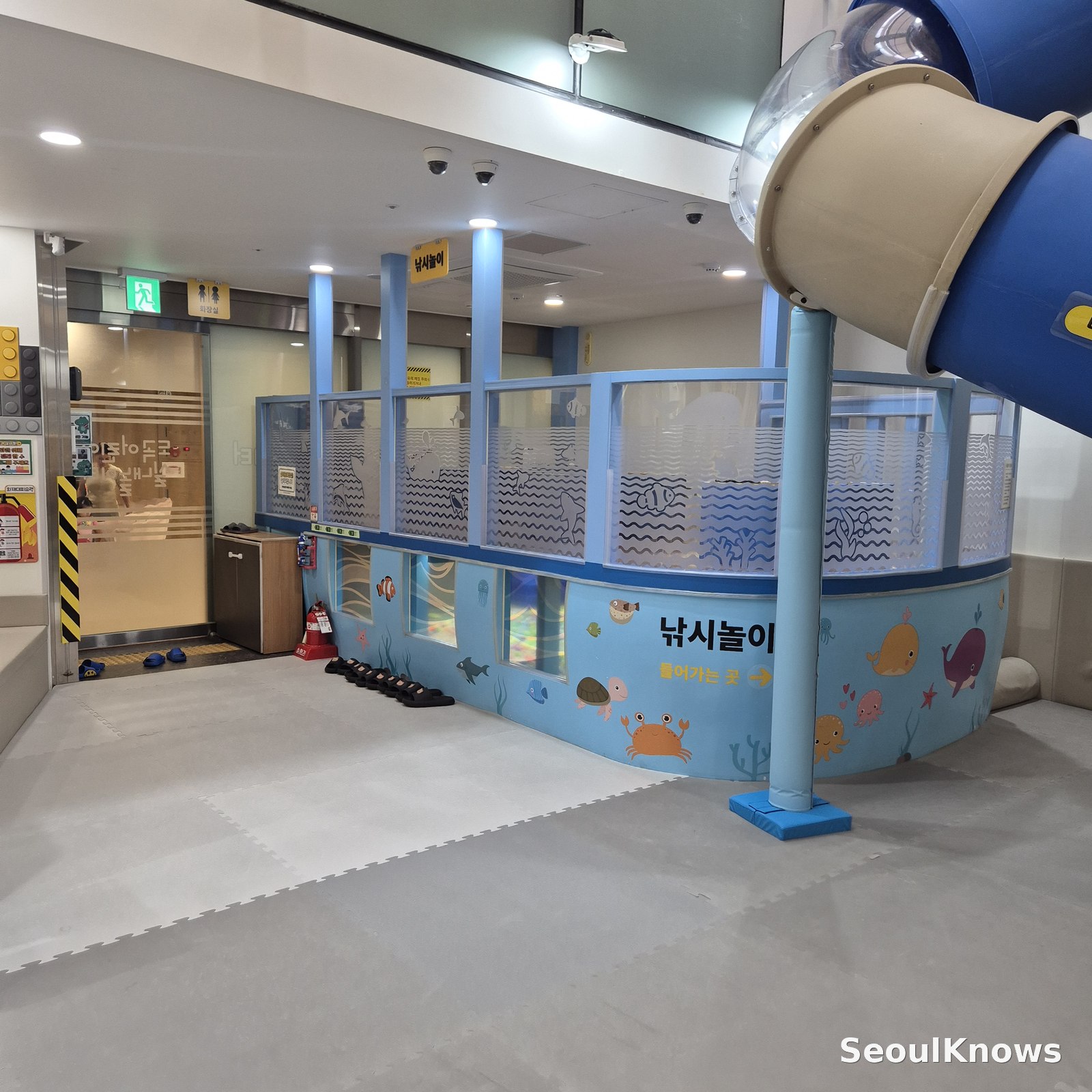
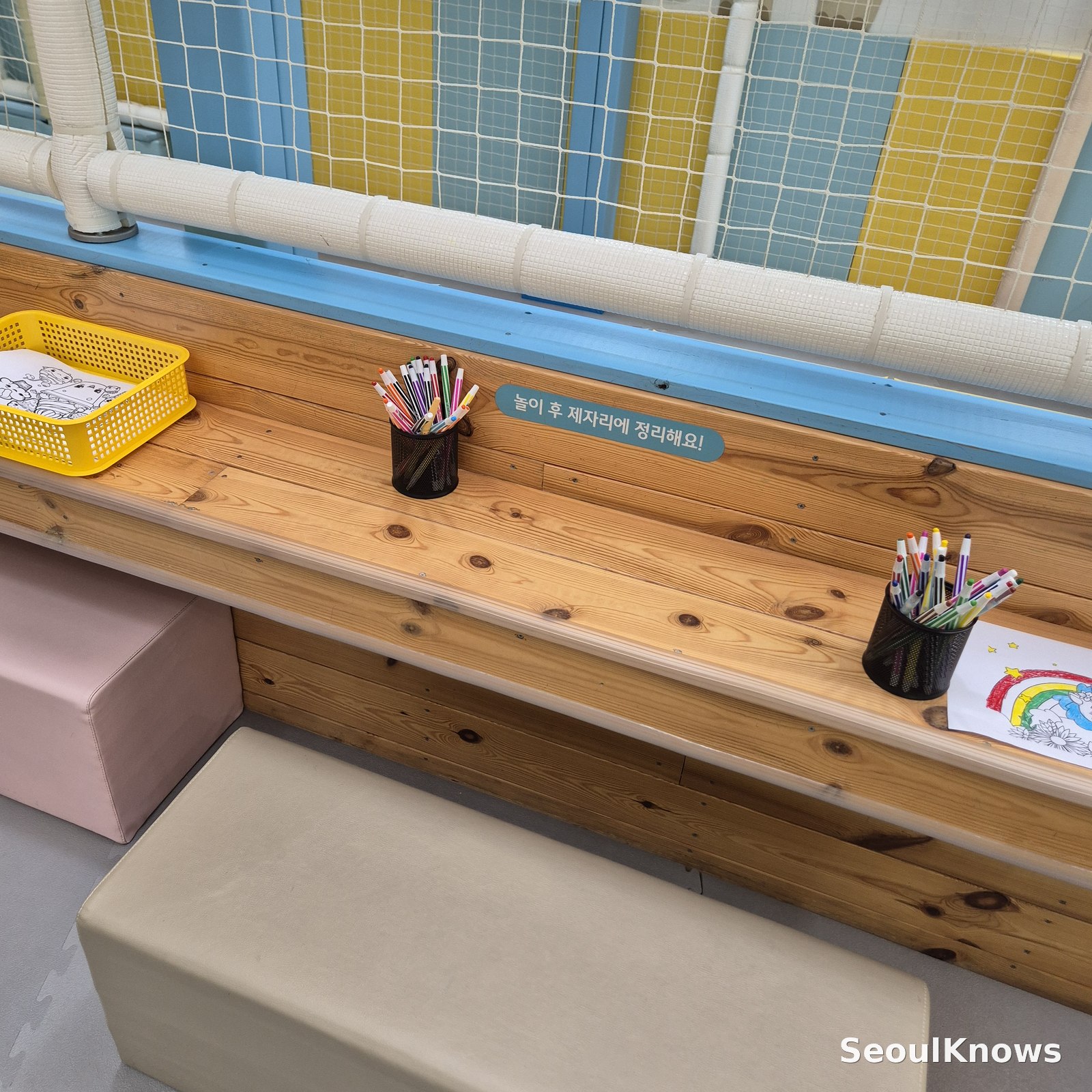
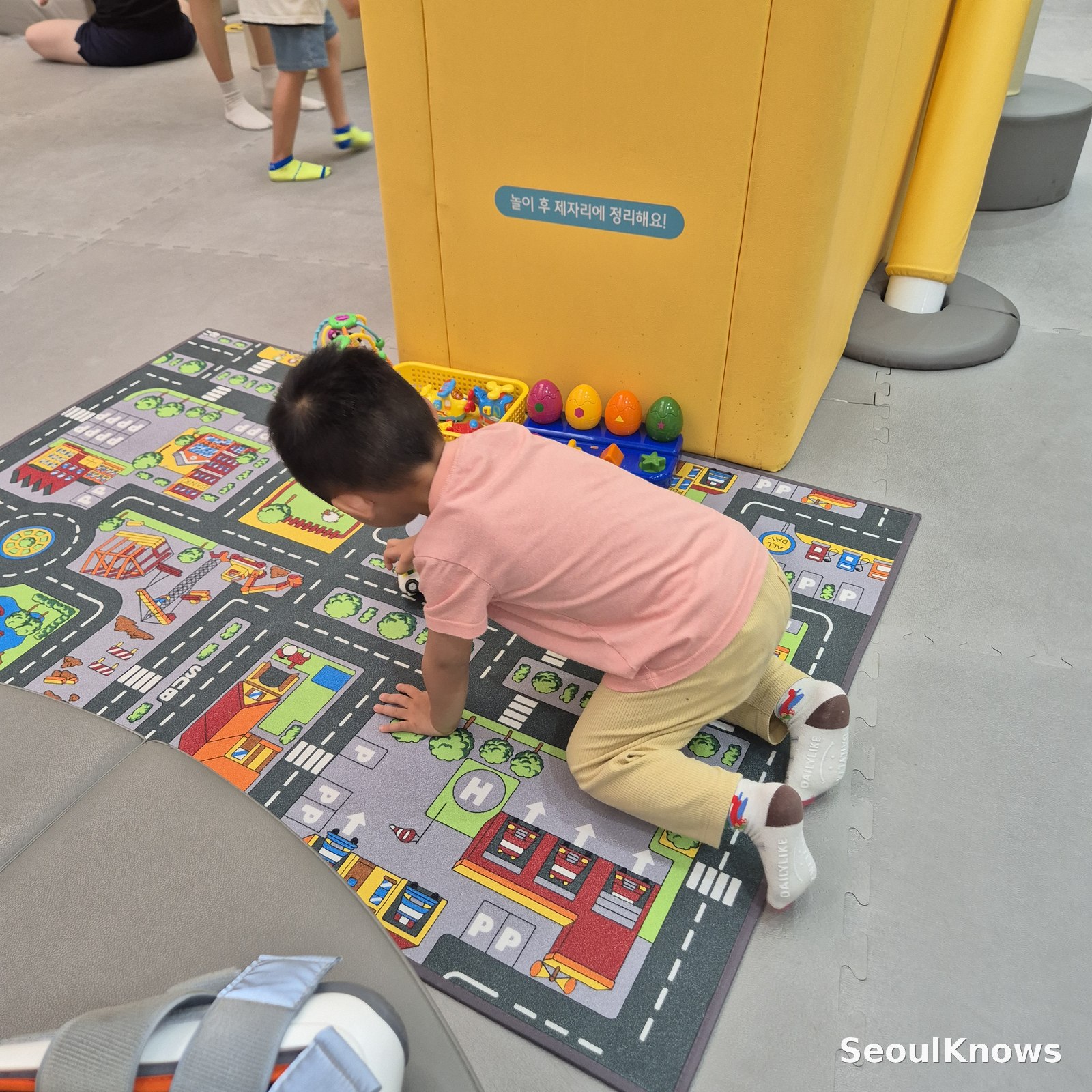
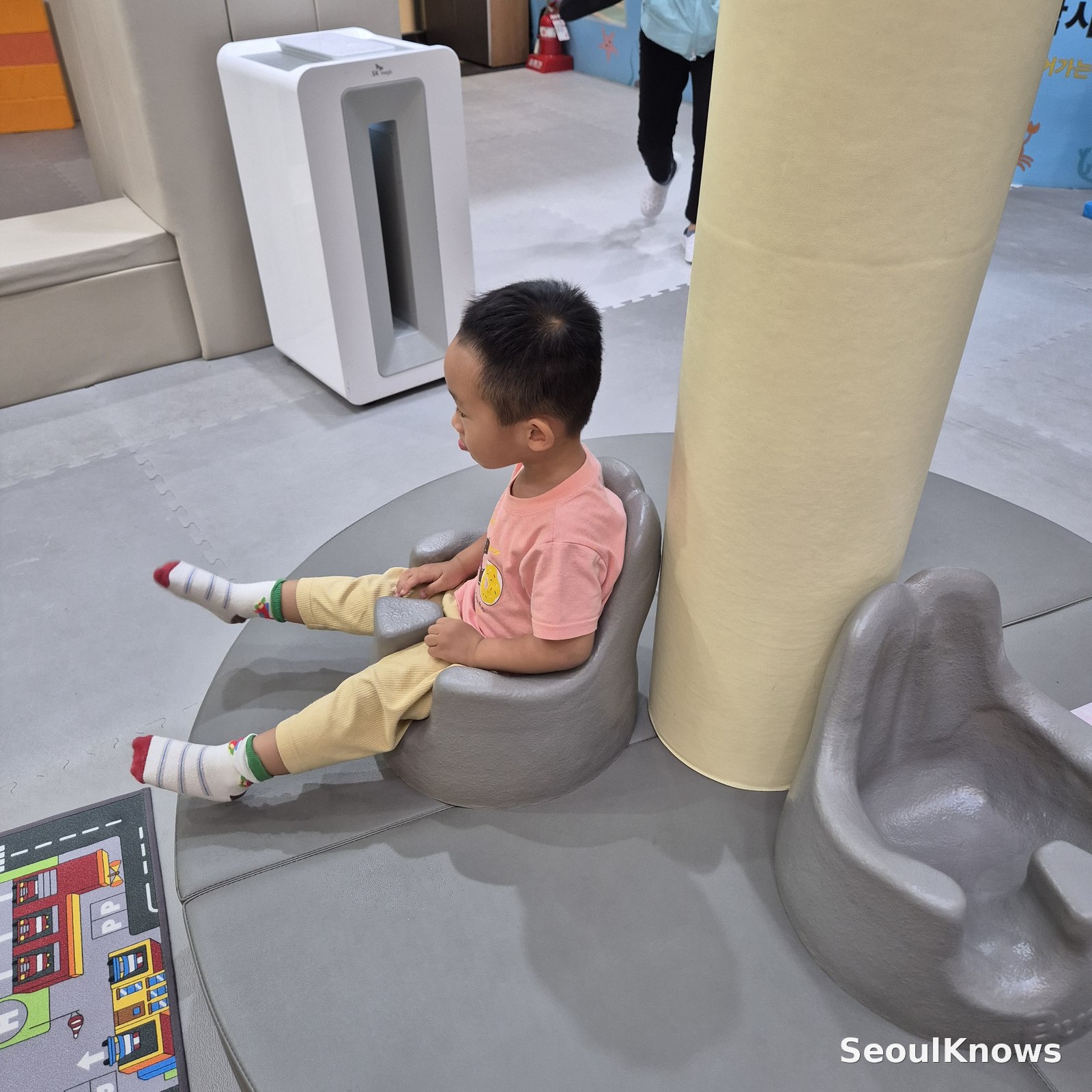
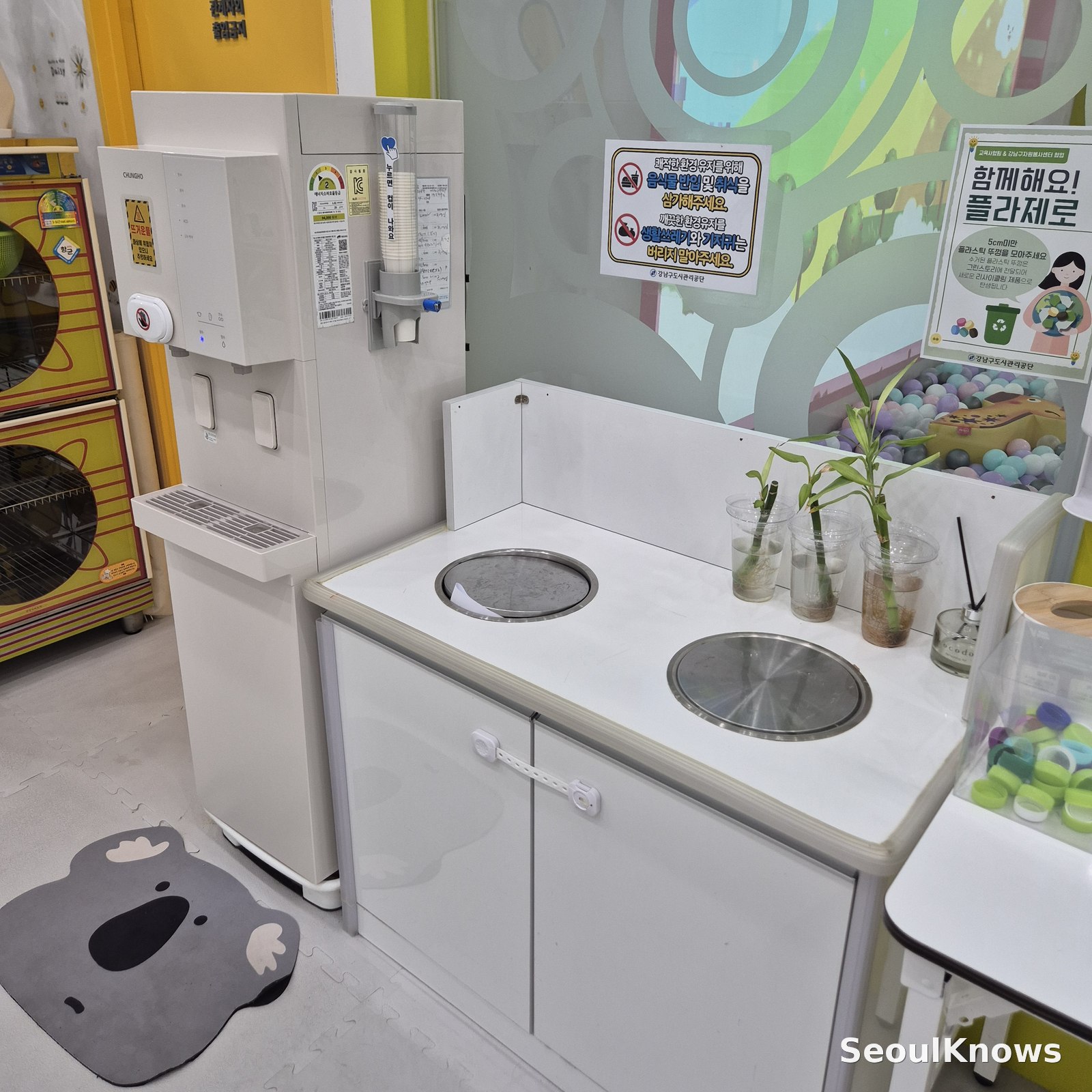
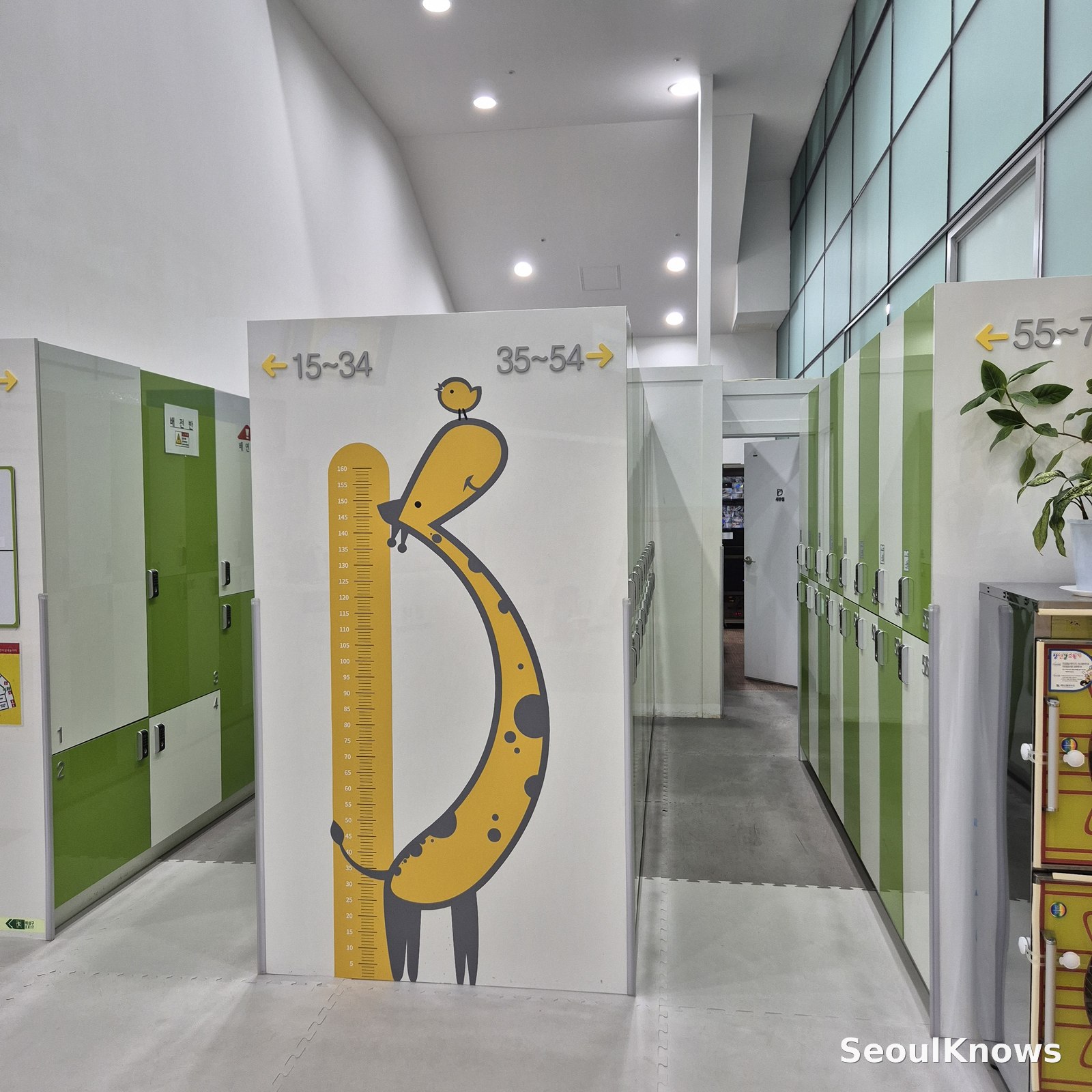
The facilities are clean and well kept — lockers, a water dispenser, hand sanitiser, tidy toilets. Nothing felt like a municipal afterthought.
If both parents come, one of you can work next door
This is the tip I would most want to know in advance.
The corridor to the playground runs past the Gangnam-gu Happy Rest Area (행복숟터), and through the glass it looks like a lounge — tables, chairs, window seats, bar seating, a tiered seating area. Gangnam converted a disused canteen in the basement of the Dogok 1-dong complex into a public rest and eating space, and it opened in February 2026.
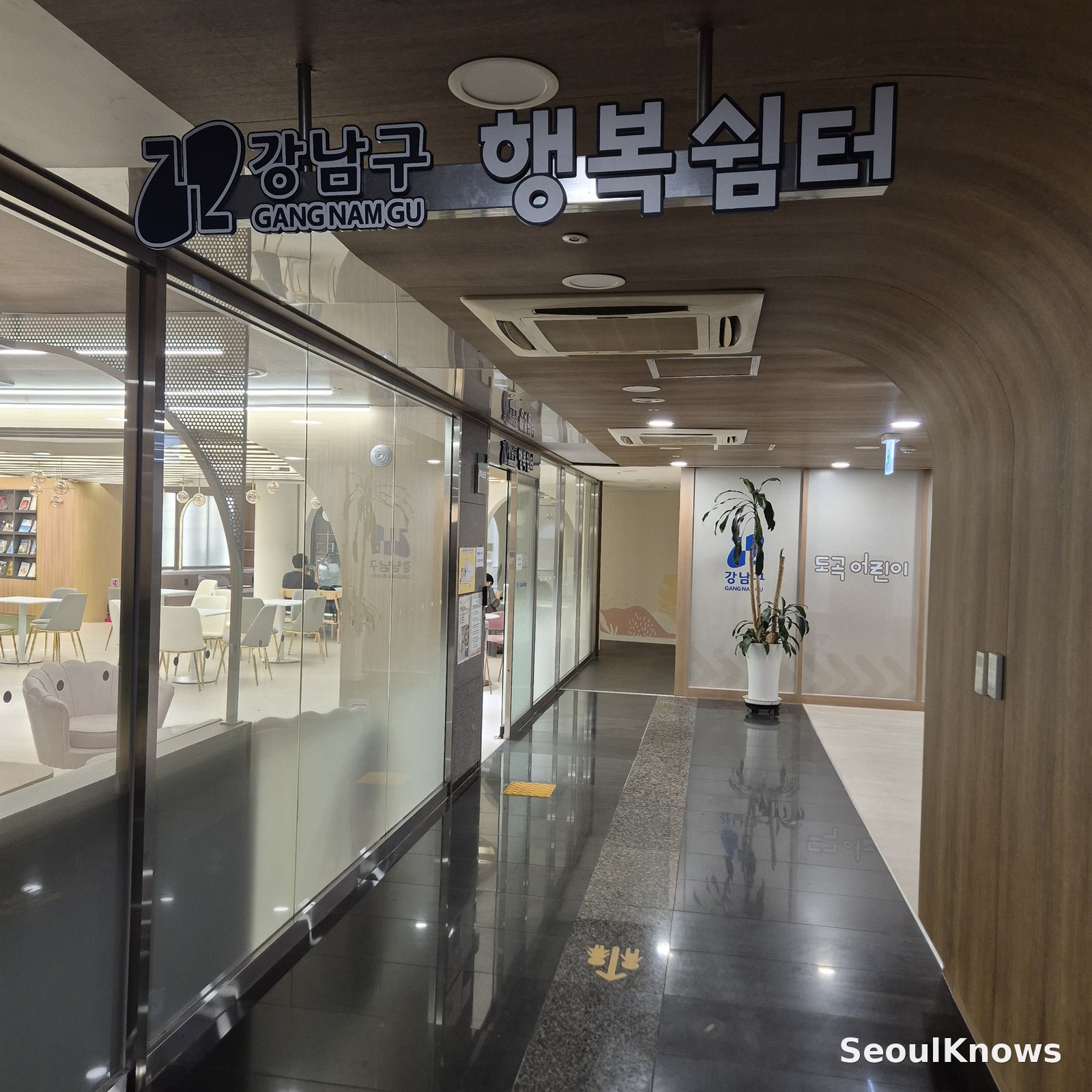
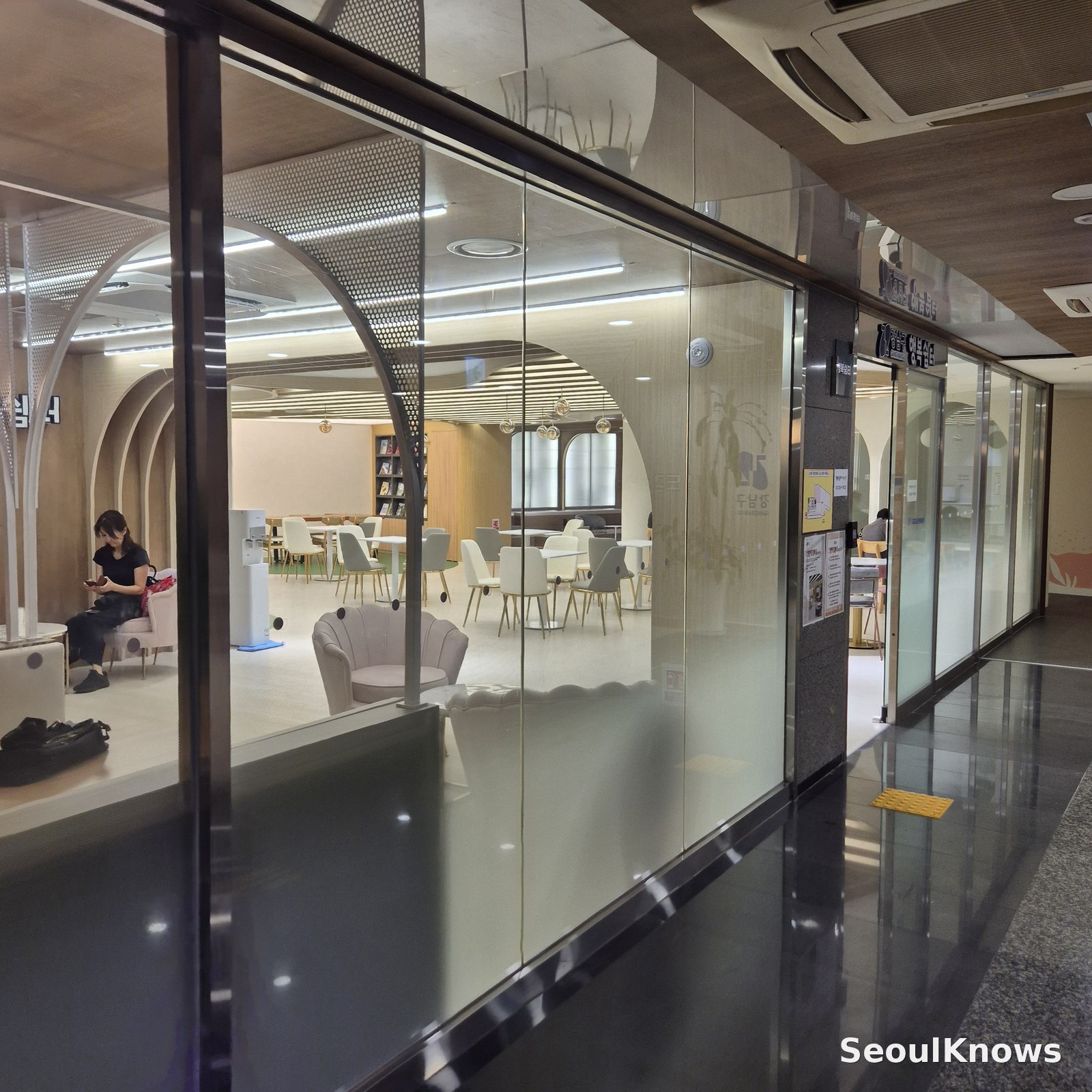
Here is why it matters. Only one guardian per child needs to go in. So if two of you come, one takes the child inside and the other can work, read or answer email in the lounge next door, then swap halfway.
Two hours is a long time to stand and watch a child climb, and the alternative to this is usually one parent scrolling on a bench. It also solves the snack problem: food and drink are banned inside the playground, while the Happy Rest Area is explicitly a rest-and-eat space, so whoever is off duty can have a coffee and the child can eat something after the session.
Leaving is on the hour
A small thing that saves an argument. Ten minutes before the session ends, exit music plays. That is your cue to tidy up the toys with your child and be out on the hour.
Tell your child in advance that the song means clean-up time. I did not know, announced departure out of nowhere, and paid for it.
Quick facts — Dogok Children’s Indoor Playground
• Address: B1–B2, 57 Dogok-ro 18-gil, Gangnam-gu, Seoul (Dogok Information & Culture Library)
• Nearest station: Maebong, Line 3
• Phone: 02-2176-0591
• Sessions: 10:00 / 13:30 / 16:00, two hours each
• Closed: Mondays and public holidays (open on Children’s Day)
• Fee: ₩1,000 per person, children and guardians alike. Card only
• Ages: preschool children aged 6 and under; one guardian per child required
• Capacity: 40 per session including guardians (20 children on the individual calendar)
• Booking opens: 1st and 3rd Saturday of the month, 11:00, at gangnam.go.kr
• Bring: socks for adults and children, resident registration extract
• Parking: shared library car park, frequently full — arrive 20–30 minutes early
• Food: not permitted inside; water dispenser available
Frequently asked questions
Can foreign residents book these playgrounds?
Yes — there is no nationality restriction on either system. The practical barrier is the account: you need to register on a Korean government site and pass identity verification, which normally means a Korean mobile line in your own name. If your phone is on someone else’s name or a company plan, that is where it breaks down. Call 120 (then 9, then 1 for English) if you get stuck.
What is the difference between a Seoul-type Kids Cafe and a district indoor playground?
Different level of government. Seoul-type Kids Cafes are a city programme with standardised rules, 216 branches in 2026, booked at umppa.seoul.go.kr/icare. District playgrounds are built and run by your gu office, with their own fees and booking windows, booked on that district’s own site. Dogok is a district one.
How much does a public indoor playground cost?
Seoul caps a Seoul-type Kids Cafe at ₩5,000 for one child plus a guardian; branch pages typically list ₩2,000 per child with adults free. Gangnam’s Dogok charges ₩1,000 per person entering, so a parent and child pay ₩2,000. Both are card-only.
Can a three-year-old handle Dogok?
Mine did, and used every piece of equipment. It is a climbing-heavy space usually recommended for ages five to seven, so a cautious toddler will need an adult on the bigger structures — but a physically confident three-year-old will be fine.
Can I turn up without a reservation?
At Dogok, yes, with conditions. There is a waiting area outside the playground, and if a booking holder has not arrived 20 minutes after the start time their slot can be released to people waiting, in order. Walk-in registration is suspended during extreme heat and extreme cold, so call ahead in midsummer or midwinter.
What happens if I book and do not show up?
At Dogok you are restricted until the end of the following month, and Gangnam’s notice says all your existing reservations are cancelled through that date. At Seoul-type Kids Cafes it is a 30-day ban across every branch in the city. Both accept a phone call as a cancellation.
Do I need to bring anything?
Socks are mandatory — for adults as well as children. Dogok also asks for a resident registration extract to confirm the child’s age. Bring a physical card; cash and Apple Pay are not accepted.
Are these open on weekends?
Yes. At Dogok all three weekend sessions are open to individuals, which is the opposite of weekdays where groups take priority. Seoul-type Kids Cafes run Tuesday to Sunday including public holidays.
The bottom line
Two hours of hard physical play for ₩2,000, in a room capped at 40 people, is not a deal you will find in the private market. The catch is never the price or the quality — it is the booking. One Korean-only calendar that opens twice a month at 11:00 on a Saturday, and a car park that fills before you get there.
If you live in Seoul with a preschooler, the single most useful thing you can do this week is find out which system covers your neighbourhood: search your district office site for your own gu’s playgrounds, and check umppa.seoul.go.kr/icare for the Seoul-type branches near you. Set a calendar alarm for whichever booking window applies. That one piece of admin buys you a year of cheap rainy Saturdays.
We are going back at the next booking date.
Written by WY, a Seoul-based local sharing honest, first-hand guides to Korea. Nothing here is sponsored; I go and pay my own way. More about me →
Want an outdoor day out instead? See our Anseong Farmland guide — a classic family day trip near Seoul with animal feeding and open meadows.