
The National Museum of Korea (국립중앙박물관) is the one museum in Seoul that almost every visitor ends up at, and for good reason. My wife, our toddler and I went on a Sunday morning in September 2025, right when KPop Demon Hunters had turned the museum shop into one of the hottest queues in the city. This guide covers what we saw, what surprised us, and everything you need to plan a visit in late 2026: whether it is still free, how to get there, what to see first, where to rest, and the questions people search before they go.

Namsan Tower framed by the museum’s open plaza.
Why everyone is going right now
The museum moved to its current building in Yongsan in 2005. It holds more than 400,000 objects, with around 10,000 on display across three floors, from prehistoric tools to Joseon paintings.
It was always busy, but 2025 was something else. The museum welcomed about 6.5 million visitors, and The Art Newspaper ranked it third in the world, behind only the Louvre and the Vatican Museums. Foreign visitors are rising fast too: about 231,000 in all of 2025, and already about 291,000 in the first eight months of 2026.
Three things drove it. Entry to the permanent galleries is free. The Room of Quiet Contemplation, a gallery built for just two statues, became a social media favorite. And Netflix’s KPop Demon Hunters (2025) borrowed the tiger and magpie of Korean folk painting, which sent fans looking for the originals and the goods based on them. In 2026 the museum also named RM of BTS as its first global ambassador.
Is it still free?
Yes, for now. The permanent exhibition is free, and you do not need to book. Special exhibitions charge separately.
That may change. The government’s 2027 budget includes a plan to charge adults for the permanent galleries, with figures around 5,000 to 10,000 won reported, and a pilot online reservation system is planned for the first half of 2027. Nothing is final, and the museum director announced his resignation in October 2026, which may slow things down. If you are visiting in 2027, check the official site before you go.
Getting there: Ichon Station, exit 2
Take Line 4 or the Gyeongui-Jungang Line to Ichon Station (이촌역) and follow the signs for exit 2. An underground walkway called the Museum Path (박물관나들길) takes you most of the way under cover, so you barely need to go outside on a rainy or freezing day. It is open from 07:00 to 23:00.
Driving is possible but slow at weekends. Parking costs 900 won for the first 30 minutes, then 300 won per 10 minutes, capped at 18,000 won a day, and waits to get in can run one to two hours on a busy weekend. On a Sunday, take the subway.
Arriving: the queue and the big screen
We arrived mid-morning, about half an hour after opening, and the line was already long. The building is huge, and the queue moves, but it is worth knowing before you go: a weekend morning is peak time. Bag checks at the entrance have separate lines for people with and without bags, so travel light if you can.

The line outside on a Sunday morning, with Namsan Tower in the distance.
On the way in, there is a large outdoor screen that mixes animation with a live picture of the people outside. The animated tiger walks among the visitors standing in the queue, who appear on the screen as if it were a giant mirror. Our toddler was fascinated, spotting real people from the line up there next to the tiger, and so were most of the children around us.
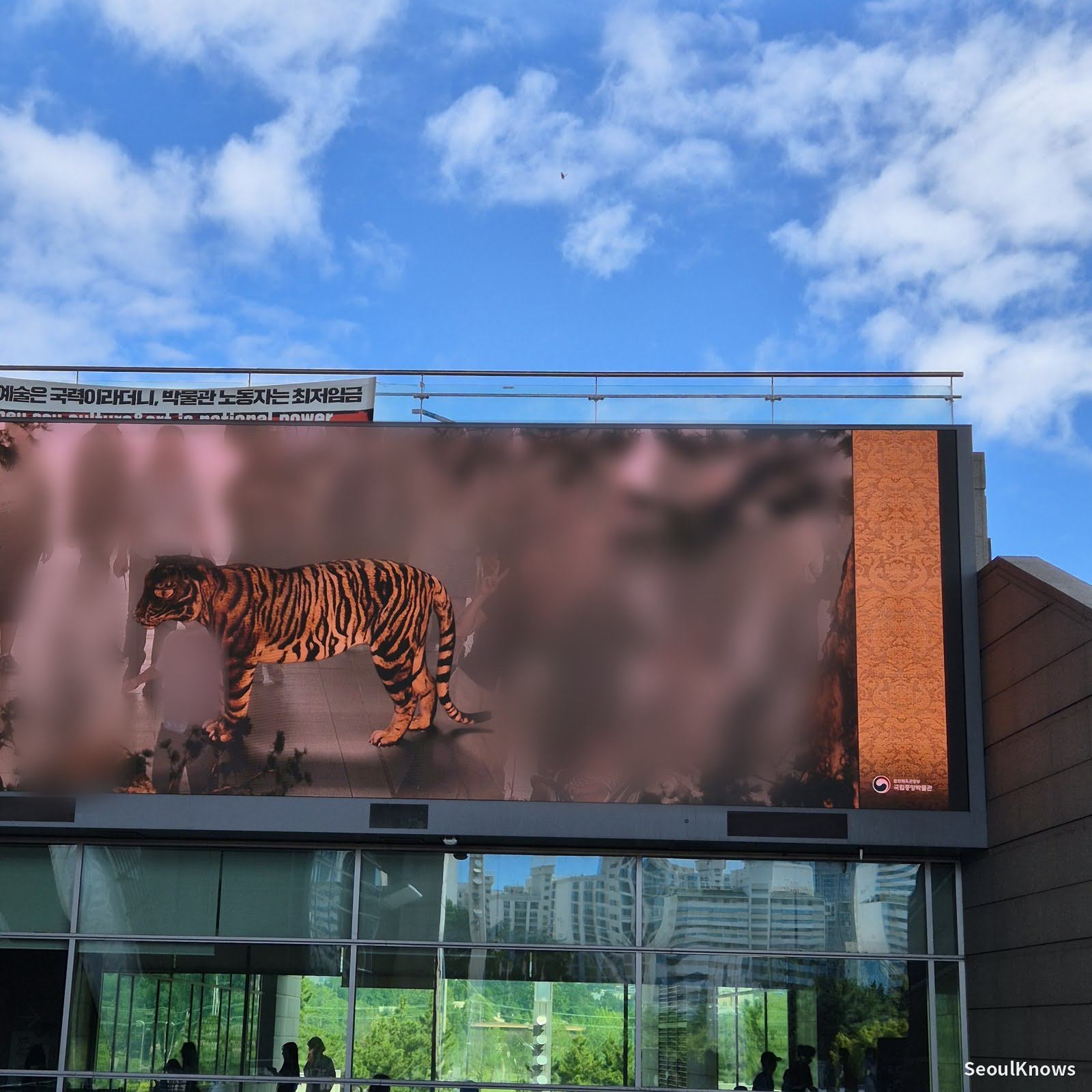
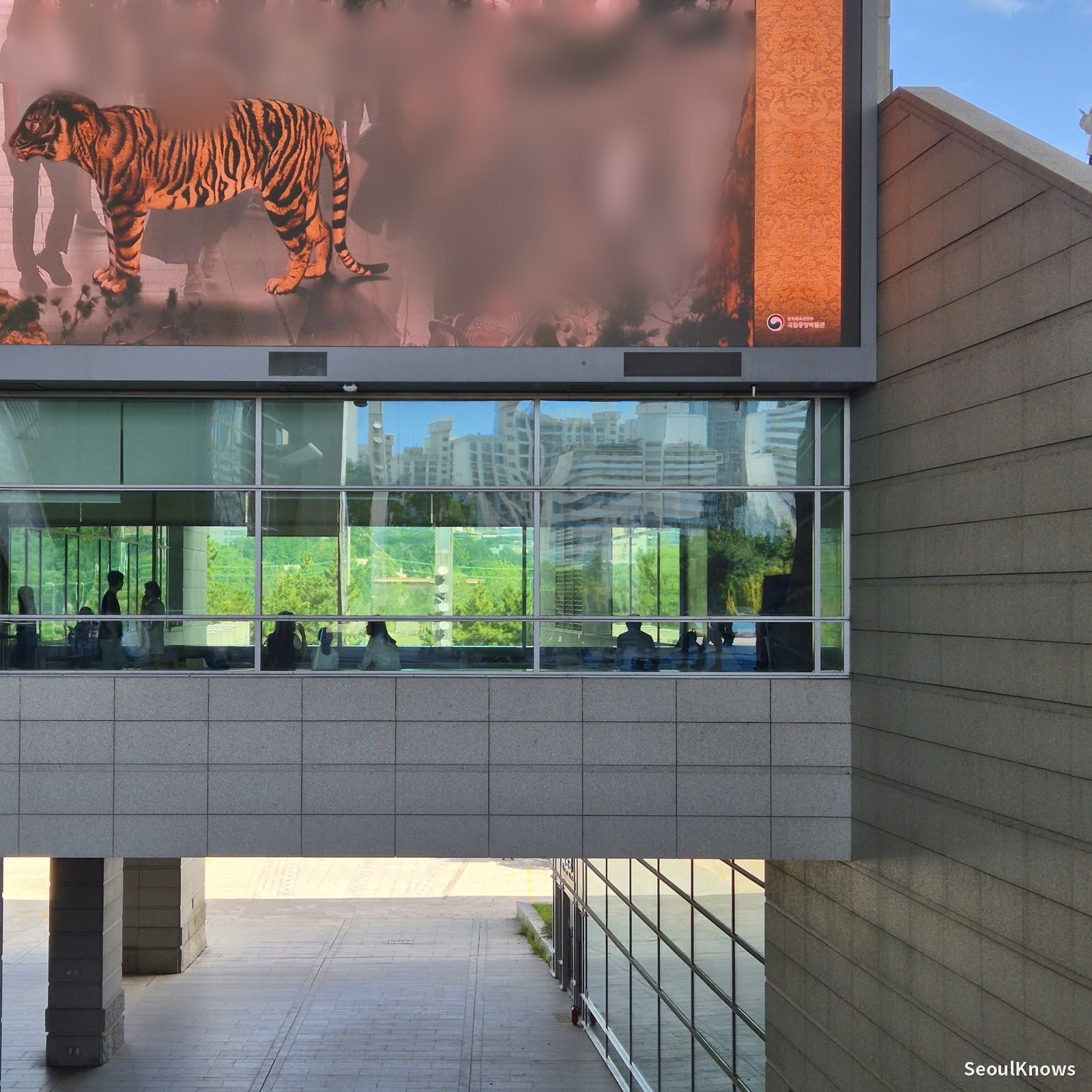
The outdoor media wall: an animated tiger among the people in the queue, shown live.
The museum shop and the KPop Demon Hunters effect
The museum shop, called MU:DS, is a destination in its own right. There are three branches inside the museum plus an online store (muds.kr), and in 2025 they sold about 41.3 billion won of goods. The bestsellers were a magpie and tiger badge, based on the same folk painting the film’s tiger and magpie come from, and a pair of “drunk scholar” glasses that change color when you pour a cold drink.


Celadon-inspired tableware and stationery in the main shop.
What surprised us most was the quality. A lot of the goods are well made and really fun, which is why the shop is always crowded and why things actually sell out. When we went, the Pensive Bodhisattva miniatures were the busiest shelf, and the color versions had a “SOLD OUT” sign on them. Sold-out items still come up often, so go early, check what is in stock, and grab what you like before it is gone, rather than leaving the shop for the end of your visit.

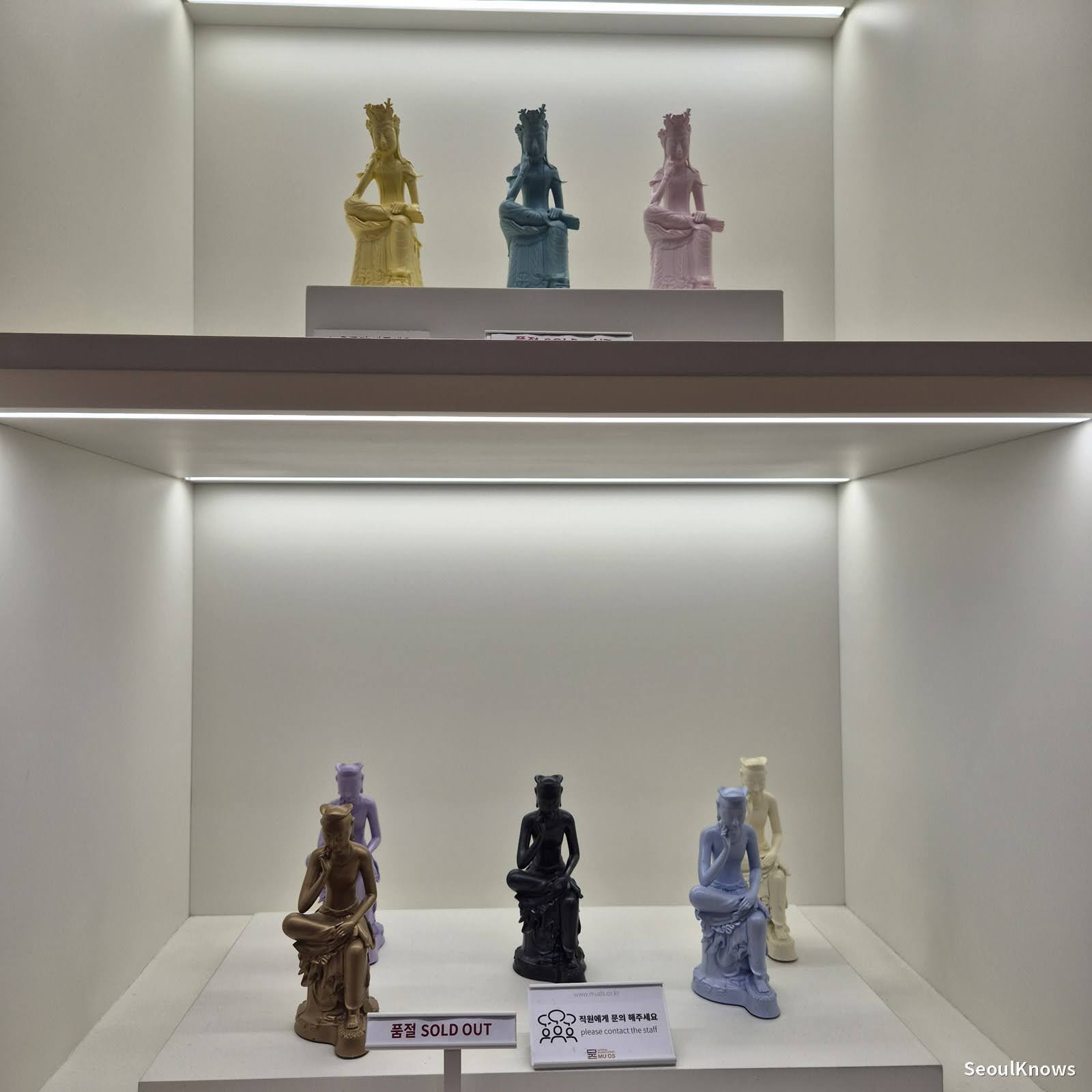
Pensive Bodhisattva miniatures, snow globes, and the sold-out sign.
Honest Seoul tips, once a week. Get the newsletter →
The Great Hall
Inside, the main corridor runs the full length of the building under a glass roof. It is called the Great Hall (역사의 길, “Path of History”), and it is free to walk through even if you do not enter a single gallery.

Light from the skylight in the Great Hall.
There was a photo zone with the museum’s bodhisattva mascot waving “안녕! 반가~” (roughly “Hi! Nice to meet you”), which our toddler loved, and a tall media screen running art from the collection. With a toddler, the Great Hall is a good place to let them walk and look around between galleries.

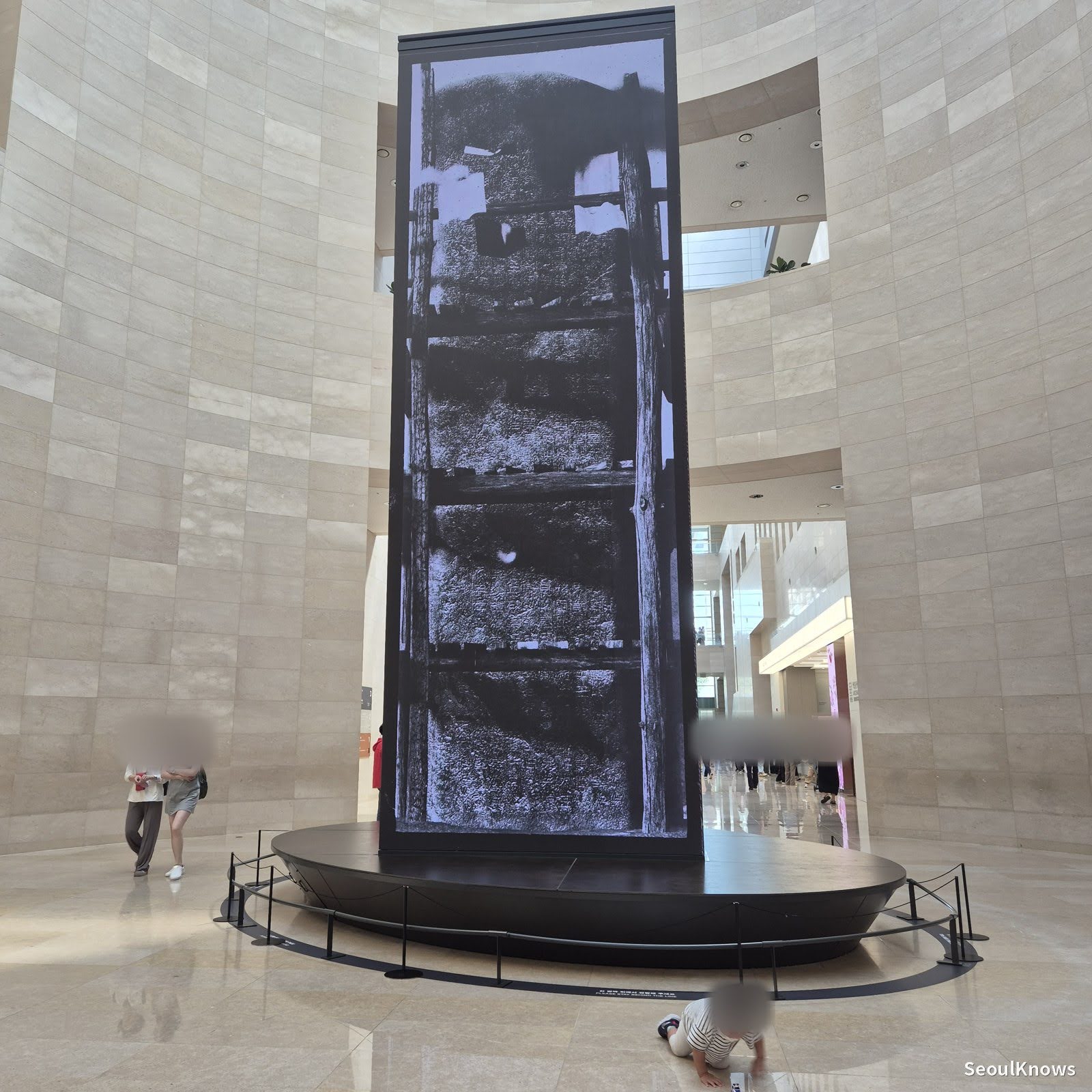
The mascot photo zone and the tall media screen in the Great Hall.
The windows on the side look straight down onto the Mirror Pond. Our little one spent a long time standing at the glass.
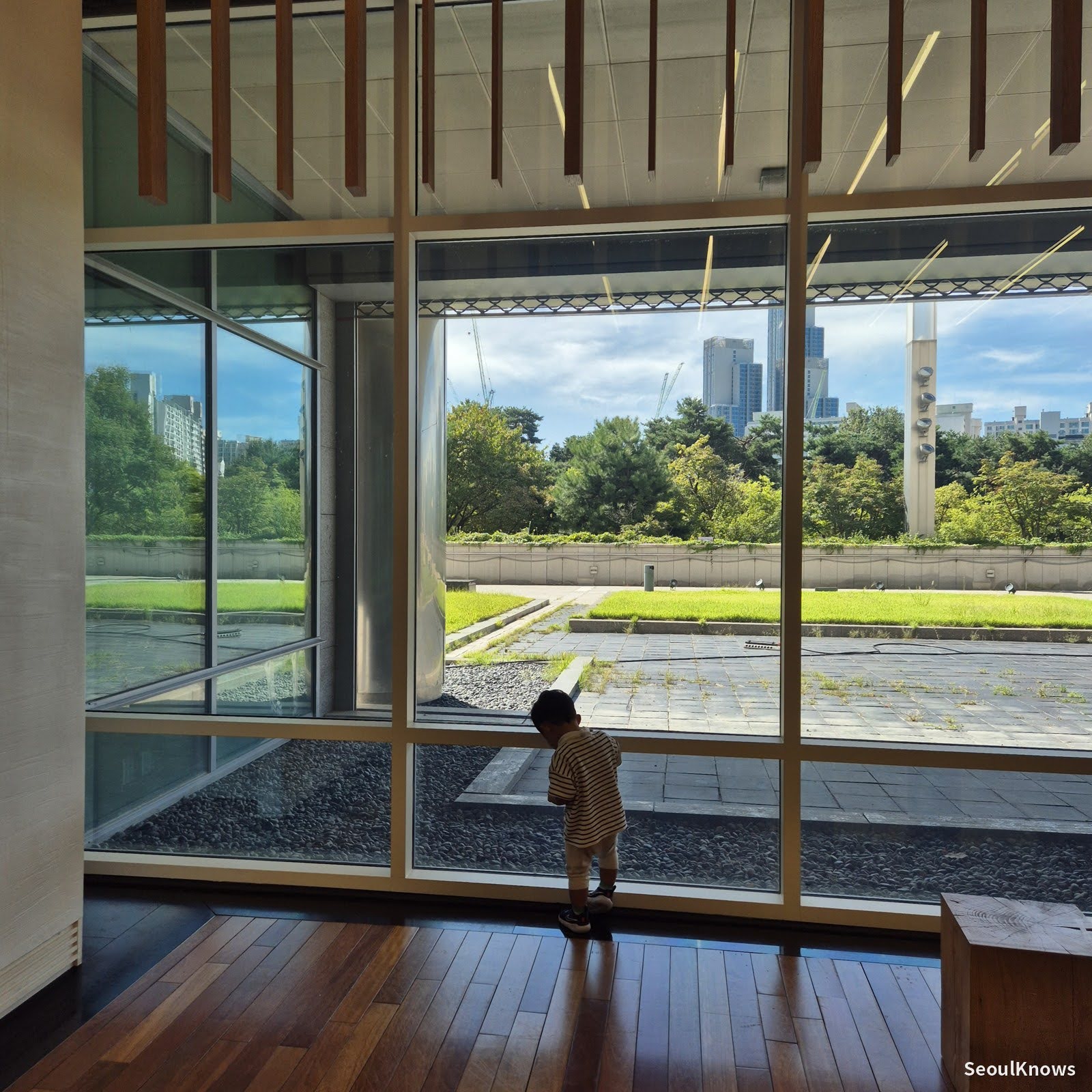
Looking out over the Mirror Pond from inside.
See the Room of Quiet Contemplation first
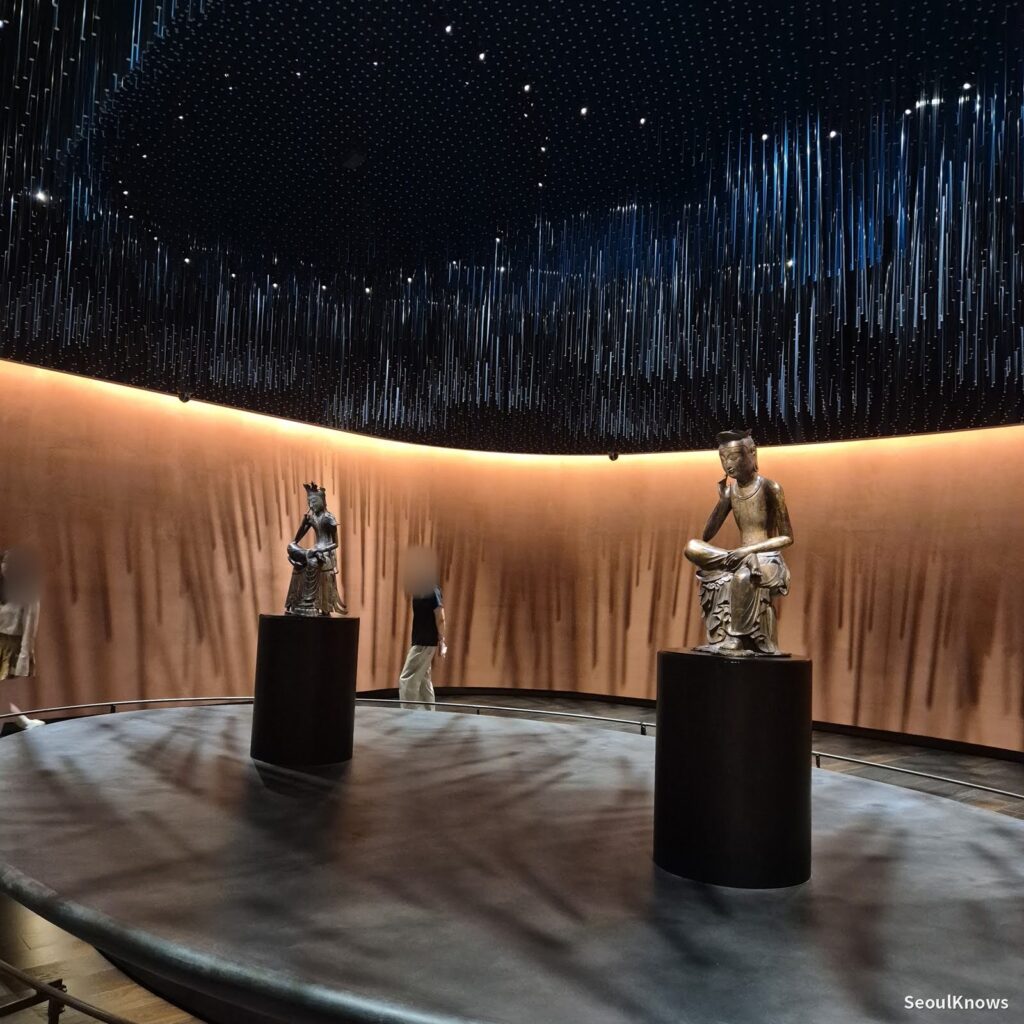
If you only see one thing, make it this. The Room of Quiet Contemplation (사유의 방) on the second floor holds two gilt-bronze Pensive Bodhisattvas from the 6th and 7th centuries, both National Treasures, in a dark room designed by architect Choi Wook. The floor rises slightly toward the statues, the ceiling is scattered with tiny lights, and there are no labels in the way. You walk all the way around them.

The two Pensive Bodhisattvas in the Room of Quiet Contemplation.
It is also the most popular room in the building, so the best tip we heard is to go there first, straight after you enter, before the crowd spreads through the galleries. Photos without flash are allowed, but the room is meant to be quiet, and people do keep their voices down.
The Gyeongcheonsa pagoda
At the far end of the Great Hall stands a ten-story marble pagoda from 1348, the Goryeo period, over 13 meters tall. You can see it from the ground floor, but the best view is from the upper floors, looking down past the carved tiers. While we were there, small guide robots were rolling around its base.

The Gyeongcheonsa pagoda seen from above.
Where to rest
A museum this size is tiring, especially with a child, and the good news is there are places to sit. We found a quiet lounge lined with shelves of objects and paper lamps, and a long wooden seating area with windows onto the park. Both were full of families taking a break.

A lounge with shelves of objects and paper lamps.


Wooden seating with views out to the park.
Immersive VR: book ahead
The museum runs free immersive VR programs in its Immersive Content Hall 2. When we passed, every session that day was fully booked. The notice said bookings open 30 days ahead, up to four people per booking and six per session, one session per person per day, for ages 8 and over and at least 130 cm tall. There were five programs, including a look inside the conservation lab and the storage vaults. If VR is on your list, book online before you travel.

The VR notice: free, book ahead, and fully booked on the day we went.
Outside: Namsan, the Mirror Pond and Theater Yong
Do not leave without going outside. The open plaza in the middle of the building frames Namsan Tower perfectly, and it is the most photographed view at the museum. The Mirror Pond, with its small pavilion, sits just below, and the grounds lead straight into Yongsan Family Park if you have energy left.
Next to the museum is Theater Yong (극장 용), its performance hall. We ended our visit there, with our toddler running ahead along the path.

Theater Yong, the museum’s performance hall, at the end of our visit.
If you only have two hours
That is about how long we spent, and with a toddler it was the right amount. A good two-hour plan:
- Room of Quiet Contemplation (2nd floor), first.
- The Gyeongcheonsa pagoda and the Great Hall.
- One gallery that interests you most: Silla gold on the 1st floor is a classic.
- The shop, if you want souvenirs.
- The open plaza for the Namsan view on the way out.
With a full day, you can work through the floors in order: Korean history on the 1st floor, calligraphy, painting and donated collections on the 2nd, and sculpture, crafts and Asian art on the 3rd.
Food and coffee
There is a food court called Hansik Migwan (한식미관) with Korean dishes such as bibimbap and tteokbokki, which reopened in July 2026 after a refurbishment, plus a restaurant by the Mirror Pond and several cafes. The tea house inside the museum, Sayu Gongan (사유공간찻집), is known for its black sesame latte. Expect lines at lunchtime on weekends, so eat early or late.
Visiting with kids
The museum is very easy with small children. Strollers and wheelchairs can be borrowed free of charge, there is a free coat check, and lockers are in front of the museum shop and at the Children’s Museum. The Children’s Museum is separate and needs an online booking: 80-minute sessions starting at 09:30, 11:00, 13:00, 14:30 and 16:00. From 15 December 2026, bookings for anyone who has not arrived 20 minutes after the start are canceled automatically.
What’s on in late 2026
Several galleries on the 2nd and 3rd floors, including Buddhist sculpture, Buddhist painting, metal crafts and wood and lacquer, are closed for renovation from 6 July 2026 to 28 January 2027. If one of those was on your list, check before you go.
Coming up are two big paid exhibitions: The Birth of Modern Art from the Kunsthaus Zürich (27 November 2026 to 18 April 2027) and a Marie Antoinette style exhibition (18 December 2026 to 31 March 2027). Smaller free displays include rare Dunhuang Buddhist sutras (23 October 2026 to 24 January 2027).
Quick facts
- Address: 137 Seobinggo-ro, Yongsan-gu, Seoul
- Getting there: Ichon Station (Line 4, Gyeongui-Jungang Line), exit 2, then the underground Museum Path
- Hours: 09:30 to 17:30; Wednesdays and Saturdays until 21:00. Last entry 30 minutes before closing
- Closed: 1 January, Seollal and Chuseok days, and the first Monday of March, June, September and December (next: 7 December 2026)
- Admission: permanent exhibition free; special exhibitions paid; fee for adults under discussion for 2027
- English help: free official app “National Museum of Korea Exhibition Guide” in five languages; guided tours in English, Chinese and Japanese (check the monthly schedule)
- Facilities: free strollers, wheelchairs and coat check; lockers by the shop and the Children’s Museum
- Parking: 900 won for 30 minutes, then 300 won per 10 minutes, 18,000 won a day
- Time needed: two hours for the highlights, a full day for everything
Frequently asked questions
Is the National Museum of Korea worth visiting?
Yes. It is the best single introduction to Korean history and art, the building and grounds are beautiful, and the permanent galleries cost nothing. Even if museums are not your thing, the Room of Quiet Contemplation is worth the trip.
Is entry to the National Museum of Korea free?
The permanent exhibition is free in 2026, with no booking needed. Special exhibitions are paid. A fee for adults is being discussed for 2027 but has not been confirmed.
How much time do you need?
Plan two hours for the highlights: the Room of Quiet Contemplation, the Gyeongcheonsa pagoda, one or two galleries and the shop. Seeing all three floors properly takes most of a day.
Why is it so popular?
Free entry, a beautiful building with a Namsan view, the Room of Quiet Contemplation going viral, and KPop Demon Hunters, whose tiger and magpie come from Korean folk painting in the same tradition as the museum’s collection.
When is it least crowded?
Weekday mornings, and Wednesday or Saturday evenings when it stays open until 21:00. Weekend mornings, especially Sundays, are the busiest.
Is there English information?
Yes. Labels are in Korean and English, the free official app covers five languages, and there are guided tours in English.
Can I take photos?
Yes, without flash in most galleries. Some special exhibitions do not allow photography, so check the sign at the entrance.
Is it good for kids?
Very. It is stroller friendly, there is plenty of space to walk in the Great Hall, and the separate Children’s Museum is designed for younger children (book online).
The bottom line
We went expecting a quick look and a souvenir, and came away thinking about two statues in a dark room. The National Museum of Korea is free, easy to reach, and big enough to fill a day, but you do not need a day. Come early, see the Room of Quiet Contemplation first, give yourself time to sit and look out of the windows, and step out onto the plaza for Namsan before you leave.
More family guides: see our Seoul With Kids hub, every place we have taken our own child, on one page.
New to Seoul? Start with our First Time in Seoul guide: the airport, the subway, what to see and what to eat, on one page.
Written by WY, a Seoul-based local sharing honest, first-hand guides to Korea. Every guide here is a place I’ve actually been to, written from my own visit, my own photos. More about me →