

If you are flying Gimpo to Jeju, you are about to use the busiest air route on the planet. OAG’s October 2026 ranking still puts it at number one worldwide, with around 1.14 million scheduled seats in a single month. Almost none of it is explained in English. Gimpo’s domestic terminal is a separate building from the international one, the check-in counters are assigned by airline number rather than by name, and there is a free electric cart shuttle between the subway station and the terminal that most visitors do not know they are entitled to use. We rode it with our luggage and a three-year-old. We made this trip as an extended family group and picked up a rental car at the other end, so the guide follows that route. It covers the whole trip, in order: getting to the right terminal, finding your airline’s counter, security, what to eat airside, and what happens the moment you land at Jeju: taxis, buses, and the rental car shuttle.
A quick word on Gimpo and why it is not Incheon
Most visitors arrive in Korea through Incheon (ICN), so Gimpo (GMP) catches people out. Gimpo sits inside Seoul city limits, close enough to the west of the city to be an easy subway ride from Hongdae or Gangnam, and it handles nearly all domestic flights plus a handful of short-haul international routes to Tokyo, Osaka, Shanghai, Taipei and Beijing. For Jeju, Gimpo is the default. Incheon runs the route too, but far less often.
The critical detail: Gimpo has two terminals, and the domestic terminal is the one you want. They are connected but they are not the same building, and Gimpo Airport Station sits between them. Follow the signs marked 국내선 (Domestic), not 국제선.

How to get to Gimpo domestic terminal
Gimpo Airport Station is served by four lines, which makes it one of the best-connected airports anywhere: Subway Line 5, Line 9, the AREX (Airport Railroad), and the Gimpo Goldline.
From Gangnam take Line 9, and use the express service rather than the all-stop, which makes a large difference on this line. From Seoul Station or Hongdae, AREX is the cleanest ride and the quickest of the three. From Jamsil, Yeouido or Gwanghwamun, Line 5 runs direct. And if you are connecting straight off an international flight, AREX links Incheon to Gimpo with no transfer, which is the move most people miss. One catch: the AREX Express train does not stop at Gimpo, so you need the All Stop service. At Gimpo Airport Station the platforms are also split by direction, with Seoul Station trains on one level and Incheon trains on another, so read the board before you go down. Check live times in Naver Map or Kakao Map before you set off, since express and all-stop services differ a lot.
A taxi from central Seoul is in the region of 30,000 won depending on where you start and how bad the traffic is, and traffic on the airport expressway is unpredictable, so the subway is usually the safer bet when you have a flight to catch.

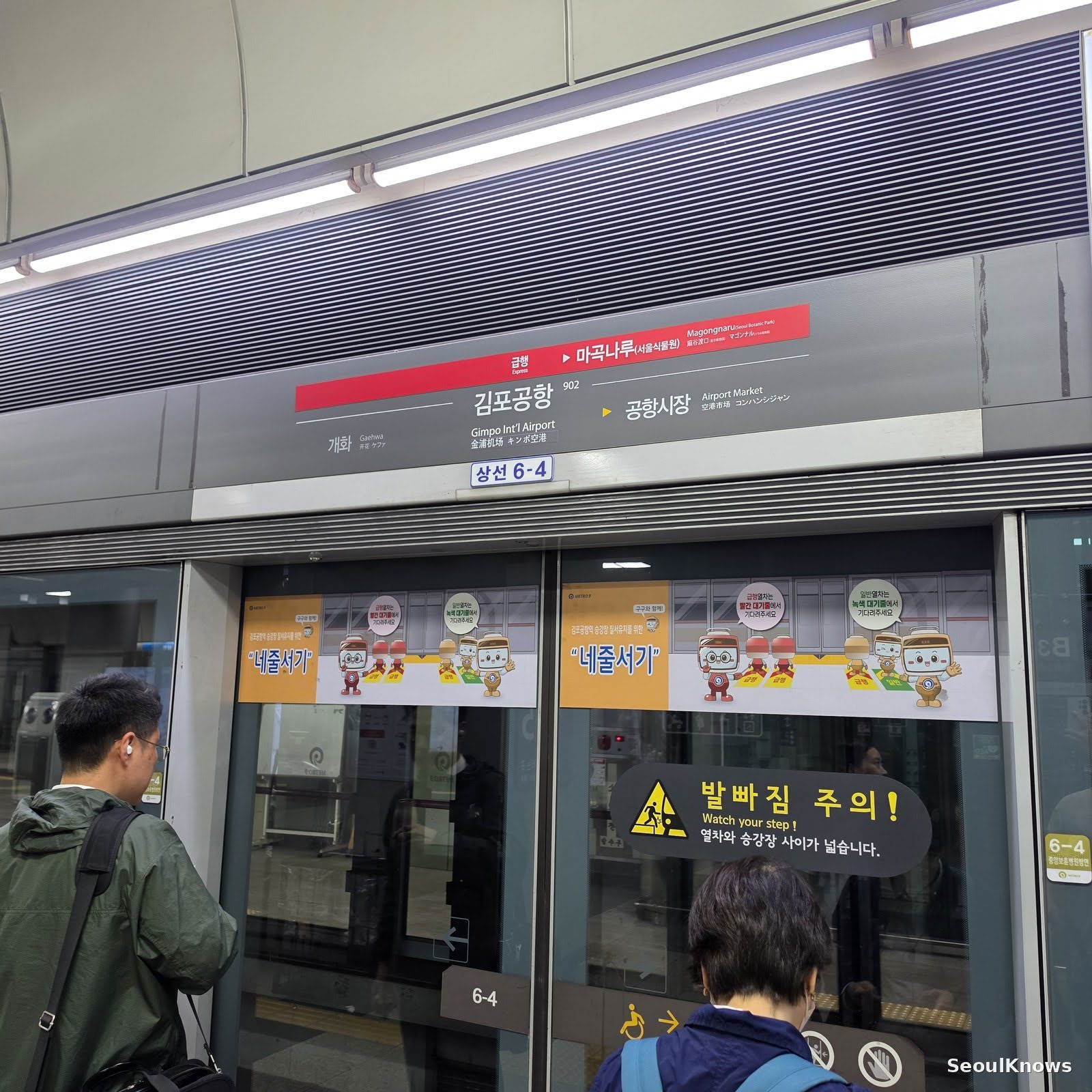
Once you are off the train, follow the signs marked 국내선 (Domestic). It is a signposted indoor walk and you never go outside. One thing worth knowing if you are carrying luggage or traveling with a small child: that walk is long. Which brings us to a free service most people walk straight past.
The free electric cart between the station and the terminal
Painted on the floor between the station and the terminal, in blue, is a marking that reads Electric Cart Stop (교통약자 전동카트 탑승장소). This is Korea Airports Corporation’s Mobility Assistance Service, and it is a staffed shuttle rather than something you borrow. A driver runs a pink open-sided electric cart, with a metal luggage trailer hitched behind it, back and forth along that long connecting corridor between the subway station and the domestic terminal entrance.
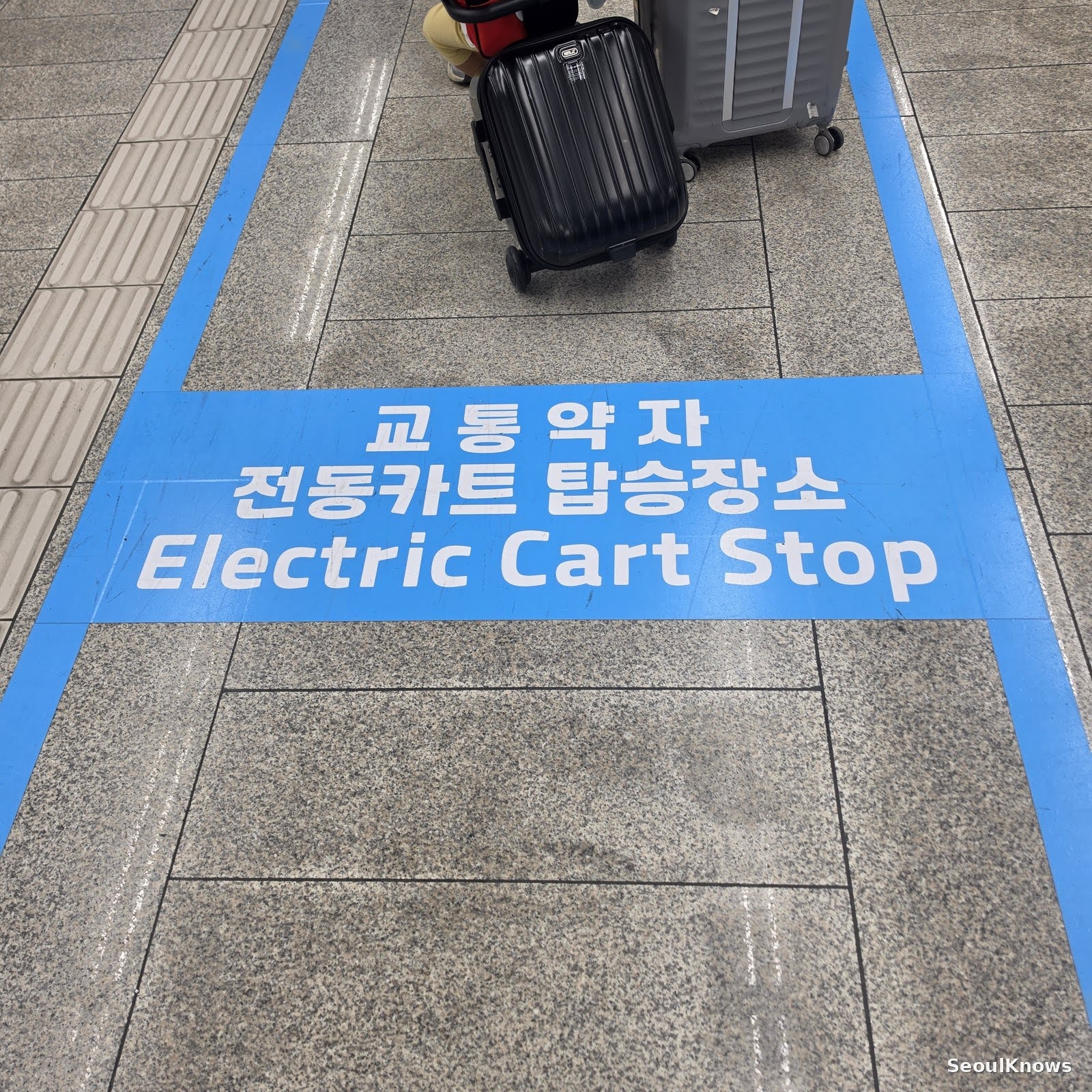
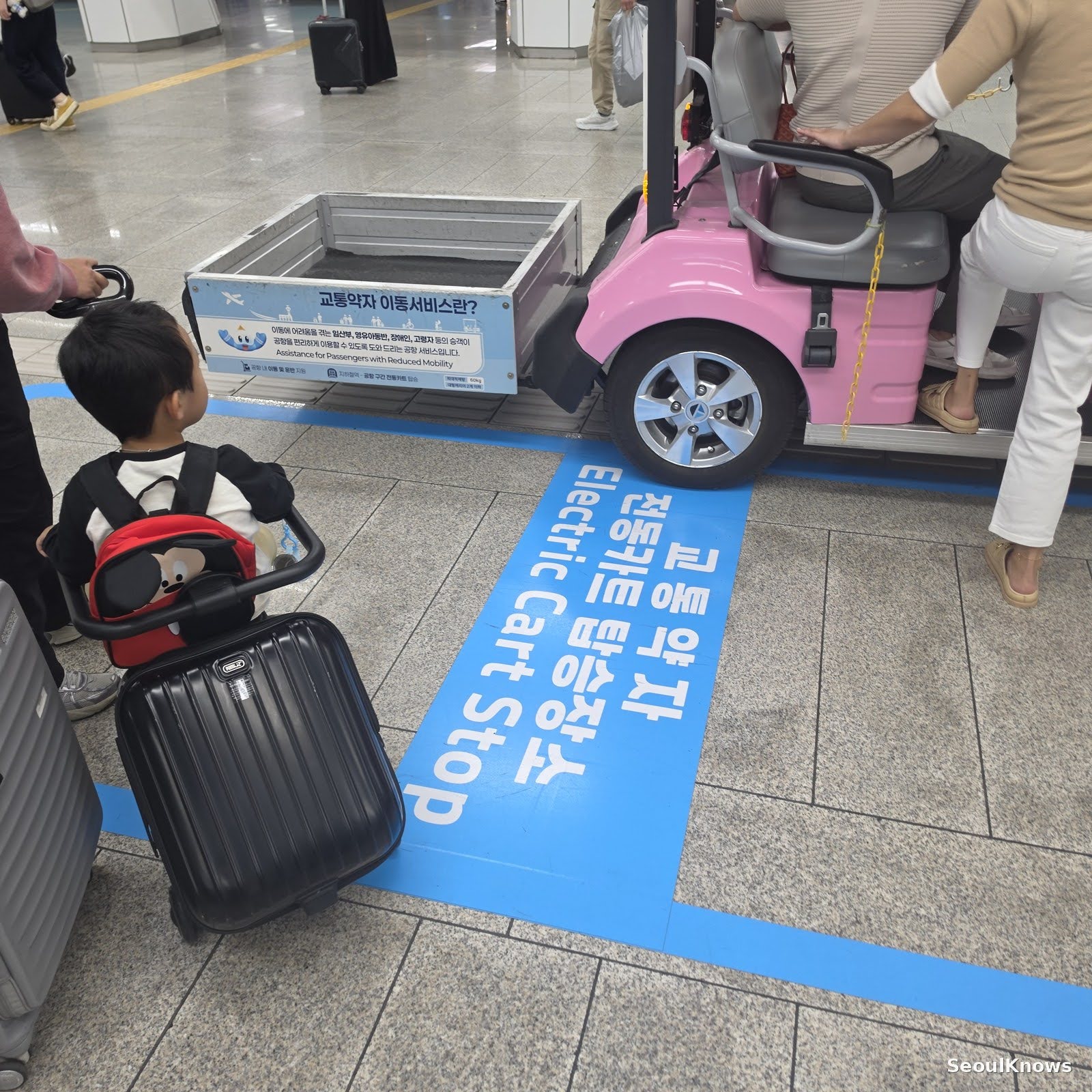
People do use it. There is usually a group waiting at the stop and you may have to let one run go before you get a seat, so if you are eligible, walk to the stop rather than assuming it will be sitting empty. The stop is in front of the underground information desk.
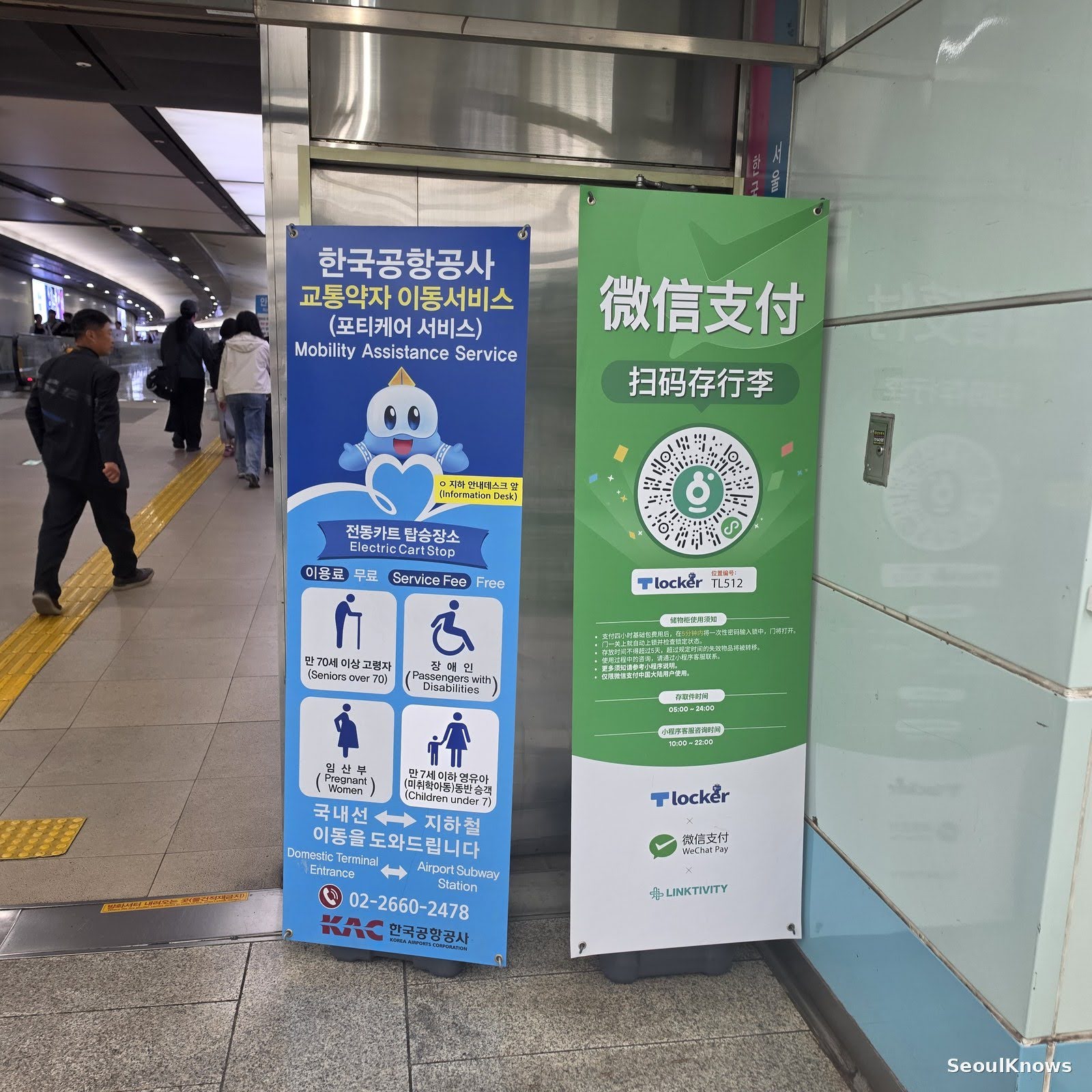
Who can ride. The standing sign at the stop is more specific than the English phrase “reduced mobility” suggests:
Seniors aged 70 and over
Passengers with disabilities
Pregnant passengers
Anyone traveling with a child aged 7 or under
There is no fee and no booking. The trailer takes up to 60kg and no more than two large suitcases, and the contact number posted on the sign is 02-2660-2478.
We used it. Our suitcases went into the trailer at the back, we sat on the bench seats, and the whole long corridor went past in a couple of minutes instead of a slow walk with a toddler who wanted to stop and look at everything. For him it was the best part of the morning. He talked about the pink car for the rest of the trip. For us it meant arriving at the check-in hall without having dragged two bags and a three-year-old the length of the building.
If you are flying with a small child, this is the single most useful thing in this guide. It is signposted in Korean and English at the stop itself, but almost nothing in English online tells a visiting family that a preschooler qualifies them for it.

If you do not qualify, the stop is still worth knowing. It is a landmark on a corridor that does not have many, and the overhead signs at that point are also where the route splits off towards the National Aviation Museum.
Finding your check-in counter
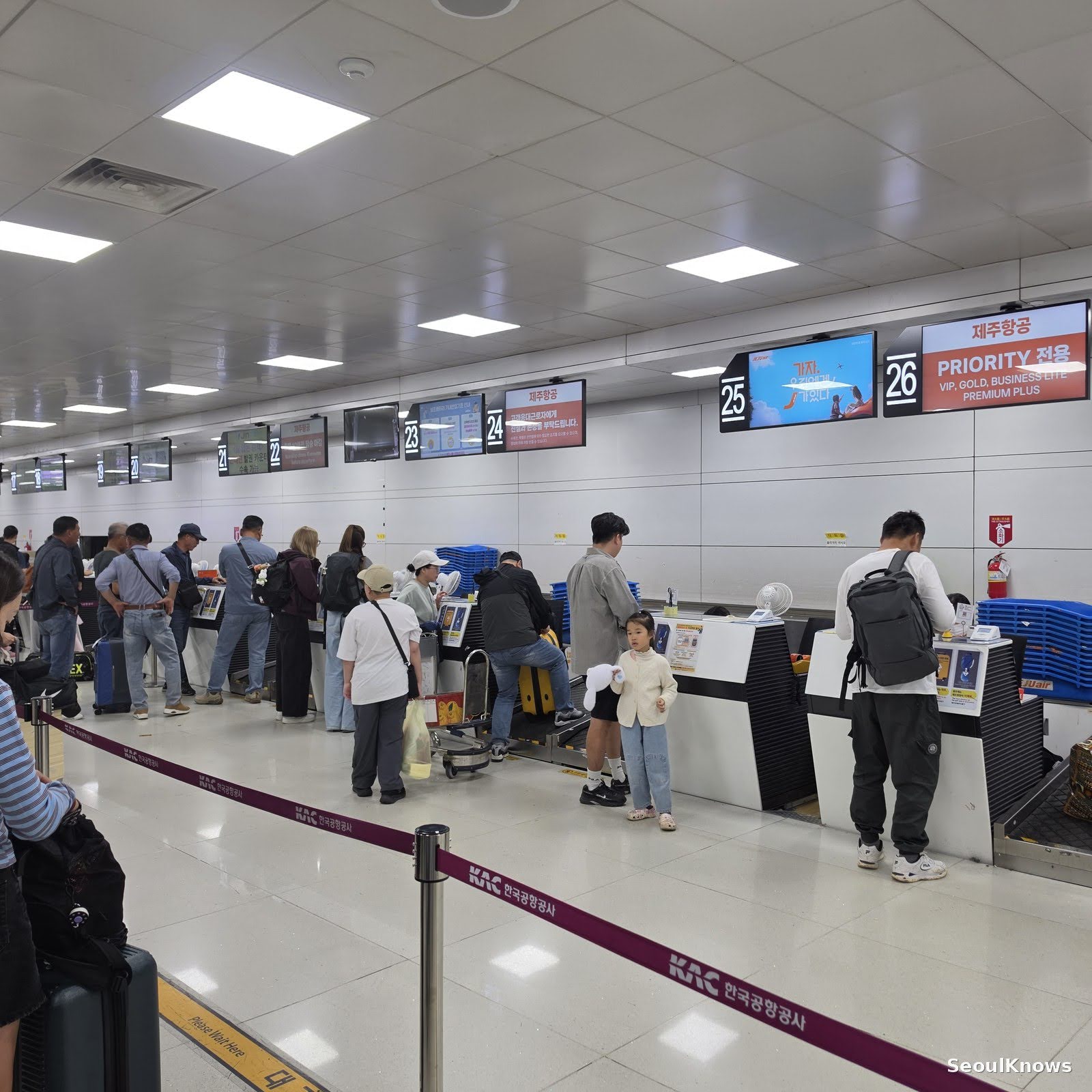
This is where Gimpo differs from most airports you have used. The departures hall is one long row of numbered desks, and each airline owns a block of numbers. The overhead signs show the airline logo above its range. There is no “Zone D, go to row 4”. You are looking for a number.
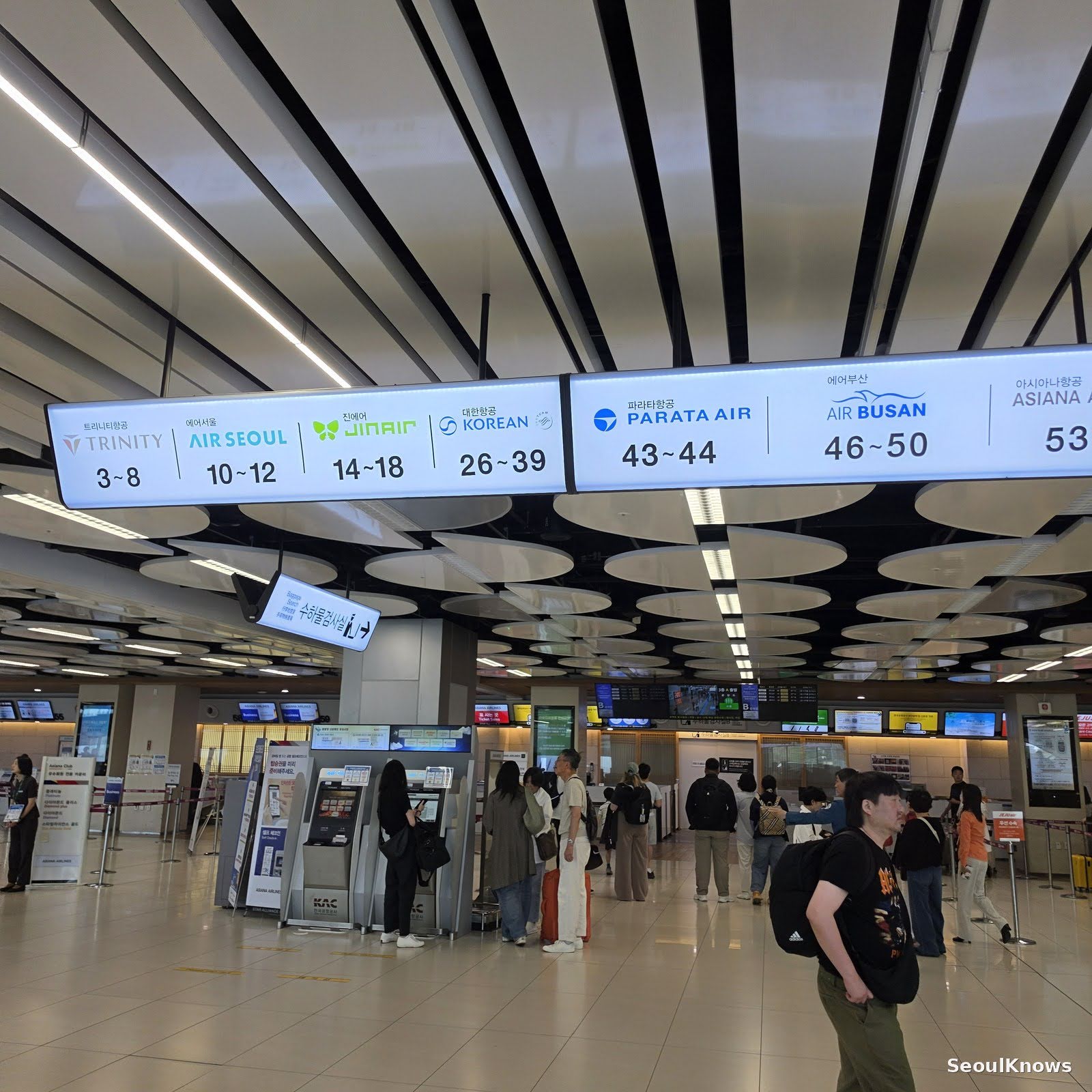
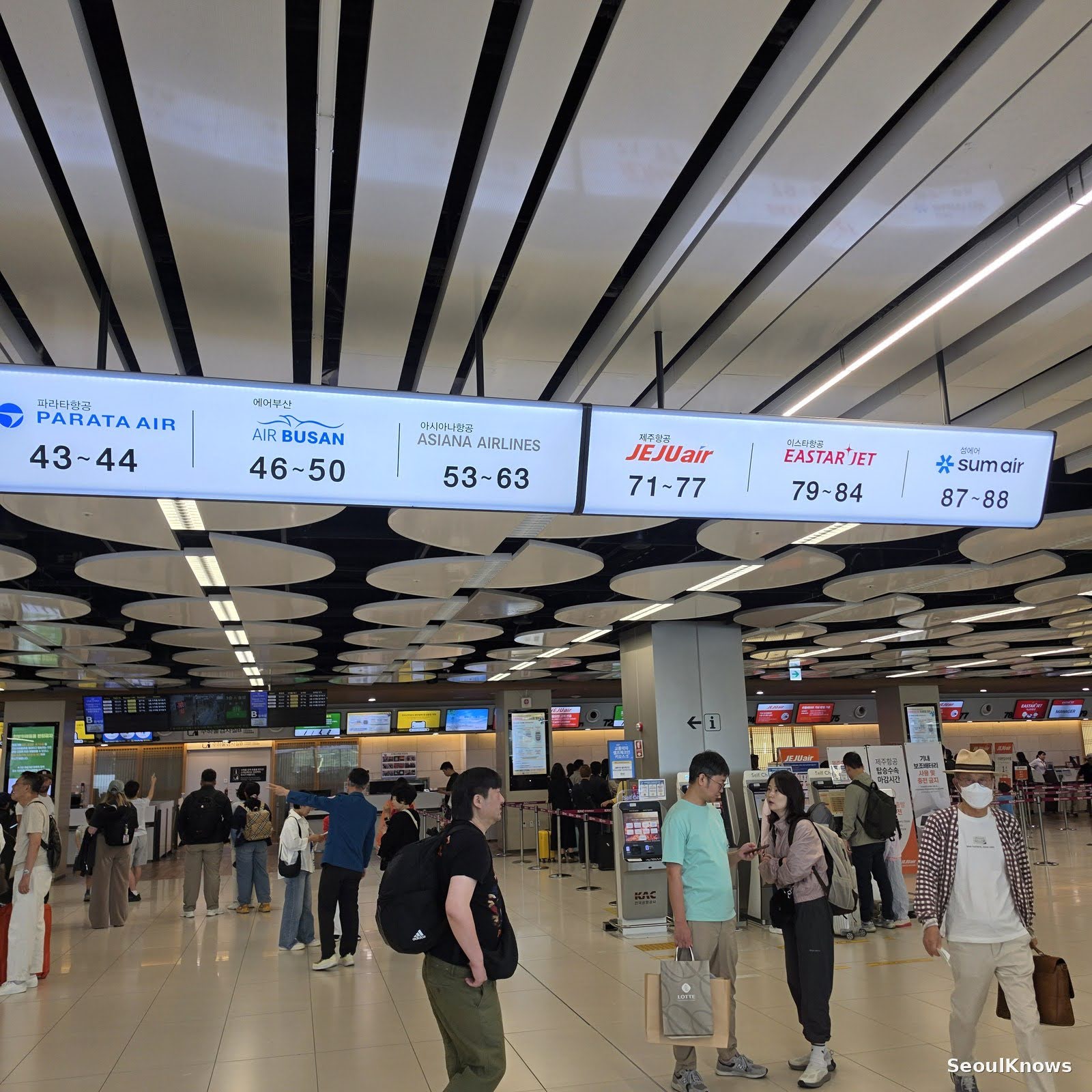
Here is the full counter map as posted in October 2026:
Trinity Air: 3-8
Air Seoul: 10-12
Jin Air: 14-18
Korean Air: 26-39
Parata Air: 43-44
Air Busan: 46-50
Asiana Airlines: 53-63
Jeju Air: 71-77
Eastar Jet: 79-84
Sum Air: 87-88
One name will catch you out. If you booked with T’way Air, look for Trinity Air. T’way rebranded as Trinity Air on 10 September 2026 and the airport counters changed name with it. The airline code and flight numbers did not change, so your ticket still says TW and an old booking confirmation in the T’way name is still valid. There is simply no T’way counter at Gimpo any more.
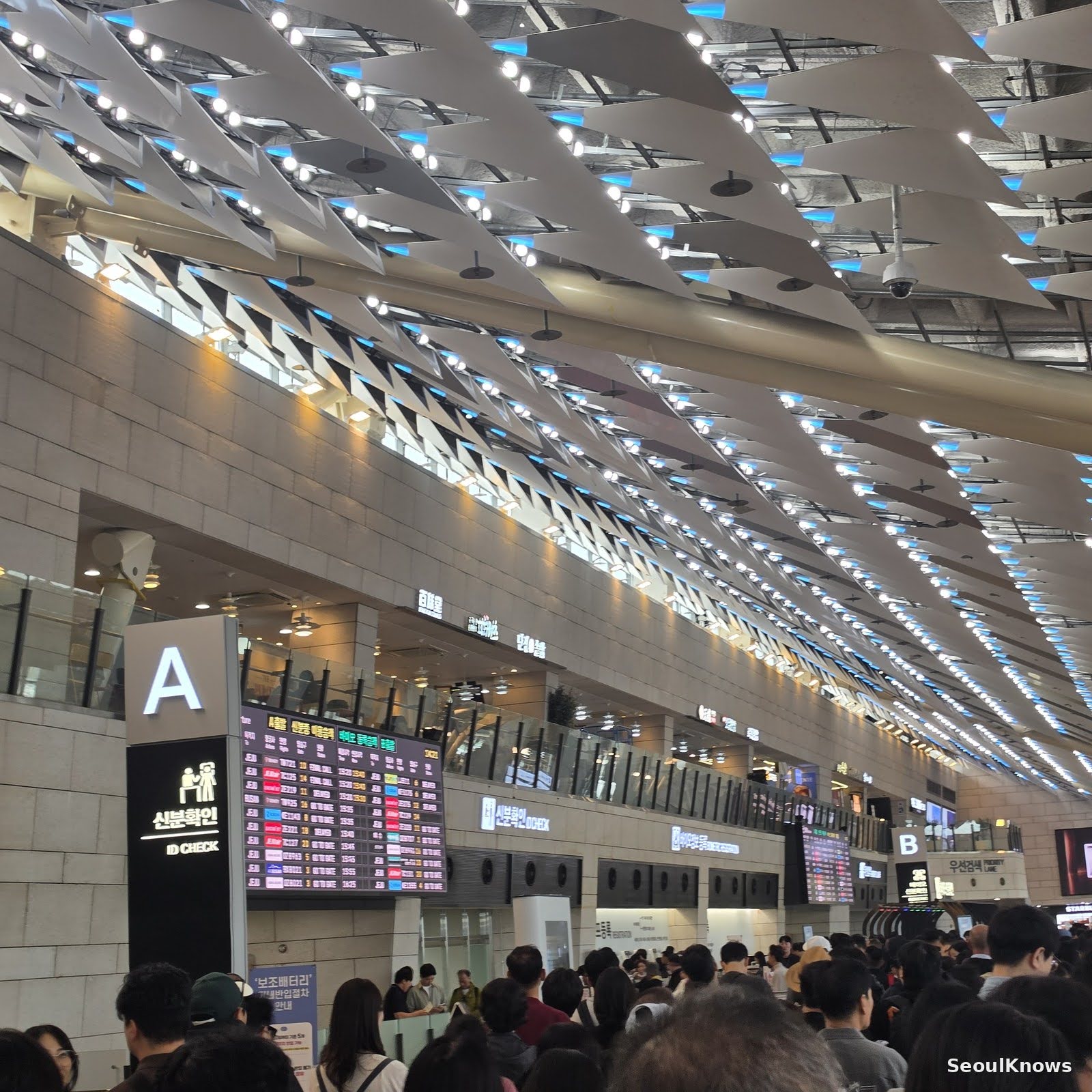
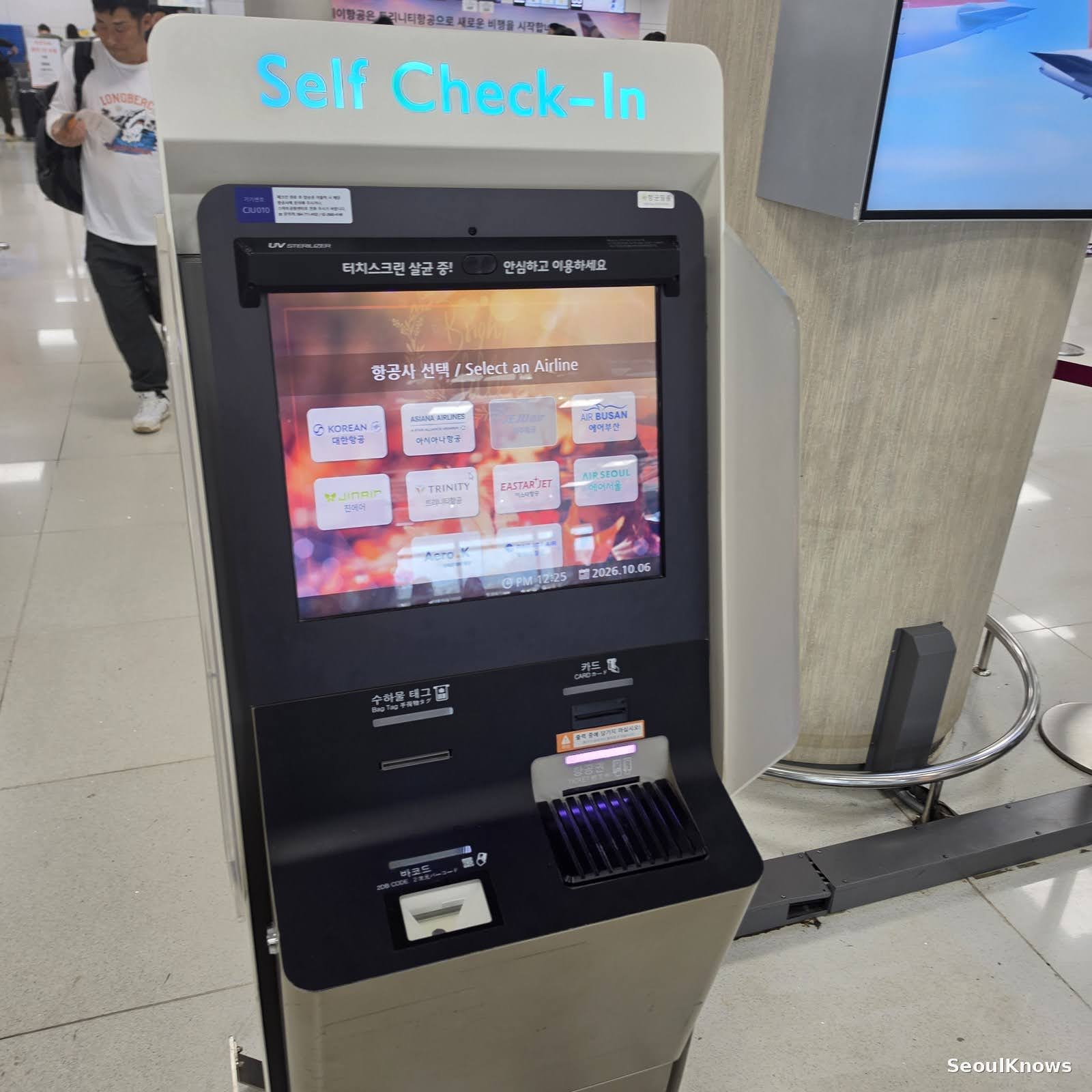
Counters are grouped into zones A and B. We flew on a public holiday weekend and zone A was backed up well past the barriers. Self check-in kiosks sit in front of most counter blocks, and if you have no checked bag you can skip the desk entirely.
Be honest with yourself about when you are flying. Gimpo to Jeju is a domestic commuter route most of the year and an hour is plenty. But Korean school holidays (late July to mid-August), Chuseok, Lunar New Year and any three-day weekend turn this hall into a crush, and the two queues that eat your time, bag drop and security, can each run 20 minutes on their own. In those weeks give yourself 90 minutes to two hours, and check in online the night before. With no checked bag and an online check-in already done, the whole thing collapses to a few minutes.
Bring your passport. Domestic flights in Korea still require photo ID at both check-in and the security gate, and for foreign passengers that means your passport, or your ARC if you are a resident. The name on your booking has to match it.
Honest Seoul tips, once a week. Get the newsletter →
Time to kill? There is a museum and a mall right here
This is the part of Gimpo most people do not plan for. Both are landside, so drop your bag first and go before security. Once the bag is gone you are free until boarding.
The National Aviation Museum of Korea is about 400m from the domestic terminal: from the first floor, follow the museum signs out towards car park 2. There is also a free airport shuttle from Gate 4 every 15 to 20 minutes. Admission is free, there are real aircraft in the atrium and parked outside, and with a child who is already excited about flying it is close to a cheat code. It opens Tuesday to Sunday, 10:00 to 18:00, last entry 17:30, and is closed every Monday. Full write-up here: The National Aviation Museum of Korea with a toddler.
Lotte Mall Gimpo Airport connects straight to Gimpo Airport Station, so you never go outside: department store, Lotte Mart, a cinema and a full floor of restaurants that beats anything airside.
Through security, and what to eat airside
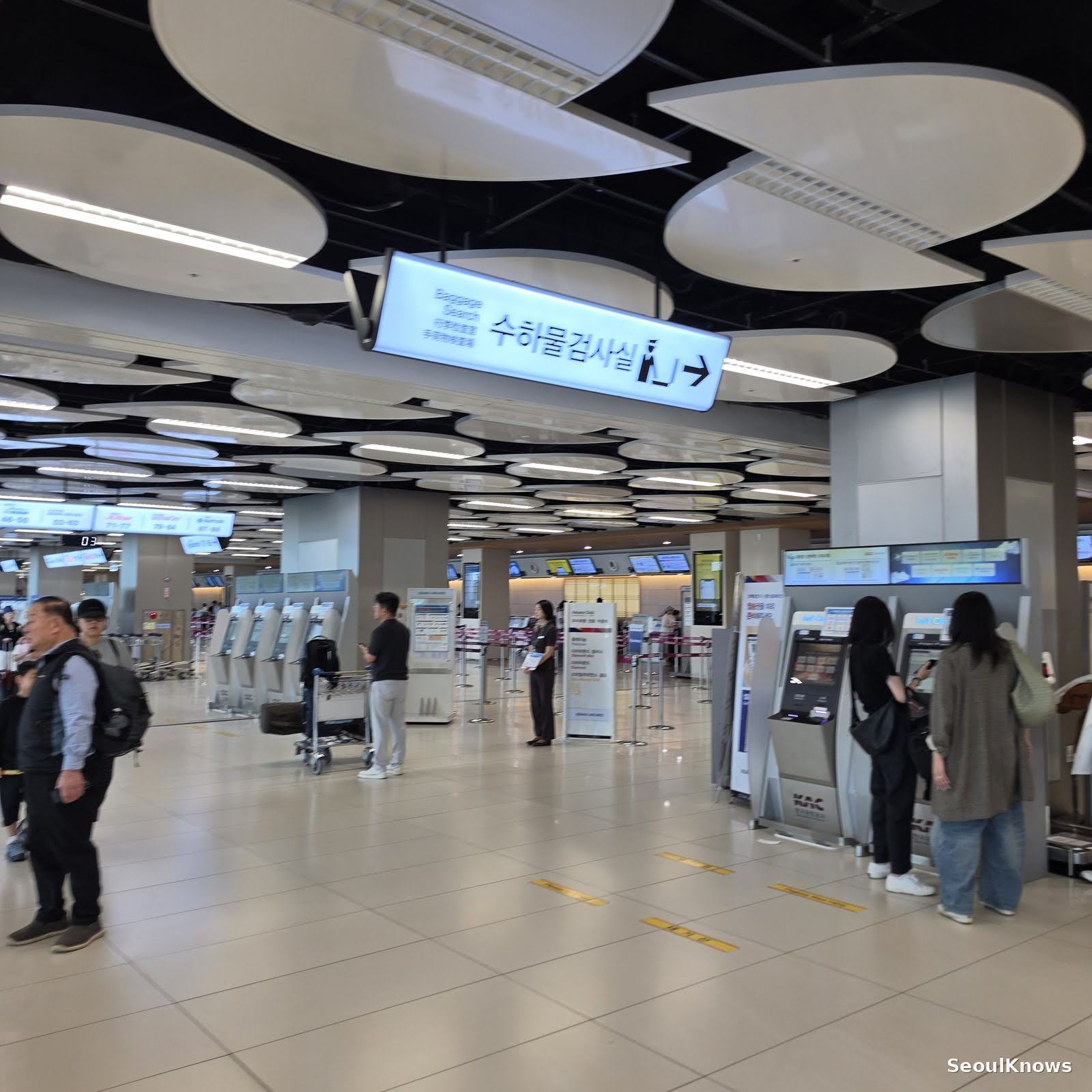
Domestic security at Gimpo is noticeably quicker than international: no immigration, no passport control, and the liquids rules are far more relaxed. Follow the signs for 수하물 검사 (baggage screening). Counters typically close around 30 minutes before departure.
The airside concourse is better than you would expect from a domestic terminal. OSULLOC, the Jeju green tea brand, has a full counter, which is mildly funny given where you are flying, but it is genuinely the easiest place in Seoul to pick up their tea sets as a gift.


The food court runs on touchscreen kiosks with photo menus, so no Korean is needed. The main counter is Flavour6 Express, with Ri Gimbap rice rolls and Dal.Komm coffee under the same roof. Prices as posted in October 2026: udon sets 14,900 won (udon alone 9,500), seolleongtang or yukgaejang 14,000, and gimbap from 5,500 for the vegetable roll to 6,500 for tuna. Two-person sets run 22,900 to 24,900. It was full at lunchtime on a holiday, with a 만석 (fully occupied) sign out.

Traveling with a baby or toddler
Gimpo’s domestic terminal has proper nursing rooms airside, not just a changing shelf in the toilets. Ours had a private feeding booth with a door, a changing table, a sink, and a hot and cold water dispenser for making up bottles, which is the detail that actually matters when you are mid-trip with a toddler.


The flight itself is short, roughly an hour in the air.
One thing worth bracing for: Jeju is windy. The island sits in open sea and the approach is frequently bumpy, sometimes enough that the cabin goes quiet on the way down. It is normal and the crews fly it every day. What does matter for planning is that strong wind is also the main reason Jeju flights get delayed, held, or occasionally diverted, so do not book a tight onward connection out of Gimpo or Jeju on the same day if you can avoid it.

Landing at Jeju: the first five minutes
Jeju Airport is small and the arrivals flow is straightforward, but the signage splits three ways almost immediately and you want to know which one you are before you walk out.

The overhead signs after baggage claim give you Taxi / Bus, P1 Parking, P2 Long-term Parking, and Rental Car, each with an arrow. They point to genuinely different exits.


Taxis and buses leave from Gate 1. Airport limousine coaches and city buses pick up on the road directly outside. Check the current route number for your destination at the information desk, because Jeju has reorganized its bus network more than once.
If you need sunscreen, toiletries or a phone cable before you start driving, there is an Olive Young in the arrivals hall, cheaper and better stocked than anything you will find at a convenience store on the road.

If you booked a rental car
We were traveling as an extended family, which settled the rental car question before we even landed. With a group that size, taxis mean splitting across several vehicles and the bus network does not reach most of what you actually came to Jeju for.
Rental companies at Jeju do not have desks in the terminal. You walk out, cross to a covered shuttle walkway, and find your company’s numbered stop: bays 1 to 7, each served by a branded minibus that runs to that company’s off-airport office.


There is a real-time arrivals board at the walkway showing which company’s shuttle is due and in how many minutes. It is the single most useful screen at Jeju Airport and it is easy to miss. With a group and a pile of suitcases it is worth checking before you all walk over, so you are not standing in the open with nothing to do. Shuttles run every few minutes at peak; the ride to the rental offices takes under ten.

Book ahead
Jeju is one of the few places in Korea where a car genuinely beats public transport. The island’s best spots are strung along the coast road with thin bus coverage. Rates climb steeply in peak season, and if you are traveling as a family group the vans and seven-seaters go first, so book before you fly rather than at the counter.
Check Jeju car rental prices on Trip.com →
Booking through this link costs you nothing extra and helps keep SeoulKnows running.
Note that most Jeju rental companies have moved to an unmanned pickup system: you collect a dispatch slip from a kiosk at their office and take the key from a numbered key box in the car park, with no staff involved. It is efficient once you know it, and completely opaque if you don’t. That is a guide of its own, and it is coming.
Flying home from Jeju
Jeju’s departures floor works the same way as Gimpo’s, with numbered counters by airline and self check-in kiosks in front of them, but the hall is narrower and it funnels. On a Monday lunchtime every counter had a queue.
Past security the concourse opens up under a white whale sculpture hanging from the ceiling, the easiest meeting point in the building if your group splits up to shop.

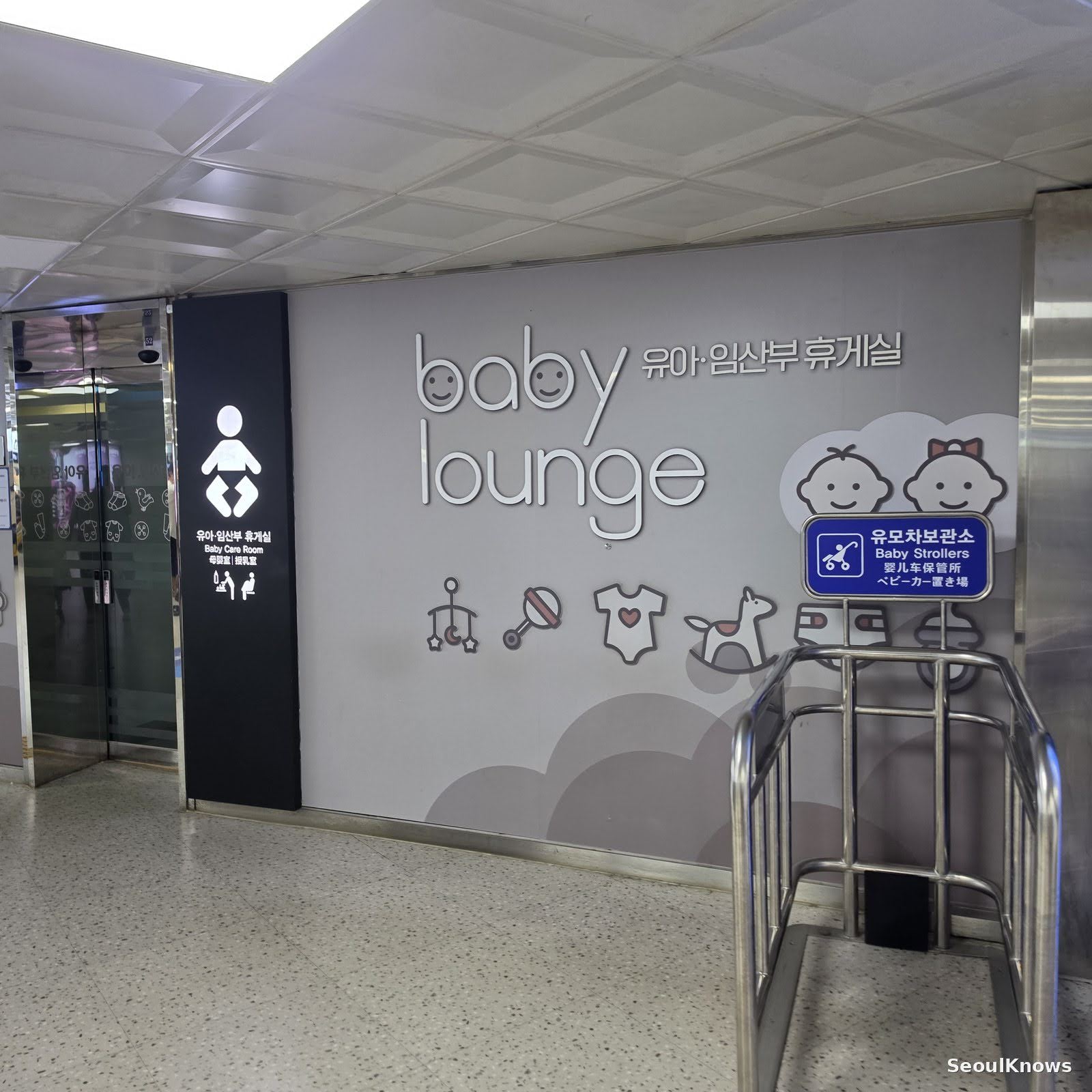
On the way back, Jeju’s departures floor has something Gimpo doesn’t: a dedicated Baby Lounge (유아·임산부 휴게실), a walled room rather than a cubicle. Inside there are curtained feeding booths, a changing bench, a sink at adult height, a water dispenser and a small sofa area.

The souvenir every Korean is queuing for
Walk the departures concourse and you will pass a Paris Baguette with a crowd around it. They are not there for bread. They are there for Jeju Maeum Sand.
It is a butter biscuit sandwich filled with a paste made from Udo peanuts, grown on the islet off Jeju’s east coast. Paris Baguette launched it in August 2019 as a Jeju-only product, and that restriction is the whole point: not in Seoul, not online, only here. Over a hundred million boxes sold, and it still clears out on busy days. Region-locked snacks are a real part of Korean travel culture, the same way Tokyo Banana works in Japan, so coming home without a box for the office is a small social failure. People queue.


Here is the part that confuses everyone, including us. The shelves under the Jeju Maeum Sand sign are empty. Bare wood and a stack of flat-packed boxes on the floor. It looks sold out, and people turn around and leave.
It is not sold out. You cannot buy it off the shelf at all. It has its own touchscreen kiosk, set slightly apart from the main counter, and that is the only way to order it. You pay at the kiosk and collect.
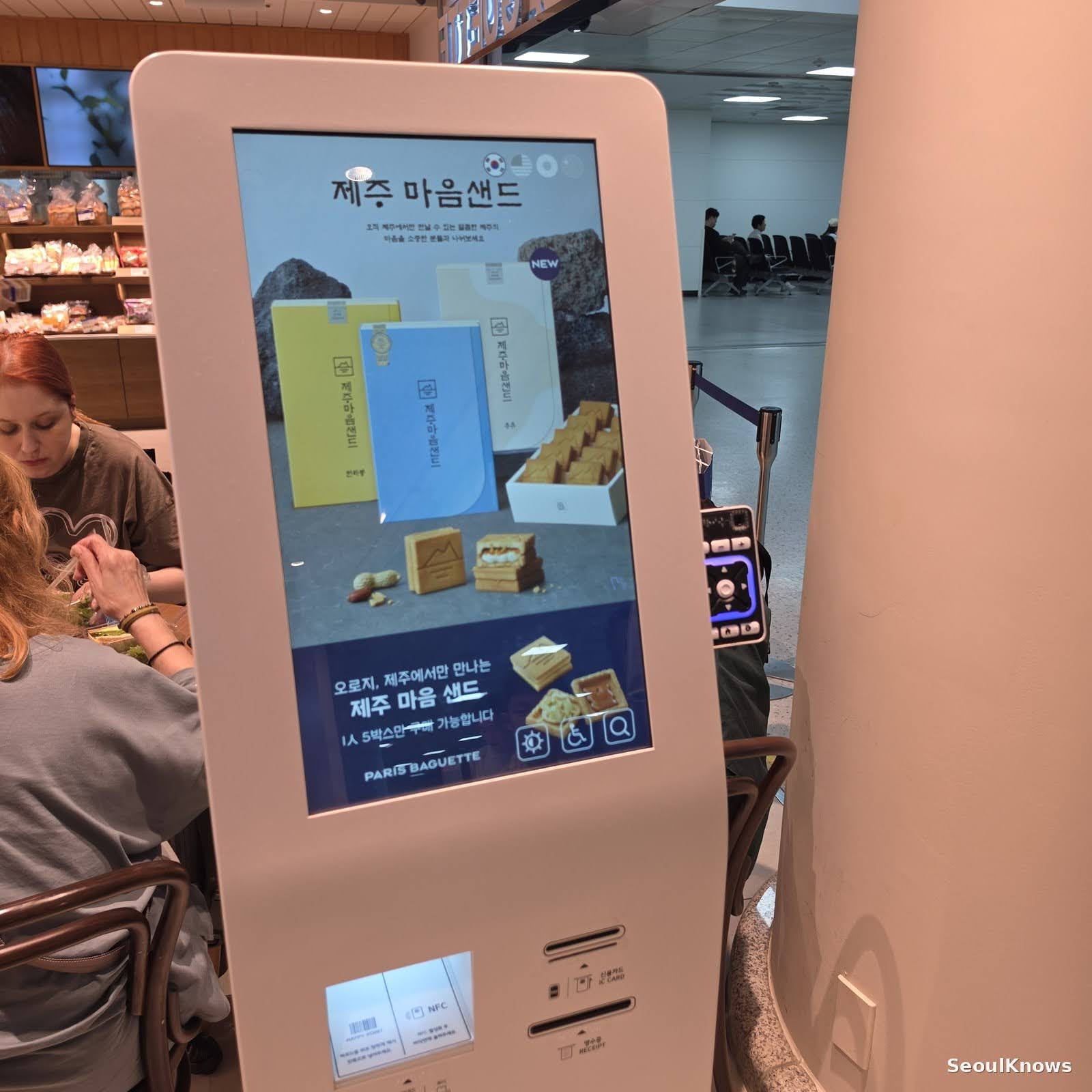
Prices in October 2026 were 19,800 won a box, in three varieties, the original peanut plus milk and hallabong tangerine, all the same price. There is a limit of five boxes per person. If the kiosk shows stock, buy it when you see it rather than after your gate is called, because it does genuinely run out on busy days.
There is also a stroller parking rail at the door. If you are flying with an infant, it is worth clearing security early and using it rather than fighting for space at the gate.
The departures floor map is posted at the escalators and is worth thirty seconds. The shops, food and lounge are spread along one long corridor and it is not obvious which end you need.

Quick facts
Route: Gimpo (GMP) to Jeju (CJU), roughly 1 hour in the air
Terminal: Gimpo Domestic Terminal, a separate building from International
Getting there: Gimpo Airport Station (Subway Line 5, Line 9, AREX, Gimpo Goldline)
Arrive: about 1 hour normally, 90 minutes to 2 hours in peak season and on holiday weekends; counters close around 30 minutes before
ID: passport for foreign visitors, ARC for residents, required at check-in and security
Check-in counters: assigned by number, not name (see the counter map above)
At Jeju: taxis and buses from Gate 1; rental car shuttles from numbered bays 1 to 7
Frequently asked questions
Do I need my passport for a domestic flight in Korea?
Yes. Photo ID is checked at check-in and again at the security gate. For foreign visitors that means your passport; residents can use an ARC. The name on the booking must match.
Is Gimpo’s domestic terminal the same building as international?
No. They are connected and share Gimpo Airport Station, but they are separate terminals. Follow signs for 국내선 (Domestic).
How early should I get to Gimpo for a Jeju flight?
An hour is comfortable most of the year, including the walk from the station. In peak season (Korean school holidays, Chuseok, Lunar New Year, any three-day weekend) allow 90 minutes to two hours.
I booked T’way Air but I cannot find the counter.
T’way Air became Trinity Air on 10 September 2026. Look for Trinity Air at counters 3 to 8. The TW flight code and your existing booking are unchanged.
Can I use the free electric cart?
If you are 70 or over, pregnant, a passenger with a disability, or traveling with a child aged 7 or under, yes. It is free and there is no booking: wait at the marked Electric Cart Stop in front of the underground information desk. The trailer takes up to 60kg and two large suitcases. Expect a short wait; it is a popular service.
Where do I buy Jeju Maeum Sand?
At Paris Baguette in the Jeju departures concourse, but not over the counter. The shelves under the sign are deliberately empty; order from the dedicated touchscreen kiosk beside the shop. 19,800 won a box, five boxes maximum per person.
The bottom line
Gimpo to Jeju is an easy flight made confusing by a handful of small things: the wrong terminal, a counter system based on numbers, and signage that assumes you already know the drill. Give yourself an hour, note your airline’s counter block before you arrive, and know which of the three exits at Jeju you are heading for. We went out through the rental car one, with a toddler, several grandparents and more suitcases than any of us wanted to carry, and it still took us a good deal more than twenty minutes from the baggage belt to sitting in the car. Everything after that is palm trees.
New to Seoul? Start with our First Time in Seoul guide: the airport, the subway, what to see and what to eat, on one page.
Written by WY, a Seoul-based local sharing honest, first-hand guides to Korea. Every guide here is a place I’ve actually been to, written from my own visit, my own photos. More about me →