
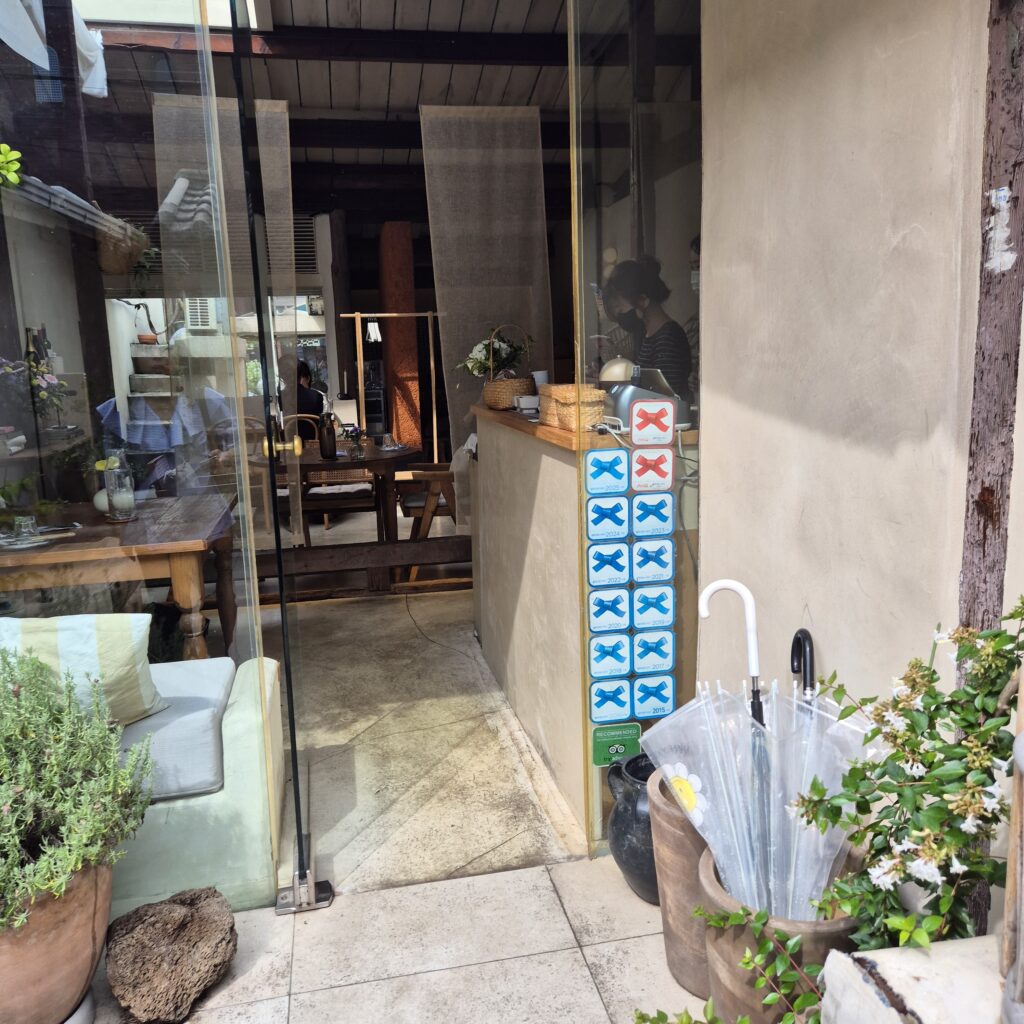
If you’ve spent any time hunting for good food in Korea, you’ve probably noticed a little blue ribbon sticker on some restaurant doors — sometimes a whole column of them, one for every year, like the spot in the photo above. That’s the Blue Ribbon Survey, and once you know how to read it, it’s one of the most useful tools for eating well in this country. Here’s the quick version.
So what is it?
The Blue Ribbon Survey (블루리본 서베이) is Korea’s first proper restaurant guide, first published in 2005. It’s often called “Korea’s Michelin,” but there’s one key difference: the ratings don’t come from anonymous inspectors — they come from ordinary diners who actually eat there. Years of that feedback get filtered into a curated guide published annually. (The name comes from the “Blue Riband,” an old Western term for top honors.)
How the ribbons work
Instead of stars or scores, places are rated with — you guessed it — ribbons, one to three of them:
- 1 ribbon — a place worth going back to.
- 2 ribbons — a place you’d happily recommend to friends.
- 3 ribbons — the best of the best in its category.
Three ribbons is the big one. To put it in perspective, the 2025 Seoul edition gave three ribbons to just 38 restaurants — so even one ribbon on the door is a genuine mark of quality. Rated spots get an official sticker on their door or window, which is why you can spot a Blue Ribbon pick just walking past. A stack of them, year after year, means a place that’s stayed good for a long time.
Wait — some of them are red, not blue
Good eye. Those red ones are the Red Ribbon, a 2024 collaboration between Blue Ribbon Survey and Coca-Cola — not a higher tier. From restaurants already in the Blue Ribbon guide, around 550 nationwide were singled out as places whose food pairs especially well with an ice-cold Coke. The three things they looked for were: dishes that go great with a cold drink (think meat, pizza, burgers, fried food, spicy stuff), consistently strong food and reviews, and a relaxed, friendly dining experience.
(You might also spot a yellow version — that’s a tie-up with the beer brand Kelly.) Bottom line: blue tells you the place is a proven Blue Ribbon pick; red is a fun “great with a cold drink” badge layered on top. The rating that matters is still the ribbon count.
Who actually decides?
In the early years an expert panel made the final call, but that was dropped — after years of data, the public’s verdict was landing in almost exactly the same place as the experts’ anyway. So today the ribbons are decided by everyday reviewers. (Another shift: since 2023 the guide also includes franchise and chain restaurants, not just independent and owner-chef spots.)
How to use it as a traveler or expat
- The website and app (bluer.co.kr) let you search rated restaurants and cafés. Heads up: it’s mostly in Korean, so a translation app helps.
- Look for the sticker. Honestly the easiest move — if you see the ribbon on the door, you’re in good hands.
- Match ribbons to your plans. One ribbon is a safe, solid meal; two is worth a detour; three is worth planning your day around.
The printed guide comes out twice a year — a Seoul edition and a national edition (everywhere except Seoul) — but you don’t need to buy anything to benefit from it.
One thing to watch out for
These days restaurants can pay to list themselves on the Blue Ribbon website, so “it’s on the site” doesn’t automatically mean “it’s great.” The real signal is whether a place made the printed guide and how many ribbons it actually holds — not just a web listing.
Isn’t checking Naver or Google reviews enough?
Different tools for different moments. Naver and Kakao reviews are great for the right now (“what’s good near me, open late?”). Blue Ribbon is more like a trusted shortlist — curated, consistent, and harder to game than a pile of star ratings. If you want to skip the tourist traps and eat where locals genuinely rate the food, it’s one of the most reliable signals you’ll find in Korea. Next time you spot that little ribbon, you’ll know it’s not just decoration.