

If you will stay in Korea longer than 90 days, you need an ARC, officially the Residence Card. You register at the immigration office that covers your home address within 90 days of landing. This guide covers the 2026 fee, the new Seoul Immigration Office address, which office takes your district, the documents for every housing type, and what to do while you wait.
The short version
| Deadline | Within 90 days of entry |
| Where | The immigration office for your district, not the closest one |
| Booking | Required, on HiKorea |
| Fee | KRW 35,000 in cash, or about KRW 39,000 with delivery |
| Bring | Passport, application form, one photo, proof of address, visa documents, cash |
| Wait | About 3 to 4 weeks, longer at the start of a semester |
Almost everyone, including banks and phone shops, still says ARC. In Korean it is 외국인등록증 (oegugin deungnokjeung).
Which Seoul office covers your district
Seoul has three offices for registration, and you must use the one that covers the district (구) on your proof of address. Booking the wrong one means starting over.
| Office | Districts it covers | Address |
|---|---|---|
| Seoul Immigration Office 서울출입국·외국인청 Munjeong-dong | Gangnam, Seocho, Songpa, Gangdong, Yongsan, Seongdong, Gwangjin, Dongjak, Gwanak. Also Seongnam, Hanam, Gwacheon. | 55 Jeongui-ro, Songpa-gu. Munjeong Station (Line 8) Exit 4, then a 10 minute walk. |
| Sejongno Branch 세종로출장소 Jongno | Jongno, Jung, Eunpyeong, Dongdaemun, Jungnang, Dobong, Seongbuk, Gangbuk, Nowon | Seoul Global Center 2F and 3F, 38 Jong-ro, Jongno-gu |
| Seoul Southern Immigration Office 서울남부출입국·외국인사무소 Magok | Seodaemun, Mapo, Gangseo, Yangcheon, Yeongdeungpo, Guro, Geumcheon | 48 Magokseo 1-ro, Gangseo-gu |

Before you book, know this:
- The Seoul Immigration Office moved on October 19, 2026. It left Mok-dong after 36 years and now sits in Munjeong-dong, Songpa-gu. The Mok-dong building handles nothing, and many older guides and saved map pins still point there.
- Hongdae, Sinchon, and Yeonnam are in Mapo and Seodaemun, so students at Yonsei, Ewha, Sogang, and Hongik go to Magok.
- In the HiKorea booking menu, the Magok office appears as Seoul Nambu Immigration Office and the Jongno branch as Seoul Immigration Office Sejongro Branch.
Living in Korea?
Get Seoul in your inbox every Monday.
New guides like this one, this week's events and new Seoul Hacks. One email a week, free.
Who needs an ARC, and by when
Anyone who will stay more than 90 days must register within 90 days of the day they entered Korea. This comes from Article 31 of the Immigration Act, and the clock starts at the airport, not when your job or semester starts.
- Students (D-2, D-4), workers (E visas), family visas (F-1, F-2, F-3, F-6): you register.
- Overseas Koreans on F-4: you file a domestic residence report instead and receive a different card.
- Diplomats and staff of embassies and international organizations (A-1, A-2, A-3): exempt.
- Tourists and anyone staying 90 days or less: no card, and no way to get one.
Book early. Slots at Seoul offices fill up around March and September, and a late registration brings a fine.
The timeline at a glance
Same info as a list
- Day 1 to 7: book. Reserve your visit on HiKorea as soon as you have an address. You do not need a Korean phone number to book.
- Before the visit: collect documents. The proof of address takes the longest, so start there.
- Visit day: about 1 to 3 hours. Hand in documents, pay the fee, give ten fingerprints.
- Waiting: 3 to 4 weeks, longer in March and September. Your registration number exists before the plastic does. A paper certificate can stand in for the card at some counters.
- Card day. Pick it up or receive it by mail, then set up your phone plan, bank account, and mobile ID.
Honest Seoul tips, once a week. Get the newsletter →
Step 1: Book your visit on HiKorea
You cannot walk in. Registration counters at Seoul offices serve people with a HiKorea reservation, with limited exceptions such as applicants aged 70 or older and pregnant applicants.
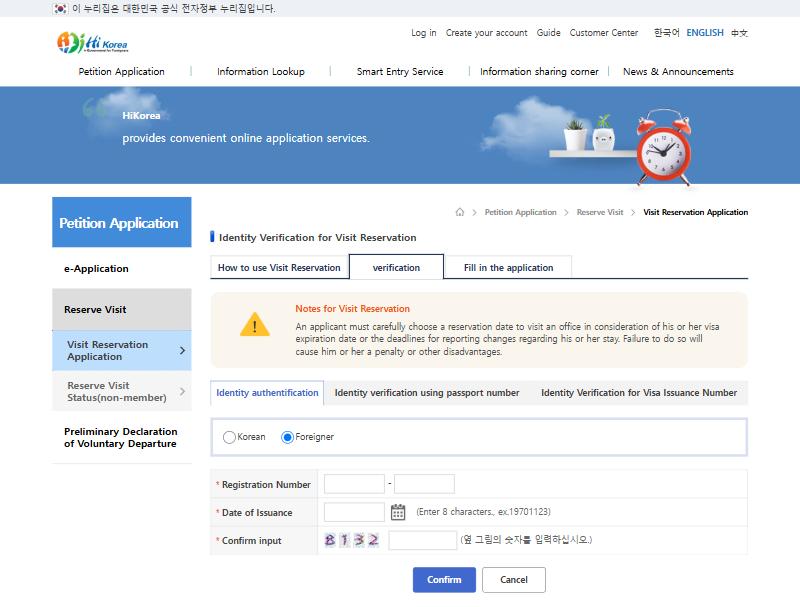
- Go to hikorea.go.kr and switch the language to English.
- Open Reserve Visit (방문예약). The path is Petition Application > Reserve Visit.
- Read the notice, tick the box at the bottom, and press Visit Reservation Application (Non-member).
- Choose the tab Identity verification using passport number, then enter your passport number, nationality, and date of birth. No account is needed. This tab works only once you have entered Korea, so you cannot book from abroad.
- Choose the office that covers your district and the service Foreign Resident Registration (외국인등록).
- Pick a date and time, then save or print the confirmation with its reservation number. You can change or cancel until the day before, not on the day itself.



If no slots are showing: check again early in the morning and late at night. People cancel, and freed slots reappear without notice. University students should ask their international office first, because many schools file group applications each semester.
If no slot exists before your 90 days end: HiKorea's own notice says to visit the office for your district in person before the deadline passes. A reservation by itself does not count as registering, so a slot dated after day 90 does not protect you. Call 1345 first to confirm what to bring. The immigration contact center answers on weekdays from 09:00 to 22:00.
Step 2: Documents and fee
Everyone brings the same six items. The proof of address is where most applications get turned away.
Nationals of countries on Korea's tuberculosis screening list may also need a TB test certificate if they did not submit one with the visa application. Call 1345 to check your case.
Proof of address by housing type
| Where you live | What to bring |
|---|---|
| University dorm | Dormitory residence certificate with the school's stamp |
| A lease in your own name | Copy of the lease showing the full address, both names and signatures, and the contract period |
| A friend's or relative's home | Confirmation of Residence/Accommodation form (거주숙소제공확인서) with your move-in date, plus a copy of both sides of the host's ID. Add the host's lease if the address on their ID is different. |
| Goshiwon, guesthouse, share house, Airbnb | Confirmation form or check-in form, the operator's business registration certificate with a matching address, and a rent receipt or bank transfer record from the last month. On a transfer record, the business name or the owner's name has to be visible. |
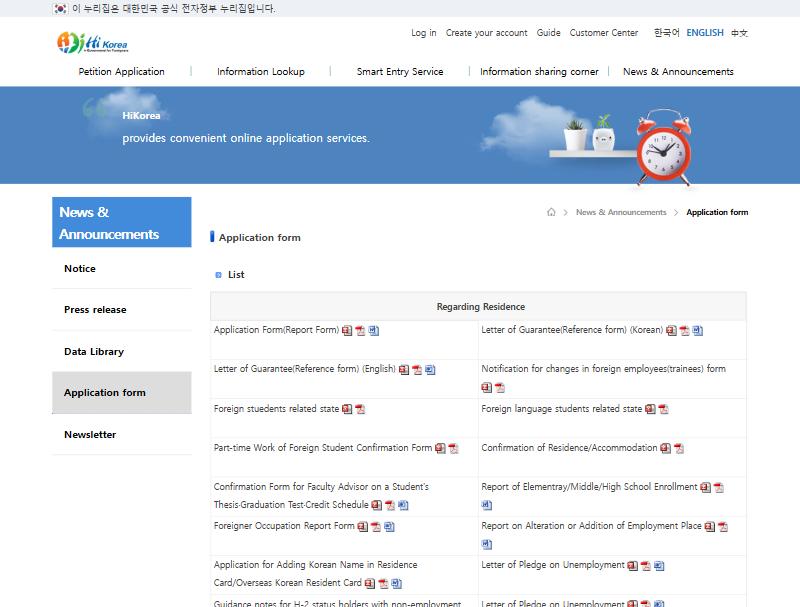
The confirmation form is on HiKorea under News & Announcements > Application form, listed as Confirmation of Residence/Accommodation. HiKorea also accepts a utility bill receipt as proof of address, and most university international offices hand out a bilingual version of the form.
The fee
The fee has been KRW 35,000 since January 1, 2025, when the card gained an IC chip. Older guides still say 30,000, and so does the English documents page on HiKorea itself. Cards are not accepted. You pay in cash at the bank machine inside the office and hand the receipt to the officer. The machine gives change. If you want the card mailed to you, registered mail adds roughly KRW 4,000, for a total of about KRW 39,000.
Step 3: Visit day
Arrive 15 to 20 minutes before your slot. A reservation fixes the day and hour, and you still take a number and wait.
- Take a number at the reservation kiosk or information desk. Show your confirmation.
- Finish the form if you have not. Sample forms are posted near the writing desks.
- Pay the fee at the bank machine and keep the receipt.
- Go to the counter when your number is called. Hand over everything in one stack.
- Give fingerprints and confirm the spelling of your name and your address.
- Choose pickup or delivery for the card. Delivery adds about KRW 4,000 and saves a second trip. You choose it when you apply, not afterward.
- Keep the receipt slip the officer gives you. It shows your application is in progress.
In the first weeks of a semester, universities report waits of 2 to 4 hours at the Seoul Immigration Office even with a reservation. Go before the semester starts if you can.
Show this at the desk
외국인등록 하러 왔습니다. 방문예약 했습니다.
I am here for foreign resident registration. I have a reservation.
등록증은 택배로 받고 싶습니다.
I would like the card delivered.
Seoul Emergency Card
Emergency numbers, where to go at night or on a Sunday, and Korean phrases to show, on two pages. Subscribe to This Week in Seoul and download it right away. We will also send the list of clinics open over Seollal 2027 when the city publishes it. One email a week, free, unsubscribe anytime.
Step 4: The wait, and what to do during it
There is no official processing time. Applicants in ordinary months report 3 to 4 weeks, and university international offices in Seoul tell students to expect up to 6 to 8 weeks at the start of a semester. The date the officer gives you at the counter is the one to trust. Picking up a finished card does not need a reservation.
You do not have to sit idle. Once your registration has been processed, you can ask for a Certificate of Foreign Resident Registration (외국인등록 사실증명). It costs KRW 2,000, shows your registration number, and is issued at immigration offices, local community centers (주민센터), and online through Gov24. Call 1345 first to confirm yours is ready to issue. Each bank branch and phone carrier decides whether to accept it in place of the card, so ask before you go.
Travel during the wait: ask 1345 before you book a flight out of Korea. Leaving while the application is pending can cancel it, and a single-entry visa may not let you back in. Have your visa type, application date, and travel dates ready when you call.
Before the card: what works and what does not
Your passport carries you through the first weeks for most daily needs. The wall is Korean identity verification (본인인증), which ties a phone number to a resident registration number.
| Works on a passport | Usually waits for the card |
|---|---|
| Prepaid SIM or eSIM, including airport SIMs with a 010 number | A phone plan in your own name |
| T-money cards and Climate Card short-term passes, sold at subway ticket machines that take foreign cards | A full bank account. Some branches open a limited account on a passport. |
| Kakao T and Uber sign-up | Baemin and Coupang Eats ordering |
| Paying with a foreign card in shops | Korean app payments and Toss |
| Seeing a doctor and buying medicine, paid in full | National Health Insurance coverage |
| Signing a lease | The mobile Residence Card |
Two of these deserve a note:
- Seeing a doctor: clinics accept a passport as ID. Without insurance you pay the full price, and prices differ by clinic, so ask for the uninsured price at the desk before you are seen.
- Signing a lease: landlords and agents write your passport name and number into the contract. Ask for a clause saying you will add your registration number once the card is issued, and one that lets you end the lease early if your visa is not extended. Keep the signed lease, because it is your proof of address for registration. Our guide to renting a room in Seoul as a foreigner covers deposits and paperwork.
Related on SeoulKnows: Do You Need an eSIM in Korea? covers the phone number and SMS problem in detail, and Seoul Hacks has tools for the first weeks.
The day you get the card: do these five things
- Put the card on your phone. Install the Mobile ID app (모바일 신분증), tap your IC chip card to the phone, and you have a mobile Residence Card with the same legal force as the plastic one. You need to be 14 or older and the phone line must be in your own name.
- Open a bank account. Bring the card and your passport. Since March 21, 2025, banks including Shinhan and Hana also accept the mobile card at the counter. How to open a bank account.
- Move your phone number into your name. A line registered to you is what unlocks identity verification in Korean apps. Pay it by auto-debit from the new account. How to get a phone plan in your name.
- Check your health insurance status. Ask your school or employer when your National Health Insurance enrollment starts. How health insurance works.
- Photograph both sides of the card and store the image somewhere safe.
One more for Seoul residents: with a registration number and a phone in your name, you can join the Climate Pass (기후동행패스), the transit refund program that replaced the 30 day Climate Card in September 2026. Seoul's own FAQ confirms foreign residents can sign up.
Three rules to remember afterward
- Moving house: report your new address within 15 days at your new community center (주민센터), district office, or immigration office. It is free.
- Lost card: report it and apply for a new one within 14 days. The reissue fee is KRW 35,000.
- Leaving Korea for good: hand the card to the immigration officer at the airport. If you paid into the national pension, read how to claim your pension refund before you go.
Seven mistakes that cost people a second trip
- Going to the old Mok-dong building, or booking the nearest office instead of the one for their district.
- Bringing a lease in someone else's name without the confirmation form and the host's ID copy.
- Bringing a goshiwon receipt alone. The operator's business registration certificate has to come with it.
- Using an old photo or one with a colored background.
- Bringing only a card, or only KRW 30,000, because an older guide said so.
- Waiting for the semester to start before booking, then finding no slots inside 90 days.
- Moving house during the wait. Stay at the registered address until the card arrives, then report the move.
Frequently asked questions
Is the ARC the same as the Residence Card?
Yes. Residence Card is the official English name. ARC, short for Alien Registration Card, is the older name that people still use. The Korean name, 외국인등록증, has not changed.
How much does the ARC cost in 2026?
KRW 35,000. The fee rose from KRW 30,000 on January 1, 2025. It is cash only, and delivery by mail brings the total to about KRW 39,000.
Where is the Seoul Immigration Office now?
At 55 Jeongui-ro, Songpa-gu, a 10 minute walk from Munjeong Station Exit 4. It moved from Mok-dong on October 19, 2026, and the Mok-dong building is closed for immigration services.
Can I apply for the ARC online?
No. You book online on HiKorea, and you still visit in person because the office takes your fingerprints.
Can I register at any immigration office in Seoul?
No. You register at the office that covers the district where you live.
How long does the ARC take?
There is no official figure. Most people wait 3 to 4 weeks, and 4 to 6 weeks or more at the start of a semester.
What if I miss the 90 day deadline?
You will be fined, and the amount grows with the delay. If no reservation slot exists before your deadline, visit the office for your district in person before the 90 days end.
Do I have to carry the card?
Yes. Article 27 of the Immigration Act requires foreign residents to carry their passport or Residence Card. The mobile Residence Card counts.
I am on an F-4 visa. Is this guide for me?
Partly. F-4 holders file a domestic residence report (국내거소신고) and receive a different card, though the offices and booking steps are the same.
Sources
Checked November 2026.
Show all 20 sources
- Ministry of Justice: Seoul Immigration Office relocation notice, October 2026
- HiKorea: Office Directory, Seoul offices and jurisdiction
- HiKorea: Reserve Visit, how to use and important notes
- HiKorea: Foreign Resident Registration, eligibility and deadline
- HiKorea: Documents for Foreign Resident Registration
- HiKorea: Residence Card return, carry, present
- HiKorea: Issuance of mobile residence card
- HiKorea: Application forms
- Immigration Act, Articles 27, 31, 33, 36 (Korea Legislation Research Institute, English)
- Enforcement Rule of the Immigration Act, Articles 72 and 73: fees and payment
- Ministry of Justice: Residence Card fee increase from January 1, 2025
- Ministry of Justice: Residence Card overview
- Ministry of Justice: mobile Residence Card leaflet
- Financial Services Commission: mobile Residence Card accepted at banks from March 21, 2025
- Seoul Metropolitan Government: Climate Pass FAQ
- Seoul Metropolitan Government: Climate Card payable by foreign card from March 17, 2026
- Yeongdeungpo-gu Office: change of residence report
- Seoul National University OGA: Residence Card
- Ewha Womans University: Spring 2026 foreign resident registration
- Inha University: registration document guide
Rules and fees change. If something here no longer matches what you saw at the counter, tell us at hello@seoulknows.com and we will recheck it.

Written by WY, a Seoul-based local. This guide was checked line by line against official Korean sources in November 2026, including the Korean pages that never get translated. More about me →
Help keep this page right
No name or email needed. Please leave out personal details.